#Z-polynomials of Schubert matroids
Let \(M\) be a loopless matroid of rank \(n,\) and let \(P_M(t)\) be its Kazhdan–Lusztig polynomial. The \(Z\)-polynomial of \(M,\) introduced by N. Proudfoot, Y. Xu and B. Young [PXY18], is \[Z_M(t) \coloneqq \sum_{F \text{ a flat}} t^{\operatorname{rk} F}\, P_{M/F}(t).\] It is palindromic of degree \(n,\) so there are unique numbers \(\gamma_k\) with \[Z_M(t)=\sum_{k\geq0}\gamma_k\, t^k(1+t)^{n-2k},\] and we write \(\Gamma_M(y)\coloneqq\sum_k\gamma_k y^k\) for the gamma polynomial. The \(\gamma_k\) are nonnegative for every matroid [FMSV22, Thm. 1.8]. The polynomial \(Z_M\) depends only on the lattice of flats, so parallel elements may be removed, and it is multiplicative on direct sums; in particular each coloop contributes a factor \(1+t.\) For the circuit \(U_{n,n+1},\) the polynomial \(Z_{U_{n,n+1}}(t)\) is the Narayana polynomial [PXY18] \[N_{n+1}(t)\coloneqq \sum_{k=0}^{n}\frac{1}{n+1}\binom{n+1}{k}\binom{n+1}{k+1}t^k =\sum_{k\geq0}\binom{n}{2k}\mathrm{Cat}_k\, t^k(1+t)^{n-2k}.\]
Real-rootedness of \(Z_M(t)\) was conjectured for all matroids [PXY18]. It holds for sparse paving matroids [XZ26] but fails for the extended binary Golay matroid [Ebe26]. For Schubert matroids the question is open; see the nested-matroid conjecture. This page collects combinatorial descriptions of \(Z_M\) and \(\Gamma_M\) for Schubert matroids and, more generally, lattice path matroids. Unless stated otherwise, the results are from unpublished work of P. Alexandersson [Ale26].
#Schubert matroids and the board of squares
Let \(\lambda=(\lambda_1\geq\dotsb\geq\lambda_n\geq1)\) be a partition with \(n\) positive parts. The Schubert matroid \(M_\lambda\) on \([n+\lambda_1]\) has as bases the sets \(\{j_1\lt{}\dotsb\lt{}j_n\}\) with \(j_a\geq a+\lambda_1-\lambda_a\) for all \(a.\) This is the Schubert matroid of \(I=\{a+\lambda_1-\lambda_a\},\) or equivalently the lattice path matroid of the Ferrers shape \(\lambda.\) It has rank \(n\) and no loops or coloops. Zero parts would add coloops, each multiplying \(Z\) by \(1+t.\) The elements \(1,\dotsc,1+\lambda_1-\lambda_2\) are parallel, so \(Z_{M_\lambda}\) does not depend on \(\lambda_1.\)
The board of squares \(B\) of \(\lambda\) consists of the boxes of \(\lambda\) that are the northwest corner of a \(2\times2\) square inside \(\lambda.\) Its row \(j,\) for \(1\leq j\lt{}n,\) has \(w_j=\lambda_{j+1}-1\) boxes. A placement on \(B\) is a set of boxes \((j_1,c_1),\dotsc,(j_s,c_s)\) of \(B\) with \(j_1\lt{}\dotsb\lt{}j_s\) and \(c_1\gt{}\dotsb\gt{}c_s,\) that is, a non-nesting rook placement on \(B.\) Give a rook in column \(c\) the weight \(x_c,\) and for \(E\subseteq[n-1]\) let \[W_B(E)\coloneqq\sum_{\text{placements in rows } \subseteq E}\ \prod_{i} x_{c_i},\] including the empty placement of weight one. The identities below hold with these column weights, and setting all \(x_c=1\) gives \(Z_{M_\lambda}(t)\) and \(\Gamma_{M_\lambda}(y).\)
Placements are the same as partitions inside \(B.\) Given a placement, let \(\eta_j\) be the column of the first rook in a row \(i\geq j,\) or zero if there is none, and put \(\eta_n=0.\) Then \(\eta\) is a partition contained in \(B,\) and the rooks sit exactly at its corners, the boxes \((j,\eta_j)\) with \(\eta_j\gt{}\eta_{j+1}.\) Conversely, every partition \(\eta\subseteq B\) arises from exactly one placement. Thus \[W_B(E)=\sum_{\substack{\eta\subseteq B\\ \text{corners in rows of } E}} \ \prod_{\text{corners } (j,\eta_j)} x_{\eta_j}.\] The partitions \(\eta\subseteq B\) are the lattice paths inside the Ferrers shape \(B,\) traced from the bottom left to the top right, and a corner of \(\eta\) is where this path turns from east to north. Through the correspondences on the page on lattice path matroids, they are also the bases of the lattice path matroid of \(B\) and the linear extensions of its width-two poset.
Example
For \(\lambda=(3,3,2,1)\) the board has rows of lengths \(2,1,0.\) Below, the board is shaded, the partition \(\eta\) is blue and the rooks are dots. The five placements are the empty one, \((1,1),\) \((1,2),\) \((2,1)\) and \(\{(1,2),(2,1)\}.\)
The corresponding partitions are \(\eta=000,\) \(100,\) \(200,\) \(110\) and \(210.\) For instance \(W_B(\{1,2\})=1+2x_1+x_2+x_1x_2,\) while \(W_B(\{2\})=1+x_1.\)
#Motzkin paths and rook placements
A Motzkin path of length \(n\) starts and ends at height zero, takes steps \(U,H,D\) of increments \(1,0,-1\) and stays weakly above zero. Let \(h_j(P)\) be the height after step \(j\) and \(k(P)\) the number of up-steps.
Theorem (Alexandersson, 2026).
For a Motzkin path \(P\) of length \(n,\) put \(E(P)=\{j\in[n-1]: h_j(P)\gt{}0\}.\) Then \[\Gamma_{M_\lambda}(y)=\sum_{P} y^{k(P)}\,W_B(E(P)), \qquad Z_{M_\lambda}(t)=\sum_{P} t^{k(P)}(1+t)^{n-2k(P)}\,W_B(E(P)).\] Thus \(\gamma_k\) counts pairs of a Motzkin path with \(k\) up-steps and a placement whose rooks all lie in rows where the path has positive height. To count \([t^i]Z_{M_\lambda},\) additionally mark \(i-k(P)\) of the horizontal steps.
In terms of the partitions \(\eta\subseteq B,\) the coefficient \(\gamma_k\) counts the pairs of a partition \(\eta\subseteq B\) and a Motzkin path with \(k\) up-steps, such that the path is positive after step \(j\) for every corner \((j,\eta_j)\) of \(\eta.\)
The same formula holds for every connected skew shape \(\lambda/\mu\) with \(n\) rows, where the board consists of the boxes \((j,c)\) with \(\mu_j\lt{}c\lt{}\lambda_{j+1},\) both for the lattice path matroid and for the rook matroid of \(\lambda/\mu.\) The two matroids have the same valuative invariants [BM26].
Proof (Sketch).
The base polytope of a lattice path matroid has a subdivision, cut out by integral prefix sums, whose maximal cells are snake matroid polytopes [BKV23], and \(Z\) is a valuative invariant [FS24]. Every interior face of the subdivision is a direct sum of connected ribbon matroids, which have Narayana \(Z\)-polynomials by the ribbon theorem below. For a Ferrers shape, the maximal cells correspond to the partitions \(\eta\subseteq B,\) and hence to placements. The faces of a fixed cell are obtained by fixing the prefix sums at a subset of \(m\) of its corner rows. Such a face contributes \((-1)^m\) times a product of the Narayana polynomials \(Z_{U_{s,s+1}}\) of its segments, which in gamma coordinates counts the Motzkin paths returning to zero after each fixed row. Inclusion–exclusion leaves exactly the Motzkin paths that are positive at every corner row.
#Ribbons and outerplanar graphs
A ribbon contains no \(2\times2\) square, so the board is empty and the formula above reduces to the Narayana polynomial. This case is proved directly, and is used in the proof above.
Theorem (Raj, 2026, [Raj26]).
Every connected ribbon lattice path matroid \(M\) of rank \(r\) has \(Z_M(t)=N_{r+1}(t),\) independently of the composition of its row lengths. In particular, \(Z_M(t)\) has \(r\) simple negative zeros.
This was conjectured on the open problems page, and was known for the circuits [PXY18] and the fan matroids [LXY18].
Proof (Sketch).
A connected ribbon matroid is graphic, represented by a path with a hub vertex joined to both ends and to some interior vertices [KMRA18]. After removing parallel spokes, it is an \((r+1)\)-cycle with noncrossing chords at the hub.
Suppose a simple graph \(G\) is the union of two graphs that meet exactly in an edge \(e=uv\) and its ends, and each side stays connected when \(e\) is deleted. The deletion formula of T. Braden and A. Vysogorets [BV20, Thm. 2.8] writes \(Z_G-Z_{G\setminus e}\) as a sum of multiples of \(\tau(M/(F\cup e)).\) Here \(\tau\) of a rank-\(s\) matroid is the coefficient of \(t^{(s-1)/2}\) in its Kazhdan–Lusztig polynomial, and zero for even \(s.\) After contracting \(e\) the two sides meet in a vertex, so \(M/(F\cup e)\) is a direct sum of two matroids of positive ranks \(s_1,s_2.\) Since \(P\) is multiplicative and \(\deg P\lt{}\operatorname{rk}/2\) in positive rank, the product has degree at most \((s_1+s_2-2)/2,\) and \(\tau\) vanishes. Hence \(Z_G=Z_{G\setminus e}.\) Removing the chords one at a time leaves the cycle, whose graphic matroid is \(U_{r,r+1}.\)
The same argument removes every diagonal of a dissected polygon, and the converse holds.
Theorem (Raj, 2026, [Raj26]).
Let \(G\) be a simple \(2\)-connected graph on \(n\geq3\) vertices. Then \([t]Z_G(t)\) equals the number of bonds of \(G,\) and is at least \(\binom{n}{2}.\) Moreover, the following are equivalent: \(G\) is outerplanar; \(Z_G(t)=N_n(t)\); \([t]Z_G(t)=\binom{n}{2}.\)
#An example
Take \(\lambda=(3,3,2,1),\) so that \(B\) has rows of lengths \(2,1,0.\) Group the placements by their set of occupied rows \(J.\) The middle column is the total weight of the placements with row set \(J,\) and the last column counts, by up-steps, the Motzkin paths of length four that are positive after every step in \(J.\)
$J$ Rook weight Motzkin paths $\emptyset$ $1$ $1+6y+2y^2$ $\{1\}$ $x_1+x_2$ $3y+2y^2$ $\{2\}$ $x_1$ $4y+y^2$ $\{1,2\}$ $x_1x_2$ $2y+y^2$At unit weights, \[\Gamma_{M_\lambda}(y)=1+18y+8y^2,\qquad Z_{M_\lambda}(t)=1+22t+50t^2+22t^3+t^4.\] This is also the \(Z\)-polynomial of the staircase \(S_4\) in the nested-matroid conjecture, as the staircase \((4,3,2,1)\) has the same board.
#A word formula
The following formula needs only one family of words: the parity of a letter gives the power of \(t,\) and its size decides whether a rook may be placed.
Proposition (Alexandersson, 2026).
Let \(\mathcal{A}_n\) be the set of words \(a_1\dotsm a_n\) of nonnegative integers with \(a_i\leq a_{i-1}+1\) for all \(i,\) where \(a_0=0.\) Then \[Z_{M_\lambda}(t)=\sum_{a\in\mathcal{A}_n} t^{\#\{i\,:\,a_i\text{ odd}\}}\, W_B\bigl(\{j\in[n-1]:a_{j+1}\geq2\}\bigr).\]
Proof
Start from a Motzkin path of length \(n\) in the theorem above with some horizontal steps marked. Replace \(U\) by \(UU,\) \(D\) by \(DD,\) an unmarked \(H\) by \(DU\) and a marked \(H\) by \(UD,\) then add \(U\) at the start and \(D\) at the end. This gives a Dyck path of semilength \(n+1\) whose height at time \(2j+1\) is \(2h_j+1.\) Every Dyck path arises once, since it has positive odd height at these times and the pairs of steps in between decode uniquely.
Let \(a_i\) be the height of the Dyck path just before its \((i+1)\)st up-step, for \(0\leq i\leq n.\) Between two consecutive up-steps there are \(a_{i-1}+1-a_i\) down-steps, so the words \(a_1\dotsm a_n\) are exactly the elements of \(\mathcal{A}_n.\) The \((i+1)\)st up-step is at position \(2i+1-a_i.\) It has even position precisely when \(a_i\) is odd, and the even-position up-steps come from the up-steps and the marked horizontal steps of the Motzkin path. Finally, \(h_j\gt{}0\) means that the Dyck path has height at least three at time \(2j+1,\) so that its \((j+2)\)nd up-step is at position at most \(2j+1\); this says \(a_{j+1}\geq2.\)
For example, for \(n=2\) the board is empty, and the words \(00,01,10,11,12\) give \(Z=1+3t+t^2.\)
Example
For \(n=4,\) the Motzkin path \(UHD\bar{H},\) with its last step marked, doubles to the Dyck path \(UUUDUDDUDD.\) The heights before its up-steps give the word \(a=1221.\) Its two odd letters come from the up-step and the marked step, and the letters \(a_2=a_3=2\) make rows \(1\) and \(2\) available, the rows where the Motzkin path is positive. The word contributes \(t^2\,W_B(\{1,2\}).\)
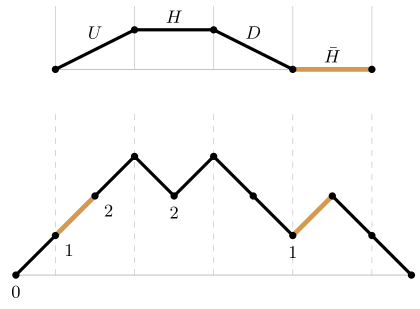
In terms of the Dyck path, \(Z_{M_\lambda}\) is a sum over standard Young tableaux \(T\) of shape \((n+1,n+1),\) where the first row lists the up-step positions: \(T\) contributes \(t\) to the power of the number of even entries in its first row, and row \(j\) of the board is available if \(T_{1,j+2}\leq 2j+1.\)
The words in \(\mathcal{A}_n\) are the area sequences \((0,a_1,\dotsc,a_n)\) of Dyck paths of semilength \(n+1,\) and the number of odd letters is the order of vanishing at \(q=-1\) of the product \(\prod_i[a_i+1]_q,\) which counts acyclic orientations of a unit interval graph; see polynomials indexed by Dyck paths.
The same words also give the gamma polynomial. Write \(a_i=2b_i+\epsilon_i\) with \(\epsilon_i\in\{0,1\}.\) If \(b_i\leq b_{i-1},\) both bits are possible, but if \(b_i\gt{}b_{i-1}\) then \(b_i=b_{i-1}+1\) and \((\epsilon_{i-1},\epsilon_i)=(1,0)\) are forced. Since \(a_{j+1}\geq2\) precisely when \(b_{j+1}\gt{}0,\) the bits do not affect the available rows, and summing over them gives the following.
Corollary (Alexandersson, 2026).
Let \(\mathcal{B}_n\) be the set of words \(b_1\dotsm b_n\) of nonnegative integers with \(b_1=0,\) in which every rise \(b_i\gt{}b_{i-1}\) has \(b_i=b_{i-1}+1\) and no two rises are consecutive. Then \[\Gamma_{M_\lambda}(y)=\sum_{b\in\mathcal{B}_n} y^{\#\text{rises of } b}\, W_B\bigl(\{j\in[n-1]:b_{j+1}\gt{}0\}\bigr).\]
For example, \(a=1234\) gives \(b=0112.\) Its two rises fix all four bits, every row is available, and the word contributes \(t^2W_B(\{1,2,3\})\) to \(Z\) and \(y^2W_B(\{1,2,3\})\) to \(\Gamma.\)
#Permutations, matchings and bases
For a \(132\)-avoiding permutation \(\pi\in\symS_{n+1}(132),\) let \(E(\pi)\) be the set of \(j\in[n-1]\) such that the values \(1,\dotsc,n+1-j\) do not occupy a single interval of positions. Then \[Z_{M_\lambda}(t)=\sum_{\pi\in\symS_{n+1}(132)} t^{\des(\pi)}\,W_B(E(\pi)).\] To see this, append a final leaf to the Motzkin path and read \(U,H,D\) in preorder as vertices with two, one and zero children. A unary vertex has its child on the left for an unmarked step and on the right for a marked one. Label the vertices \(n+1,n,\dotsc,1\) in preorder and read them in inorder. This gives each \(132\)-avoiding permutation once, the descents come from the vertices with a right child, and after \(j\) vertices in preorder the \(1+h_j\) unvisited subtrees are the intervals occupied by \(1,\dotsc,n+1-j.\)
Example
Let \(n=3\) and \(\lambda=(3,3,2),\) so that the board has rows of lengths \(2\) and \(1.\) The fourteen permutations in \(\symS_4(132)\) correspond to the fourteen words in \(\mathcal{A}_3\) and to the marked Motzkin paths of length three, where \(\bar{H}\) is a marked level step. The last column is the number of placements in the available rows.
$a$ $P$ $\pi$ $\des(\pi)$ $E(\pi)$ $W_B(E(\pi))$ $000$ $HHH$ $1234$ $0$ $\emptyset$ $1$ $001$ $HH\bar{H}$ $2134$ $1$ $\emptyset$ $1$ $010$ $H\bar{H}H$ $3124$ $1$ $\emptyset$ $1$ $100$ $\bar{H}HH$ $4123$ $1$ $\emptyset$ $1$ $012$ $HUD$ $2314$ $1$ $\{2\}$ $2$ $120$ $UDH$ $3412$ $1$ $\{1\}$ $3$ $122$ $UHD$ $2341$ $1$ $\{1,2\}$ $5$ $011$ $H\bar{H}\bar{H}$ $3214$ $2$ $\emptyset$ $1$ $101$ $\bar{H}H\bar{H}$ $4213$ $2$ $\emptyset$ $1$ $110$ $\bar{H}\bar{H}H$ $4312$ $2$ $\emptyset$ $1$ $112$ $\bar{H}UD$ $4231$ $2$ $\{2\}$ $2$ $121$ $UD\bar{H}$ $3421$ $2$ $\{1\}$ $3$ $123$ $U\bar{H}D$ $3241$ $2$ $\{1,2\}$ $5$ $111$ $\bar{H}\bar{H}\bar{H}$ $4321$ $3$ $\emptyset$ $1$Several rows give the same contribution \(t^{\des(\pi)}W_B(E(\pi))\); adding them up gives \[Z_{M_\lambda}(t)=1+13t+13t^2+t^3=(1+t)(1+12t+t^2).\]
Summing over signs gives a second formula. Order signed integers as usual and count descents between adjacent entries; then \[Z_{M_\lambda}(t)=2^{-(n+1)}\sum_{\pi\in\symS_{n+1}(132)} W_B(E(\pi)) \sum_{\epsilon\in\{\pm1\}^{n+1}} t^{\des(\epsilon\pi)}.\]
Matching each up-step of a Motzkin path with its down-step gives a noncrossing partial matching on \([n],\) and \(h_j\gt{}0\) means that \(j\) lies under an arc, that is, \(p\leq j\lt{}q\) for some arc \((p,q).\) Thus \(\gamma_k\) counts noncrossing partial matchings with \(k\) arcs, together with a placement whose rooks lie in rows covered by arcs.
There is also a formula that starts from an actual basis rather than from the board. Read a basis \(A\) of \(M_\lambda\) in increasing order, and call \(b\in A\) internally active if no smaller element \(e\notin A\) makes \((A\setminus\{b\})\cup\{e\}\) a basis. Then \(\gamma_k\) counts pairs of a basis \(A\) and a Motzkin path with \(k\) down-steps, in which an internally active element is read as a step \(U\) or \(H,\) and any other element as \(U,\) \(H\) or \(D,\) but only from positive height.
Further descriptions of \(Z_{M_\lambda}(t)\) in the same spirit sum \(t^{s}\,W_B(E)\) over the following objects, for the stated statistic \(s\) and row set \(E\):
lists \(u_1\lt{}\dotsb\lt{}u_k\) and \(v_1\lt{}\dotsb\lt{}v_k\) in \([n]\) with \(u_i\leq v_i,\) with \(s=k,\) and \(j\in E\) if \(u_i\leq j\lt{}v_i\) for some \(i\);
plane rooted trees on \(n+2\) vertices \(v_0,\dotsc,v_{n+1},\) numbered in preorder, with \(s\) the number of internal vertices minus one, and \(j\in E\) if \(v_{n+1-j}\) is not on any of the paths that start at a child of the root and repeatedly take the last child;
permutations \(\pi\in\symS_{n+1}(312),\) with \(s=\des(\pi),\) and \(j\in E\) if position \(j+1\) is the middle position of an occurrence of the pattern \(231.\)
#Adding a row and real-rootedness
The word formula builds \(Z\) one row at a time. Appending a letter \(q\) to a word with last letter \(p\) is allowed when \(p\geq q-1,\) contributes \(t\) if \(q\) is odd, and, if \(q\geq2,\) allows a rook in the new row of the board in any column to the left of the last rook.
Let \(\lambda\) have \(m+1\) positive parts, let \(Z_m\) be the \(Z\)-polynomial of \((\lambda_1,\dotsc,\lambda_m),\) and let \(Z_{m+1}\) be that of \(\lambda.\) Let \(Q_{m+1}(t)\) be \(t^{-1}\) times the sum in the word formula for \(\lambda\) over the words with last letter at least two; such a word contains an odd letter. Every word for \((\lambda_1,\dotsc,\lambda_m)\) extends by the letters \(0\) and \(1\) without making the new row available, so \[Z_{m+1}(t)=(1+t)Z_m(t)+t\,Q_{m+1}(t).\]
Question (Alexandersson, 2026).
For every partition \(\lambda\) with \(m+1\) positive parts, does \(Q_{m+1}(t)\) interlace \(Z_m(t)\)?
At a zero \(r\) of \(Z_m,\) the recursion gives \(Z_{m+1}(r)=rQ_{m+1}(r),\) so a positive answer implies the nested-matroid conjecture by induction on the number of rows. For \(\lambda=(3,3,2,1)\) one has \(Z_3=(1+t)(1+12t+t^2)\) and \(Q_4=8(1+3t+t^2).\) At the zeros of \(1+12t+t^2,\) \(Q_4=-72t\gt{}0,\) while \(Q_4(-1)=-8,\) so the zeros interlace.
Grouping the words is essential. For \(n=3\) and the empty board, the words ending in \(0\) and in \(3\) give \(1+3t+t^2\) and \(t^2,\) but \(1+3t+3t^2\) is not real-rooted, so the polynomials by last letter do not form an interlacing family.
In the same unpublished work [Ale26], the coefficient sequences of \(Z_{M_\lambda}\) and \(\Gamma_{M_\lambda}\) are shown to be strictly log-concave for every Schubert matroid, and \(Z_{M_\lambda}\) is shown to be real-rooted for every Schubert matroid of rank at most \(27.\)
Bibliography
- [Ale26]Per Alexandersson. Combinatorial models for Z-polynomials of Schubert matroids. Unpublished notes, 2026.
.bib
@misc{Alexandersson2026SchubertMatroidZ, author = {Per Alexandersson}, title = {Combinatorial models for {Z}-polynomials of {S}chubert matroids}, year = {2026}, howpublished = {Unpublished notes} } - [BKV23]Carolina Benedetti, Kolja Knauer and Jerónimo Valencia-Porras. On lattice path matroid polytopes: Alcoved triangulations and snake decompositions. arXiv:2303.10458, 2023.
.bib
@article{BenedettiKnauerValencia2023x, Author = {Carolina Benedetti and Kolja Knauer and Jerónimo Valencia-Porras}, Title = {On lattice path matroid polytopes: alcoved triangulations and snake decompositions}, Year = {2023}, Eprint = {2303.10458}, url = {https://arxiv.org/abs/2303.10458}, journal = {arXiv e-prints} } - [BM26]Joseph E. Bonin and Anna Mier. A construction that preserves the configuration of a matroid, with applications to lattice path matroids. The Electronic Journal of Combinatorics, 33(1):#P1.11, 2026.
.bib
@article{BoninMier2026, author = {Bonin, Joseph E. and {de Mier}, Anna}, title = {A construction that preserves the configuration of a matroid, with applications to lattice path matroids}, journal = {The Electronic Journal of Combinatorics}, volume = {33}, number = {1}, pages = {\#P1.11}, year = {2026}, doi = {10.37236/14238}, url = {https://doi.org/10.37236/14238} } - [BV20]Tom Braden and Artem Vysogorets. Kazhdan–Lusztig polynomials of matroids under deletion. The Electronic Journal of Combinatorics, 27(1):Paper No. 1.17, 2020.
.bib
@article{BradenVysogorets2020, author = {Braden, Tom and Vysogorets, Artem}, title = {Kazhdan--{L}usztig polynomials of matroids under deletion}, year = {2020}, journal = {The Electronic Journal of Combinatorics}, volume = {27}, number = {1}, pages = {Paper No. 1.17}, doi = {10.37236/9026}, url = {https://doi.org/10.37236/9026} } - [Ebe26]Jens Niklas Eberhardt. Condensed configurations and valuative matroid invariants. arXiv:2609.20903, 2026.
.bib
@article{Eberhardt2026x, author = {Jens Niklas Eberhardt}, title = {Condensed configurations and valuative matroid invariants}, year = {2026}, eprint = {2609.20903}, url = {https://arxiv.org/abs/2609.20903}, journal = {arXiv e-prints} } - [FMSV22]Luis Ferroni, Jacob P. Matherne, Matthew Stevens and Lorenzo Vecchi. Hilbert–Poincaré series of matroid Chow rings and intersection cohomology. arXiv:2212.03190v3, 2022.
.bib
@article{FerroniMatherneStevensVecchi2022x, author = {Luis Ferroni and Jacob P. Matherne and Matthew Stevens and Lorenzo Vecchi}, title = {Hilbert--{P}oincar{\'e} series of matroid {C}how rings and intersection cohomology}, year = {2022}, eprint = {2212.03190v3}, url = {https://arxiv.org/abs/2212.03190v3}, journal = {arXiv e-prints}, doi = {10.1016/j.aim.2024.109733} } - [FS24]Luis Ferroni and Benjamin Schröter. Valuative invariants for large classes of matroids. Journal of the London Mathematical Society, 110(3):e12984, 2024.
.bib
@article{FerroniSchroter2024, author = {Ferroni, Luis and Schr{\"o}ter, Benjamin}, title = {Valuative invariants for large classes of matroids}, year = {2024}, journal = {Journal of the London Mathematical Society}, volume = {110}, number = {3}, pages = {e12984}, doi = {10.1112/jlms.12984}, url = {https://doi.org/10.1112/jlms.12984} } - [KMRA18]Kolja Knauer, Leonardo Martínez-Sandoval and Jorge Luis Ramírez Alfonsín. A Tutte polynomial inequality for lattice path matroids. Advances in Applied Mathematics, 94:23–38, 2018.
.bib
@article{KnauerMartinezSandovalAlfonsin2018, author = {Knauer, Kolja and Mart{\'i}nez-Sandoval, Leonardo and Ram{\'i}rez Alfons{\'i}n, Jorge Luis}, title = {A {T}utte polynomial inequality for lattice path matroids}, year = {2018}, journal = {Advances in Applied Mathematics}, volume = {94}, pages = {23--38}, doi = {10.1016/j.aam.2016.11.008}, url = {https://doi.org/10.1016/j.aam.2016.11.008} } - [LXY18]Linyuan Lu, Matthew H. Y. Xie and Arthur L. B. Yang. Kazhdan–Lusztig polynomials of fan matroids, wheel matroids and whirl matroids. arXiv:1802.03711, 2018.
.bib
@article{LuXieYang2018x, author = {Linyuan Lu and Matthew H. Y. Xie and Arthur L. B. Yang}, title = {{K}azhdan--{L}usztig polynomials of fan matroids, wheel matroids and whirl matroids}, year = {2018}, eprint = {1802.03711}, url = {https://arxiv.org/abs/1802.03711}, journal = {arXiv e-prints} } - [PXY18]Nicholas Proudfoot, Yuan Xu and Ben Young. The Z-polynomial of a matroid. Electronic Journal of Combinatorics, 25(1):P1.26, 2018.
.bib
@article{ProudfootXuYoung2018, author = {Nicholas Proudfoot and Yuan Xu and Ben Young}, title = {The {Z}-polynomial of a matroid}, journal = {Electronic Journal of Combinatorics}, volume = {25}, number = {1}, pages = {P1.26}, year = {2018}, eprint = {1706.05575}, url = {https://arxiv.org/abs/1706.05575} } - [Raj26]Steve Raj. Outerplanarity from the Z-polynomial of a graphic matroid. Working draft, 2026.
.bib
@misc{Raj2026Outerplanarity, author = {Steve Raj}, title = {Outerplanarity from the {Z}-polynomial of a graphic matroid}, year = {2026}, date = {2026-11-25}, howpublished = {Working draft} } - [XZ26]Matthew H. Y. Xie and Philip B. Zhang. Real-rootedness of the $Z$-polynomials of sparse paving matroids and strict interlacing for uniform matroids. arXiv:2609.07636v1, 2026.
.bib
@article{XieZhang2026SparsePaving,
  author = {Matthew H. Y. Xie and Philip B. Zhang},
  title = {Real-rootedness of the {$Z$}-polynomials of sparse paving matroids
    and strict interlacing for uniform matroids},
  year = {2026},
  eprint = {2609.07636v1},
  url = {https://arxiv.org/abs/2609.07636v1},
  journal = {arXiv e-prints}
}