#Matroids
Matroids were first introduced by H. Whitney [Whi35], and independently by T. Nakasawa, see [NK09]. The theory was further developed by S. MacLane, B.L. van der Waerden, R. Rado, and W.T. Tutte.
For systematic references on matroid theory, see James Oxley’s book [Oxl11] and Tutte’s introduction [Tut71].
The guiding example is linear independence. Let \(E=\{v_1,\dotsc,v_n\}\) be a finite list of vectors in a vector space \(V.\) The subsets of \(E\) that are linearly independent behave much like independent sets in a graph, and the maximal independent subsets behave like bases of a vector space. A matroid abstracts exactly this exchange behavior.
There are several equivalent, or cryptomorphic, ways to specify a matroid: by bases, independent sets, rank functions, circuits, flats, or closure operators. The most useful description depends on the problem. We start with bases, since this leads directly to the basis-generating polynomial and the matroid base polytope.
#Bases
Let \(E\) be a finite set, called the ground set, and let \(\mathcal{B}\) be a nonempty collection of subsets of \(E,\) all of the same cardinality \(r.\) Then \(M=(E,\mathcal{B})\) is a matroid if the basis exchange axiom holds: for every two bases \(A,B\in\mathcal{B}\) and every \(x\in A\setminus B,\) there is some \(y\in B\setminus A\) such that \[(A\setminus \{x\})\cup \{y\} \in \mathcal{B}.\] The cardinality \(r\) is called the rank of the matroid, and the elements of \(\mathcal{B}\) are the bases of \(M.\) The basis-generating polynomial of \(M\) is \[B_M(\xvec)\coloneqq \sum_{B\in\mathcal{B}} \prod_{i\in B} x_i.\] This polynomial is a central bridge from matroids to stable and Lorentzian polynomials. Its support is the set of indicator vectors of bases, a basic example of an \(M\)-convex set.
Example (Uniform matroid).
The uniform matroid \(U_{r,n}\) is the matroid on ground set \([n]\) whose bases are all \(r\)-element subsets of \([n].\) For example, the bases of \(U_{2,3}\) are \(12,\) \(13,\) and \(23.\)
#Independent sets
Equivalently, a matroid can be specified by its independent sets. A collection \(\mathcal{I}\subseteq 2^E\) is the collection of independent sets of a matroid if
\(\emptyset\in\mathcal{I}\);
if \(I\in\mathcal{I}\) and \(J\subseteq I,\) then \(J\in\mathcal{I}\);
if \(I,J\in\mathcal{I}\) and \(|I|\lt{}|J|,\) then there is some \(x\in J\setminus I\) such that \(I\cup\{x\}\in\mathcal{I}.\)
The bases are the maximal independent sets. For a vector configuration, this recovers the ordinary linearly independent subsets.
#Rank functions
A matroid can also be defined via a rank function. Let \(E\) be a finite set. A rank function \(r\) is an integer-valued function on subsets of \(E,\) satisfying the following three properties:
\(0 \leq r(X) \leq |X|\) for every \(X \subseteq E\);
\(r(X) \leq r(Y)\) for all \(X\subseteq Y \subseteq E\);
\(r(X \cup Y) + r(X \cap Y) \leq r(X)+r(Y),\) whenever \(X,Y \subseteq E.\)
The third condition says that the rank function is submodular.
A set is an independent set if \(r(X)=|X|.\) The bases of a matroid are all independent sets of maximal rank.
If \((E,\mathcal{B})\) is a matroid with bases \(\mathcal{B},\) then the rank of a set \(X\) is simply \[r(X) = \max \{ |X \cap B| : B \in \mathcal{B} \} = \max \{ |I| : I \subseteq X \text{ and } I \in \mathcal{I} \}.\] That is, the rank of \(X\) is the cardinality of a maximal independent subset contained in \(X.\)
#Flats
A subset \(X \subseteq E\) of a matroid is called a flat (or closed) if there is no element we can add to \(X\) from \(E \setminus X\) and preserve the rank. For representable matroids, flats correspond to the various linear subspaces spanned by the independent sets.
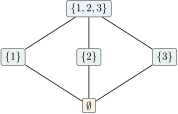
The set of flats forms a lattice under inclusion, the lattice of flats.
Example (The lattice of flats of \(U_{2,3}\)).
For the uniform matroid \(U_{2,3},\) the flats are \[\emptyset,\quad \{1\},\quad \{2\},\quad \{3\},\quad \{1,2,3\}.\] The two-element subsets are not flats: for instance, \(r(\{1,2\})=r(\{1,2,3\})=2,\) so adding the missing element does not increase the rank. Thus the lattice of flats is
If \(W_i(M)\) denotes the number of flats of rank \(i,\) then the sequence \((W_i(M))_i\) is the sequence of Whitney numbers of the second kind . M. Larson gives a graphic counterexample to J. H. Mason’s conjecture that these numbers are always log-concave [Lar26]. The graph is a generalized theta graph whose matroid simplifies to \(U_{3,4}\) with parallel classes of sizes \(1,26,26,26.\) The same paper leaves open whether these Whitney numbers are always unimodal.
#Matricubes
O. Amini and L. Gierczak introduce matricubes, which axiomatize intersection patterns of finite collections of initial flags in a vector space [AG24]. When each flag has length one, the axioms recover ordinary matroids. The paper gives cryptomorphic descriptions in terms of rank functions, flats, circuits, and independent sets, together with a duality theory and links to permutation arrays.
#Operations on matroids
#Matroid loops and coloops
Let \(M\) be a matroid on the ground set \(E.\) An element \(e \in E\) is called a loop if it does not appear in any basis. An element \(e \in E\) is called a coloop if it appears in every basis.
#Connected matroids
If \(M_1\) and \(M_2\) are matroids on disjoint ground sets, their direct sum \(M_1\oplus M_2\) is the matroid whose bases are all unions \(B_1\cup B_2\) with \(B_i\) a basis of \(M_i.\) A nonempty matroid is called a connected matroid if it cannot be written as a direct sum of two matroids on nonempty ground sets.
#Dual of a matroid
If \(M=(E,\mathcal{B})\) then \(M^* \coloneqq (E,\mathcal{B}^*)\) with \[\mathcal{B}^* \coloneqq \{E \setminus A : A \in \mathcal{B}\}\] is also a matroid. The matroid \(M^*\) is called the dual of \(M.\)
The dual of the uniform matroid \(U_{r,n}\) is the uniform matroid \(U_{n-r,n}.\)
#Minors of a matroid
Let \(M=(E,\mathcal{B})\) be a matroid and \(e \in E.\) The deletion \(M \setminus e\) is the matroid on ground set \(E\setminus \{e\},\) and the bases are \[\begin{cases} \{ B \in \mathcal{B} : e \notin B \} & \text{ if $e$ is not a coloop} \\ \{ B \setminus \{e\} : B \in \mathcal{B} \} & \text{ if $e$ is a coloop}. \end{cases}\] The deletion \(M \setminus X\) is computed by iteratively deleting each element in \(X.\)
The restriction of \(M\) to \(X \subseteq E\) is denoted \(M \vert_{X},\) and corresponds to deletion of \(M\) by \(E\setminus X.\)
The contraction \(M / e\) is the matroid on ground set \(E\setminus \{e\}\) whose bases are \[\begin{cases} \{ B \setminus \{e\} : B \in \mathcal{B},\ e\in B \} & \text{ if $e$ is not a loop} \\ \{ B : B \in \mathcal{B} \} & \text{ if $e$ is a loop}. \end{cases}\] Deletion and contraction are dual operators: \[M/e = (M^* \setminus e)^*.\]
Example (Deletion and contraction in \(U_{2,3}\)).
Let \(M=U_{2,3},\) so \[\mathcal{B}(M)=\{12,13,23\}.\] Deleting \(3\) removes the bases containing \(3,\) hence \[\mathcal{B}(M\setminus 3)=\{12\},\] so \(M\setminus 3\) is \(U_{2,2}\) on the ground set \(\{1,2\}.\) Contracting \(3\) uses the bases containing \(3\) and then removes \(3\): \[\mathcal{B}(M/3)=\{1,2\}.\] Thus \(M/3\) is \(U_{1,2}.\)
#Families of matroids
#Graphic matroids
Given a graph \(G=(V,E),\) the graphic matroid associated to \(G\) is the matroid whose independent sets are the subsets of \(E\) that contain no cycles.
Example
In the figure below, five vectors define a matroid. Vectors \(b,c,d,e\) lie in the same plane, while \(a\) is independent of them. To the right is a graph that defines the same matroid.

The sets of linearly independent vectors are \[\mathcal{I} = \{ abc, abd, abe, ace, ab, ac, ad, ae, bc, bd, be, cd, ce, a, b, c, d, e \}.\]
#Representable matroids
A matroid isomorphism from \((E_1,\mathcal{B}_1)\) to \((E_2,\mathcal{B}_2)\) is a bijection from \(E_1\) to \(E_2\) which induces a bijection from \(\mathcal{B}_1\) to \(\mathcal{B}_2.\)
Given an \(r \times n\) full-rank matrix \(X\) over a field \(\mathbb{F},\) with columns \(v_1,\dotsc,v_n,\) we let \(M[X]\) be the matroid with ground set \([n]\) whose bases are the \(r\)-subsets \(B\subseteq[n]\) for which \(\{v_i:i\in B\}\) has rank \(r.\)
A matroid \(M\) is said to be realizable over a field \(\mathbb{F}\) if it is isomorphic to some \(M[X]\) with \(X \in \mathbb{F}^{r \times n }.\)
There are matroids which are not realizable over any field, for example the Vámos matroid. It is the matroid whose bases are all \(4\)-element subsets of \([8],\) except \[1234, 1456, 1478, 2356, 2378.\]

Theorem
If \(M\) is representable over \(\mathbb{F}\) then so is \(M^*.\)
Theorem
A matroid \(M\) is representable over every field \(\mathbb{F}\) if and only if it is the vector matroid for some totally unimodular matrix, that is, a matrix whose minors all have determinant \(\pm 1\) or \(0.\)
Matroids representable over every field are called regular matroids.
Theorem
All graphic matroids are regular.
#Oriented matroids
An oriented matroid is a matroid together with orientation data abstracting the signs of linear dependences among real vectors. Equivalently, one may specify signed circuits or a chirotope satisfying the oriented-matroid axioms. For a real matrix, the signs of its maximal minors define a realizable oriented matroid; see [Oxl11] for background.
A tope of a simple rank-\(r\) oriented matroid is simplicial when it has exactly \(r\) facets. The Las Vergnas simplex conjecture predicted that every simple oriented matroid has a simplicial tope. Q. Gu and K. Knauer disprove this by constructing a simple rank-\(7\) oriented matroid on \(24\) elements with no simplicial tope [GK26, Thm. 1.2]. They also disprove the Cordovil–Las Vergnas connectivity conjecture: for every \(r\geq7\) and \(n\geq r+17,\) the mutation graphs on uniform rank-\(r\) oriented matroids with \(n\) elements are disconnected [GK26, Thm. 1.6].
#Rigidity matroids
Let \(V\) be a finite vertex set. The generic \(d\)-dimensional rigidity matroid is the matroid on the edge set of the complete graph on \(V\) in which a set of edges is independent if the corresponding squared edge-length constraints are generically independent for point configurations in \(\setR^d.\)
#Partition matroids
A partition matroid is a direct sum of uniform matroids. This family is closed under minors and duality. All partition matroids are lattice path matroids.
#Transversal matroids
Definition
Let \((A_1,A_2,\dotsc,A_m)\) be subsets of some set \(E\) (this is called a set system). A partial transversal of the set system is a subset \(I=\{e_1,e_2,\dotsc,e_k\} \subseteq E\) for which there is an injection \(\phi:\{1,\dotsc,k\}\to\{1,\dotsc,m\}\) such that \(e_i \in A_{\phi(i)}.\) We can think of this as \(e_i\) being a representative of some \(A_j.\) If we have a representative from each \(A_j,\) the set \(I\) is just called a transversal.
Theorem (Piff–Welsh, 1970).
Let \((A_1,A_2,\dotsc,A_m)\) be a set system on \(E,\) and let \(\mathcal{I}\) be the set of partial transversals. Then \(\mathcal{M} = (E,\mathcal{I})\) is a matroid, where the partial transversals constitute the independent sets. Moreover, \(\mathcal{M}\) is representable over \(\mathbb{F}_k\) for \(k\) sufficiently large, in particular over all infinite fields.
Example
Consider the set system \(\{1, 2, 3\},\) \(\{2, 4, 5\},\) \(\{1, 4, 5\},\) and \(\{3, 4, 5\}\) on \(E = [5].\) The transversals of this set system are \(1234,1235,1245,1345,\) and \(2345,\) and thus constitute the set of bases of a transversal matroid.
There is a close connection between partial transversals and matchings. Consider the bipartite graph where one part is labeled by the elements of \(E,\) and the other part corresponds to \(A_1,\dotsc,A_m.\) The vertex \(e \in E\) is connected to \(A_j\) if and only if \(e \in A_j.\) A partial transversal is then a matching, and transversals are maximal matchings.
The family of transversal matroids is closed under deletion/restriction, but not under contraction in general. S. Bastida gives a polynomial-time algorithm deciding whether a single-element contraction of a transversal matroid is again transversal [Bas24]. When the contraction is transversal, the algorithm also produces a transversal representation.
B. Toft introduces path-circular matroids, which form a new minor-closed class of transversal matroids [Tof25].
#Matching matroids
Let \(G=(V,E)\) be a graph. Consider all subsets \(I \subseteq V\) that can be covered by a matching on \(G.\) Then these subsets form the independent sets of a matroid, called the matching matroid. For \(A\subseteq V,\) let \(\mathrm{match}(G,A)\) be the family of subsets \(I \subseteq A,\) that may be covered by a matching of \(G.\) Then \(\mathrm{match}(G,A)\) is a matroid with \(A\) as ground set. Compare this with the multivariate matching polynomial, which is stable.
Matching matroids and transversal matroids are the same class; see [EF65, Tri92].
Example (A matching matroid).
Let \(G\) be the graph on \([7]\) with edges \(12,23,13,34,45,35,56,67.\) Then the matching matroid of \(G\) has the set of bases \[\mathcal{B} = \{123456,123467,123567,124567,134567,234567\},\] since \(G\) has the (maximal) matchings \[\{12,34,56\}, \{12,34,67\}, \{12,35,67\}, \{13,45,67\}, \{23,45,67\}.\]
#Lattice path matroids
The family of lattice path matroids was introduced by J. Bonin, A. de Mier and M. Noy [BMN03]. This family is closed under all matroid minors (deletions and contractions) and also under matroid duality. All lattice path matroids are transversal matroids, and they are also positroids [Oh11].
For examples, Dyck path models and the connection with width-two posets, see the separate page on lattice path matroids.
#Positroids
A positroid is a matroid on a cyclically ordered ground set that is represented by a totally nonnegative matrix. Positroids were introduced by A. Postnikov in the study of the totally nonnegative Grassmannian [Pos06].
They form a minor-closed family of representable matroids, closed also under duality and cyclic shifts of the ground set. Important examples include Schubert matroids, lattice path matroids and rook matroids. For the Grassmann-necklace, network and polytope descriptions, see the page on positroids; for the Grassmannian geometry behind Schubert matroids, see varieties in algebraic combinatorics.
Unit interval positroids admit a Catalan recursion for externally ordered bases [CC21]. Positroid envelopes give another way to group positroids: J. Quail and P. Rombach prove that every positroid envelope class contains a graphic positroid [QR24].
#Matroids in optimization
Matroids are one of the basic settings where the greedy algorithm is exact. Given weights on the ground set, the maximum-weight basis can be found by considering elements in decreasing weight order and adding an element whenever it preserves independence. Conversely, among hereditary set systems, the validity of this greedy algorithm for all weight functions characterizes matroids. Edmonds’ polyhedral viewpoint realizes the independent-set polytope of a matroid by the inequalities \[x(A) \leq r(A) \qquad (A\subseteq E), \qquad x_e\geq 0 \qquad (e\in E),\] where \(r\) is the rank function [Edm70]. Classical algorithmic background includes matroid intersection algorithms [Law75].
#Tutte polynomial
The Tutte polynomial \(T_M(x,y)\) of a matroid \(M\) on ground set \(E\) is defined via a deletion-contraction recursion. If \(M\) is the empty matroid, then \(T_M(x,y) \coloneqq 1.\)
If \(e \in E\) is a loop in \(M\) then \[T_M(x,y) = y \cdot T_{M/e}(x,y).\] If \(e \in E\) is a coloop in \(M\) then \[T_M(x,y) = x \cdot T_{M/e}(x,y).\] If \(e \in E\) is neither a loop nor a coloop, then \[T_M(x,y) = T_{M/e}(x,y) + T_{M\setminus e}(x,y).\]
Example (A deletion-contraction computation).
Let \(M=U_{2,3}.\) No element of \(M\) is a loop or a coloop, and the computation above gives \[M\setminus 3=U_{2,2}, \qquad M/3=U_{1,2}.\] The matroid \(U_{2,2}\) has two coloops, so \(T_{U_{2,2}}(x,y)=x^2.\) Similarly, \[T_{U_{1,2}}(x,y)=T_{U_{1,1}}(x,y)+T_{U_{0,1}}(x,y)=x+y.\] It follows that \[T_{U_{2,3}}(x,y)=x^2+x+y.\]
#Internal and external activity
In the definition below, we assume that the ground set is \(\{1,2,\dotsc,n\}.\) For other ground sets, one needs to choose a total ordering on the ground set, and the word smaller is with respect to this ordering.
Definition (Internally and externally active elements).
Let \(\mathcal{B}\) be the set of bases for a matroid with ground set \(E=\{1,2,\dotsc,n\}.\) Let \(F \in \mathcal{B}.\) An element \(e\in E\) is said to be
internally active if \(e \in F,\) and there is no smaller \(y \in E\setminus F\) such that \[(F\setminus \{e\})\cup \{y\} \text{ is in } \mathcal{B};\]
externally active if \(e \notin F,\) and there is no smaller \(y \in F\) such that \[(F\setminus \{y\})\cup \{e\}\text{ is in } \mathcal{B}.\]
The Tutte polynomial can then be expressed as \[T_M(x,y) = \sum_{B \in \mathcal{B}} x^{ia(B)} y^{ea(B)}\] where \(ia(B)\) and \(ea(B)\) denote the internal and external activity, respectively.
#Properties of the Tutte polynomial
The Tutte polynomial satisfies \(T_{M}(x,y) = T_{M^*}(y,x).\) It is also multiplicative with respect to direct sum: \[T_{M_1 \oplus M_2}(x,y) = T_{M_1}(x,y) T_{M_2}(x,y).\]
B. Rhoades, V. Tewari, and A. Wilson construct a superspace analogue of the external zonotopal algebra attached to a hyperplane arrangement [RTW24]. The bigraded Hilbert series of this quotient is a bivariate evaluation of the Tutte polynomial, with the two gradings tracking bosonic and fermionic degree.
#Matroid (base) polytopes
Definition (Matroid base polytope).
The matroid base polytope of a matroid is the convex hull of the indicator vectors of its bases.
For example, the base polytope of the matroid with bases \(\{123456,123467,123567,124567,134567,234567\}\) is the convex hull of
\((1,1,1,1,1,1,0), \) \( (1,1,1,1,0,1,1), \) \( (1,1,1,0,1,1,1), \) \( (1,1,0,1,1,1,1), \) \( (1,0,1,1,1,1,1), \) \( (0,1,1,1,1,1,1).\)We let \(\xvec(S) \coloneqq \sum_{i \in S} x_i.\)
Theorem
The matroid base polytope is precisely the polytope defined by the following inequalities: \[\xvec(S) \leq r(S) \text{ for all $S \subseteq E$}, \qquad x_i \geq 0 \text{ for all $i \in [n]$},\] together with the equality \(\xvec([n]) = r([n]).\)
The matroid base polytope is a generalized permutohedron.
Every matroid base polytope has a regular unimodular triangulation ; see [BL23]. This implies that the base polytope satisfies the integer decomposition property, a property previously proved in [GR12]. M. Larson gives a rank-\(9\) binary matroid on \(18\) elements for which the \(s=2\) basis-pair version of White’s conjecture, often called Farber’s conjecture, fails [Lar26]. The same example shows that symmetric exchange binomials need not generate the toric ideal of a matroid. This does not refute the weaker quadratic-generation form of White’s conjecture. A. Chavez, G. Dorpalen-Barry, L. Ferroni, F. Liu, F. Rincón, and A. R. Vindas-Meléndez show that the linear coefficient of the Ehrhart polynomial of a matroid base polytope, after evaluating at \(t-1,\) recovers the beta invariant up to normalization [CDFL+25].
For positroids, the matroid base polytope has a particularly simple description using only cyclic intervals in the ground set; see positroid polytopes.
J. A. D. Loera, D. C. Haws, and M. Köppe study Ehrhart polynomials of matroid polytopes and polymatroids [DLHK08]. For fixed rank, their methods compute these Ehrhart polynomials in polynomial time; their examples also show that the Ehrhart polynomial of a matroid base polytope is not a deletion-contraction invariant. L. Ferroni constructs matroids whose base polytopes are not Ehrhart positive [Fer22].
Several special families are now understood in more detail. N. J. Y. Fan and Y. Li study Ehrhart polynomials of Schubert matroids, including positivity results and Kohnert-diagram formulas [FL23]. D. Hanely, J. L. Martin, D. McGinnis, D. Miyata, G. D. Nasr, A. R. Vindas-Meléndez, and M. Yin treat paving matroids and panhandle matroids [HMMM+23], while D. Deligeorgaki, D. McGinnis, and A. R. Vindas-Meléndez give Ehrhart bounds for these families using chain forests [DMV23]. Y. Jiang studies Ehrhart \(h^*\)-polynomials of positroid polytopes [Jia24], and A. Hsiao, K. Karu, and J. Yang study mixed volumes of matroids [HKY24].
#Snapper polynomials and zonotopal classes
For a loopless matroid \(M\) and a generalized permutohedron \(P,\) the associated class \(L_P\) in the matroid \(K\)-ring has a Snapper polynomial \[\chi_{M,P}(q)\coloneqq \chi(M,L_P^{\otimes q}).\] A zonotopal class has nonnegative weights supported on the rank-two flats of \(M\); graphical zonotopes provide examples. S. Li expresses its Snapper polynomial as a weighted independence polynomial of a Dilworth truncation and proves that it is magic positive. Consequently, its \(h^*\)-polynomial is real-rooted [Li26, Thms. 1.1–1.2].
#The characteristic polynomial of a matroid
The Rota–Heron–Welsh conjecture asserts log-concavity of the absolute values of the coefficients of the characteristic polynomial of a matroid. Katz gives an expository volume-polynomial approach to this result via Lorentzian polynomials [Kat25].
#Kazhdan–Lusztig polynomials
For the classical Hecke-algebra version, see Kazhdan–Lusztig polynomials. The matroid Kazhdan–Lusztig polynomial is the Kazhdan–Lusztig–Stanley polynomial attached to the lattice of flats of a matroid.
A. L. L. Gao and M. H. Y. Xie define inverse Kazhdan–Lusztig polynomials for matroids through the inverse Kazhdan–Lusztig–Stanley functions [GX21]. They compute them for boolean and uniform matroids, and derive a formula for the ordinary Kazhdan–Lusztig polynomials of uniform matroids from the inverse theory. Their conjecture that the coefficients of every inverse matroid Kazhdan–Lusztig polynomial are log-concave is false. E. Badalov constructs, over every prescribed finite field, simple \(3\)-connected matroids whose inverse-polynomial coefficients are positive and strictly decreasing but whose negative internal Turán determinants occur at any prescribed nonempty finite set of indices contained in \(\{2,3,\dotsc\}\) [Bad26, Thm. C]. The universal Turán inequality at the first internal index remains open. A. L. L. Gao, N. Proudfoot, A. L. B. Yang, and Z.-X. Zhang study leading Kazhdan–Lusztig coefficients for braid matroids [GPYZ23]. Their formulas also include leading coefficients of inverse Kazhdan–Lusztig polynomials for braid matroids.
A. L. L. Gao, Y. Li, and M. H. Y. Xie compute equivariant inverse Kazhdan–Lusztig polynomials for thagomizer matroids [GLX25]. Thagomizer matroids are graphic matroids associated with the complete tripartite graphs \(K_{1,1,n}.\) Their formulas give the corresponding non-equivariant inverse Kazhdan–Lusztig polynomials and imply log-concavity for this family.
Let \(T_n=K_{1,1,n},\) and write \(P_n(x)=P_{T_n}(x)\) for the ordinary matroid Kazhdan–Lusztig polynomial. The graphic matroid of \(T_n\) is the thagomizer matroid.
Theorem (Zhang, [Zha26]).
For \(n\geq 2\) and \(0\leq\lambda\leq n/2,\) the polynomial \[P_n(x)+\lambda x\] has exactly \(\lfloor n/2\rfloor\) zeros, all simple and negative. In particular, \(P_{T_n}(x)=P_n(x)\) and \(P_{K_{2,n}}(x)=P_n(x)+x\) are real-rooted.
The corresponding matroid \(Z\)-polynomials agree, and \[Z_{T_n}(x)=Z_{K_{2,n}}(x)\] has \(n+1\) distinct negative zeros.
The first polynomial also has the Catalan permutation interpretation \[P_n(x)=\sum_{\pi\in\symS_n(321)}x^{\des(\pi)},\] where \(\symS_n(321)\) denotes the set of \(321\)-avoiding permutations. The proof of the polynomial-pencil result uses a transformation to Chebyshev polynomials and strict interlacing at their zeros.
Theorem (Xie–Zhang, [XZ26, Thms. 1.1–1.3]).
For every sparse-paving matroid \(M,\) both its \(Z\)-polynomial and its gamma polynomial have only negative real zeros. If \(U_{m,d}\) denotes the uniform matroid of corank \(m\) and rank \(d,\) then \[Z_{U_{m,d}}(x)\quad\text{strictly interlaces}\quad Z_{U_{m,d+1}}(x)\] for \(m,d\geq1.\) The gamma polynomials satisfy the corresponding strict comparisons: \(\Gamma_{U_{m,d}}\) strictly interlaces \(\Gamma_{U_{m,d+1}}\) and \(\Gamma_{U_{m+1,d+1}}\) for \(m,d\geq1,\) and strictly interlaces \(\Gamma_{U_{m+1,d}}\) for \(m\geq1\) and \(d\geq2.\)
#Chow polynomials
The Chow ring of a matroid is the Chow ring of the Bergman fan of the matroid. For a loopless matroid, it has generators indexed by the nonempty proper flats, with linear relations coming from elements of the ground set and quadratic relations killing products of incomparable flats [AHK18]. Chow polynomials and augmented Chow polynomials encode Hilbert–Poincaré series of the Chow ring and augmented Chow ring associated with a matroid. E. Hoster gives explicit combinatorial formulas for both polynomials for uniform matroids, proving a conjecture of Ferroni and interpreting the coefficients through Schubert matroids [Hos24]. P. Brändén and L. Vecchi prove the Huh–Stevens real-rootedness conjecture for the Chow polynomials of uniform matroids, and also prove real-rootedness for Chow and augmented Chow polynomials of maximally ranked posets [BV26]. E. Hoster and C. Stump prove the same real-rootedness for finite graded simplicial posets with a top element and positive \(h\)-vector, including the lattices of flats of uniform matroids [HS25]. For the dual of such a poset, they also prove that the Chow polynomial interlaces the augmented Chow polynomial.
Total nonnegativity supplies another large class. For a lower-triangular totally nonnegative matrix with diagonal entries equal to one, the associated Chow polynomials \(H_n\) and Chow-derangement polynomials \(d_n\) are real-rooted, with \[H_n\prec d_n,\qquad H_n\prec H_{n+1},\qquad d_n\prec d_{n+1}\] [BV25, Thm. 4.18]. More generally, if \(P\) or its dual is a totally nonnegative poset, then its Chow, Chow-derangement, augmented Chow, and Chow–Eulerian polynomials are real-rooted [BV25, Thm. 6.1]. In particular, all four are real-rooted for the lattice of flats of every paving matroid [BV25, Cor. 7.2].
K. Binder and L. Vecchi refine the uniform-matroid results by cohomological degree [BV26]. They prove that every refined Hodge–Poincaré polynomial of the singular cohomology ring of the Bergman fan of \(U_{r,n}\) is real-rooted [BV26, Thm. 1.4]. The same holds for their modified augmented Bergman fan [BV26, Thm. 1.6]. In contrast, the corresponding refinements for the original augmented fan need not even be unimodal. They conjecture real-rootedness of the non-augmented refinements for every loopless matroid [BV26, Conj. 1.5].
#Polymatroids
#Submodular functions
Let \(E\) be a finite set. A function \(f:2^E\to\setR\) is submodular if \[f(A)+f(B) \geq f(A\cup B)+f(A\cap B) \qquad \text{for all } A,B\subseteq E.\] Matroid rank functions and polymatroid rank functions are submodular functions.
Polymatroids are a weighted version of matroids, where the rank of a subset does not have to be bounded by its cardinality. Let \(E\) be a finite set. A polymatroid rank function is a function \(r:2^E\to \setR_{\geq 0}\) such that \[r(\emptyset)=0, \qquad r(A) \leq r(B) \text{ whenever } A\subseteq B,\] and \[r(A)+r(B) \geq r(A\cup B)+r(A\cap B) \qquad \text{for all } A,B\subseteq E.\] Thus \(r\) is normalized, increasing, and submodular. The associated polymatroid polytope is \[P(r)=\{x\in \setR_{\geq 0}^E : x(A)\leq r(A) \text{ for all } A\subseteq E\},\] where \(x(A)\coloneqq \sum_{i\in A} x_i.\) Its base polytope is obtained by adding the equation \(x(E)=r(E).\) This is the polyhedral point of view due to J. Edmonds [Edm70].
If \(r\) is integer-valued, the integer points in the base polytope are called the bases of the integral polymatroid. These bases form an \(M\)-convex subset of \(\setN^E,\) and conversely finite \(M\)-convex subsets of \(\setN^E\) are the base sets of integral polymatroids; see also K. Murota’s discrete convex analysis [Mur03]. This makes polymatroids the natural non-multiaffine extension of matroids.
The connection with Lorentzian polynomials is especially clean. If \(B\subseteq \setN^E\) is the set of bases of an integral polymatroid, then \[F_B(\xvec)\coloneqq \sum_{\alpha\in B} \frac{\xvec^\alpha}{\alpha_1!\alpha_2!\dotsm \alpha_n!}\] is Lorentzian [BH20]. Conversely, the support of every Lorentzian polynomial is \(M\)-convex, so it is the support of an integral polymatroid base family. In the multiaffine case \(B\subseteq\{0,1\}^E,\) this recovers matroid bases and their basis-generating polynomials.
Example (Matroids as polymatroids).
If \(M\) is a matroid with rank function \(r_M,\) then \(r_M\) is a polymatroid rank function. The polymatroid base polytope is exactly the matroid base polytope. Its integer bases are the vectors \(\evec_B\) for the bases \(B\) of \(M,\) and the normalized support polynomial above is the ordinary basis generating polynomial of \(M.\)
Example (A truncated box polymatroid).
Fix nonnegative integers \(u_1,\dotsc,u_n\) and an integer \(0\leq d\leq u_1+\dotsb+u_n.\) The function \[r(A)=\min\left(d,\sum_{i\in A} u_i\right)\] is a polymatroid rank function. Its integral bases are the vectors \(\alpha\in\setN^n\) such that \[0\leq \alpha_i\leq u_i \qquad \text{and} \qquad \alpha_1+\dotsb+\alpha_n=d.\] For instance, with \(u=(2,2,1)\) and \(d=2,\) the bases are \[(2,0,0), (1,1,0), (1,0,1), (0,2,0), (0,1,1).\] The corresponding Lorentzian polynomial is \[\frac{x_1^2}{2}+x_1x_2+x_1x_3+\frac{x_2^2}{2}+x_2x_3.\] When all \(u_i=1,\) this example is the uniform matroid.
Example (Linear polymatroids).
Let \(V_1,\dotsc,V_n\) be subspaces of a vector space. Then \[r(A)=\dim\left(\sum_{i\in A} V_i\right)\] is a polymatroid rank function. If each \(V_i\) is one-dimensional and no \(V_i\) is zero, this recovers a linear matroid. Higher-dimensional subspaces give genuine polymatroids.
E. Swartz, P. Wentworth-Nice, and A. Xue study realizations of polymatroids from finite groups, in analogy with realizations of matroids over finite fields [SWX24]. X. Guan and X. Jin give a direct proof that the polymatroid Tutte polynomial is well-defined [GJ24].
#Further reading and adjacent topics
#Adjacent pages
Several matroid-related topics have their own pages on this site. See lattice path matroids for lattice-path, rook, and snake matroids, positroids for the totally nonnegative Grassmannian side, and stable polynomials for the half-plane property and basis-generating polynomials. For saturated Newton polytopes and the \(M\)-convex exchange condition generalizing matroid bases, see Newton polytopes and \(M\)-convexity. The Lindström–Gessel–Viennot lemma also appears in several path models related to matroid polytopes.
#Valuative and quasisymmetric invariants
L. J. Billera, N. Jia, and V. Reiner introduce a quasisymmetric function attached to a matroid [BJR09]. L. Ferroni and B. Schröter characterize Tutte polynomials of matroids as universal valuative invariants [FS24]. F. Breuer and C. J. Klivans introduce the arboricity polynomial, which counts covers of the ground set by disjoint independent sets [BK25]. They realize it through quasisymmetric functions and Ehrhart theory of the normal fan of the matroid base polytope, and show that it is not a Tutte invariant.
R. Penaguiao and S. Rehberg lift the Billera–Jia–Reiner invariant to the chromatic word-quasisymmetric function of a labeled matroid [PR26]. The lift is valuative and remembers the order of the ground set; in particular, it is not a matroid-isomorphism invariant.
A. Fink, K. Shaw, and D. E. Speyer introduce the \(\omega\)-invariant of a matroid as the top coefficient of Speyer’s \(g\)-polynomial [FSS24]. They give simplified formulas and show how nonnegativity of this invariant for minors can imply nonnegativity of all coefficients of \(g_M(t)\) under connectivity hypotheses.
#Log-concavity and stability
S. Cao, K. Chen, Y. Li, and Y. Wu settle Dowling’s polynomial conjecture for independent sets of matroids using Lorentzian polynomials [CCLW26]. J. Giansiracusa, F. Rincón, V. Schleis, and M. Ulirsch extend log-concavity results to independent sets of valuated matroids [GRSU24].
For the half-plane property and stability perspective, see also stable polynomials. The matroid connection is developed in [Br07, CW06]; more recent related results are given by M. Kummer and D. Sawall [KS25].
#Variants and adjacent classes
There are several useful recent variants and adjacent classes.
J. G. Oxley’s book [Oxl11] is a standard reference for many of these matroid classes. A rank-\(r\) matroid is a paving matroid if every subset of size less than \(r\) is independent, equivalently if every circuit has size at least \(r.\) It is sparse paving if both the matroid and its dual are paving.
Definition (\(\Delta\)-matroid).
A \(\Delta\)-matroid is a pair \((E,\mathcal{F})\) where \(\mathcal{F}\) is a nonempty collection of subsets of \(E,\) called feasible sets, satisfying the symmetric exchange axiom: for all \(F_1,F_2\in\mathcal{F}\) and all \(x\in F_1\triangle F_2,\) there is some \(y\in F_1\triangle F_2\) such that \(F_1\triangle\{x,y\}\in\mathcal{F}.\)
Definition (Valuated matroid).
A valuated matroid of rank \(r\) on \(E\) is a function on the \(r\)-subsets of \(E,\) with values in \(\setR\cup\{\infty\},\) whose finite support is the set of bases of a matroid and whose values satisfy the tropical Plücker relations.
The stable-polynomial support theorem extends to the signed and valuated setting. For a multiaffine real stable polynomial, the signs of its nonzero coefficients define an oriented \(\Delta\)-matroid. For a multiaffine stable polynomial over the complex Puiseux series, the coefficient valuations define a valuated \(\Delta\)-matroid in the regular-subdivision sense [Chi26, Thms. 3.1 and 4.1].
Definition (Flag matroid).
A flag matroid is a compatible sequence of matroids \(M_1,\dotsc,M_k\) on the same ground set, with increasing ranks, such that the bases form feasible flags \(B_1\subseteq B_2\subseteq\dotsb\subseteq B_k.\) Equivalently, it is the type \(A\) case of a Coxeter matroid.
Definition (Coxeter matroid).
A Coxeter matroid is a matroid-like structure attached to a finite Coxeter group \(W\) and a parabolic subgroup \(W_P.\) Its feasible sets are elements of the quotient \(W/W_P\) satisfying the Coxeter-matroid version of the greedy algorithm. Ordinary matroids and flag matroids are the type \(A\) examples.
E. Partida studies shifted and threshold matroids [Par26]. S. Degen and L. Kühne show that most \(q\)-matroids are not representable [DK24]. M. Ceria, T. Johnsen, and R. Jurrius develop a \(q\)-analogue of delta-matroids [CJJ24], while D. M. Chen, M. Sanchez, J. Veliz, and Z. Ying study lattice path delta-matroids [CSVY23]. K. Calvert, A. Dermenjian, A. Fink, and B. Smith characterize strong \(\Delta\)-matroids by several equivalent exchange and antipode conditions, and relate peerless antipode equations to tropicalizations of quadrics for the orthogonal Grassmannian [CDFS26]. J. P. Hamre connects sparse paving matroids with Schubert coefficients [Ham24].
M. Baker, H. Dobbelaere, B. Fullmer, and P. Gajdoš introduce matroid bingo as a characterization of matroids [BDFG25].
#Miscellaneous appearances
M. Hellmuth and C. R. Seemann show that minimal representative triple sets for phylogenetic trees form the bases of a matroid [SH18]. A. Geiger, K. Kuehn, and R. Vlad study graph curve matroids [GKV23]. E. Y. Lerner gives a matroid variant of the Matiyasevich formula [Ler24]. J. Singh and V. Sivaraman study extensions of matroid classes closed under flats [SS24].
R. Huang and G.-C. Rota formulate Rota’s basis conjecture in connection with Latin squares and straightening coefficients [HR94, Conj. 4]. In matroid language, it says that if \(B_1,\dotsc,B_n\) are bases of a rank \(n\) matroid, then the multiset union \(B_1\cup\dotsb\cup B_n\) can be partitioned into \(n\) disjoint rainbow bases, each containing exactly one element from each \(B_i.\)
Bibliography
- [AHK18]Kareem Adiprasito, June Huh and Eric Katz. Hodge theory for combinatorial geometries. Annals of Mathematics, 188(2):381–452, September 2018.
.bib
@article{AdiprasitoHuhKatz2018, title = {Hodge theory for combinatorial geometries}, volume = {188}, ISSN = {0003-486X}, url = {http://dx.doi.org/10.4007/annals.2018.188.2.1}, DOI = {10.4007/annals.2018.188.2.1}, number = {2}, journal = {Annals of Mathematics}, publisher = {Annals of Mathematics}, author = {Adiprasito, Kareem and Huh, June and Katz, Eric}, year = {2018}, pages = {381--452}, month = sep } - [AG24]Omid Amini and Lucas Gierczak. Combinatorial flag arrangements. arXiv:2404.01971, 2024.
.bib
@article{AminiGierczak2024x, author = {Omid Amini and Lucas Gierczak}, title = {Combinatorial flag arrangements}, year = {2024}, eprint = {2404.01971}, url = {https://arxiv.org/abs/2404.01971}, journal = {arXiv e-prints} } - [BL23]Spencer Backman and Gaku Liu. A regular unimodular triangulation of the matroid base polytope. arXiv:2309.10229, 2023.
.bib
@article{BackmanLiu2023x, Author = {Spencer Backman and Gaku Liu}, Title = {A Regular Unimodular Triangulation of the Matroid Base Polytope}, Year = {2023}, Eprint = {2309.10229}, url = {https://arxiv.org/abs/2309.10229}, journal = {arXiv e-prints} } - [Bad26]Elias Badalov. Prescribed Turán sign patterns for inverse Kazhdan–Lusztig polynomials of matroids. arXiv:2609.13417v1, 2026.
.bib
@article{Badalov2026x, author = {Elias Badalov}, title = {Prescribed {T}ur{\'a}n sign patterns for inverse {K}azhdan--{L}usztig polynomials of matroids}, year = {2026}, eprint = {2609.13417v1}, url = {https://arxiv.org/abs/2609.13417v1}, journal = {arXiv e-prints} } - [BDFG25]Matthew Baker, Hope Dobbelaere, Brennan Fullmer and Patrik Gajdoš. Matroid bingo. arXiv:2509.02832, 2025.
.bib
@article{BakerDobbelaereFullmerGajdos2025x, author = {Matthew Baker and Hope Dobbelaere and Brennan Fullmer and Patrik Gajdo{\v{s}}}, title = {Matroid bingo}, year = {2025}, eprint = {2509.02832}, url = {https://arxiv.org/abs/2509.02832}, journal = {arXiv e-prints} } - [Bas24]Samuel Bastida. Contracting a Single Element in a Transversal Matroid. arXiv:2405.09088, 2024.
.bib
@article{Bastida2024x, author = {Samuel Bastida}, title = {Contracting a {S}ingle {E}lement in a {T}ransversal {M}atroid}, year = {2024}, eprint = {2405.09088}, url = {https://arxiv.org/abs/2405.09088}, journal = {arXiv e-prints} } - [BJR09]Louis J. Billera, Ning Jia and Victor Reiner. A quasisymmetric function for matroids. European Journal of Combinatorics, 30(8):1727–1757, November 2009.
.bib
@article{BilleraJiaReiner2009, doi = {10.1016/j.ejc.2008.12.007}, url2 = {https://doi.org/10.1016/j.ejc.2008.12.007}, year = {2009}, month = nov, publisher = {Elsevier {BV}}, volume = {30}, number = {8}, pages = {1727--1757}, author = {Louis J. Billera and Ning Jia and Victor Reiner}, title = {A quasisymmetric function for matroids}, journal = {European Journal of Combinatorics} } - [BV26]Kyle Binder and Lorenzo Vecchi. Augmented singular cohomology, uniform matroids, and real-rootedness. arXiv:2609.15946v1, 2026.
.bib
@article{BinderVecchi2026x, author = {Kyle Binder and Lorenzo Vecchi}, title = {Augmented singular cohomology, uniform matroids, and real-rootedness}, year = {2026}, eprint = {2609.15946v1}, url = {https://arxiv.org/abs/2609.15946v1}, journal = {arXiv e-prints} } - [BMN03]Joseph Bonin, Anna Mier and Marc Noy. Lattice path matroids: Enumerative aspects and Tutte polynomials. Journal of Combinatorial Theory, Series A, 104(1):63–94, October 2003.
.bib
@article{BoninMierNoy2003, title = {Lattice path matroids: enumerative aspects and {T}utte polynomials}, volume = {104}, ISSN = {0097-3165}, url = {http://dx.doi.org/10.1016/S0097-3165(03)00122-5}, DOI = {10.1016/s0097-3165(03)00122-5}, number = {1}, journal = {Journal of Combinatorial Theory, Series A}, publisher = {Elsevier BV}, author = {Bonin, Joseph and de Mier, Anna and Noy, Marc}, year = {2003}, month = oct, pages = {63--94} } - [Br07]Petter Brändén. Polynomials with the half-plane property and matroid theory. Advances in Mathematics, 216(1):302–320, 2007.
.bib
@article{Branden2007, title={Polynomials with the half-plane property and matroid theory}, author={Br{\"{a}}nd{\'{e}}n, Petter}, journal={Advances in Mathematics}, volume={216}, number={1}, pages={302--320}, year={2007}, doi={10.1016/j.aim.2007.05.011}, publisher={Elsevier} } - [BH20]Petter Brändén and June Huh. Lorentzian polynomials. Annals of Mathematics, 192(3), November 2020.
.bib
@article{BrandenHuh2020, title = {Lorentzian polynomials}, volume = {192}, ISSN = {0003-486X}, url = {http://dx.doi.org/10.4007/annals.2020.192.3.4}, DOI = {10.4007/annals.2020.192.3.4}, number = {3}, journal = {Annals of Mathematics}, publisher = {Annals of Mathematics}, author = {Br{\"{a}}nd{\'{e}}n, Petter and Huh, June}, year = {2020}, month = nov } - [BV26]Petter Brändén and Lorenzo Vecchi. Chow polynomials of uniform matroids are real-rooted. Combinatorial Theory, 6(1), 2026.
.bib
@article{BrandenVecchi2025Uniform, author = {Petter Brändén and Lorenzo Vecchi}, title = {Chow polynomials of uniform matroids are real-rooted}, year = {2026}, journal = {Combinatorial Theory}, volume = {6}, number = {1}, doi = {10.5070/C66165702}, eprint = {2501.07364v2} } - [BV25]Petter Brändén and Lorenzo Vecchi. Chow polynomials of totally nonnegative matrices and posets. arXiv:2509.17852v3, 2025.
.bib
@article{BrandenVecchi2025x, author = {Petter Brändén and Lorenzo Vecchi}, title = {Chow polynomials of totally nonnegative matrices and posets}, year = {2025}, eprint = {2509.17852v3}, url = {https://arxiv.org/abs/2509.17852v3}, journal = {arXiv e-prints} } - [BK25]Felix Breuer and Caroline J. Klivans. The Arboricity Polynomial. arXiv:2505.02822, 2025.
.bib
@article{BreuerKlivans2025x, author = {Felix Breuer and Caroline J. Klivans}, title = {The {A}rboricity {P}olynomial}, year = {2025}, eprint = {2505.02822}, url = {https://arxiv.org/abs/2505.02822}, journal = {arXiv e-prints} } - [CDFS26]Kieran Calvert, Aram Dermenjian, Alex Fink and Ben Smith. Characterisations of strong $\Delta$-matroids. arXiv:2607.02419, 2026.
.bib
@article{CalvertDermenjianFinkSmith2026x, author = {Kieran Calvert and Aram Dermenjian and Alex Fink and Ben Smith}, title = {Characterisations of strong $\Delta$-matroids}, year = {2026}, eprint = {2607.02419}, url = {https://arxiv.org/abs/2607.02419}, journal = {arXiv e-prints} } - [CC21]Jan Tracy Camacho and Anastasia Chavez. Catalan recursion on externally ordered bases of unit interval positroids. Involve, a Journal of Mathematics, 14(5):893–905, 2021.
.bib
@article{CamachoChavez2021, author = {Jan Tracy Camacho and Anastasia Chavez}, title = {Catalan recursion on externally ordered bases of unit interval positroids}, year = {2021}, journal = {Involve, a Journal of Mathematics}, volume = {14}, number = {5}, pages = {893--905}, publisher = {Mathematical Sciences Publishers}, doi = {10.2140/involve.2021.14.893}, url = {https://doi.org/10.2140/involve.2021.14.893} } - [CCLW26]Shiqi Cao, Keyi Chen, Yitian Li and Yuxin Wu. Dowling’s polynomial conjecture for independent sets of matroids. arXiv:2601.03809, 2026.
.bib
@article{CaoChenLiWu2026x, author = {Shiqi Cao and Keyi Chen and Yitian Li and Yuxin Wu}, title = {Dowling's polynomial conjecture for independent sets of matroids}, year = {2026}, eprint = {2601.03809}, url = {https://arxiv.org/abs/2601.03809}, journal = {arXiv e-prints} } - [CJJ24]Michela Ceria, Trygve Johnsen and Relinde Jurrius. A q-analogue of delta-matroids and related concepts. arXiv:2406.14944, 2024.
.bib
@article{CeriaJohnsenJurrius2024x, author = {Michela Ceria and Trygve Johnsen and Relinde Jurrius}, title = {A q-analogue of delta-matroids and related concepts}, year = {2024}, eprint = {2406.14944}, url = {https://arxiv.org/abs/2406.14944}, journal = {arXiv e-prints} } - [CDFL+25]Anastasia Chavez, Galen Dorpalen-Barry, Luis Ferroni, Fu Liu, Felipe Rincón and Andrés R. Vindas-Meléndez. The Ehrhart polynomial of a matroid specializes to the beta invariant. arXiv:2504.15518, 2025.
.bib
@article{ChavezDorpalenBarryFerroniLiuRinconVindasMelendez2025x, author = {Anastasia Chavez and Galen Dorpalen-Barry and Luis Ferroni and Fu Liu and Felipe Rincón and Andrés R. Vindas-Meléndez}, title = {The {E}hrhart polynomial of a matroid specializes to the beta invariant}, year = {2025}, eprint = {2504.15518}, url = {https://arxiv.org/abs/2504.15518}, journal = {arXiv e-prints} } - [CSVY23]Douglas M. Chen, Mario Sanchez, John Veliz and Zhiyan Ying. Lattice Path Delta Matroids. arXiv:2311.15441, 2023.
.bib
@article{ChenSanchezVelizYing2023x, author = {Douglas M. Chen and Mario Sanchez and John Veliz and Zhiyan Ying}, title = {Lattice {P}ath {D}elta {M}atroids}, year = {2023}, eprint = {2311.15441}, url = {https://arxiv.org/abs/2311.15441}, journal = {arXiv e-prints} } - [Chi26]Tracy Chin. Oriented and Valuated Delta Matroids from Stable Polynomials. arXiv:2609.13501v1, 2026.
.bib
@article{Chin2026x, author = {Tracy Chin}, title = {Oriented and {V}aluated {D}elta {M}atroids from {S}table {P}olynomials}, year = {2026}, eprint = {2609.13501v1}, url = {https://arxiv.org/abs/2609.13501v1}, journal = {arXiv e-prints} } - [CW06]Youngbin Choe and David G. Wagner. Rayleigh matroids. Combin. Probab. Comput., 15(5):765–781, 2006.
.bib
@article {ChoeWagner2006, AUTHOR = {Choe, Youngbin and Wagner, David G.}, TITLE = {Rayleigh matroids}, JOURNAL = {Combin. Probab. Comput.}, FJOURNAL = {Combinatorics, Probability and Computing}, VOLUME = {15}, YEAR = {2006}, NUMBER = {5}, PAGES = {765--781}, ISSN = {0963-5483,1469-2163}, MRCLASS = {05B35}, MRNUMBER = {2248326}, MRREVIEWER = {Carles\ Padr\'{o}}, DOI = {10.1017/S0963548306007541}, URL = {https://doi.org/10.1017/S0963548306007541}, } - [DLHK08]Jesús A. De Loera, David C. Haws and Matthias Köppe. Ehrhart polynomials of matroid polytopes and polymatroids. Discrete & Computational Geometry, 42(4):670–702, May 2008.
.bib
@article{DeLoera2008, title = {Ehrhart Polynomials of Matroid Polytopes and Polymatroids}, volume = {42}, ISSN = {1432-0444}, url = {http://dx.doi.org/10.1007/s00454-008-9080-z}, DOI = {10.1007/s00454-008-9080-z}, number = {4}, journal = {Discrete \& Computational Geometry}, publisher = {Springer Science and Business Media LLC}, author = {De Loera, Jesús A. and Haws, David C. and K\"{o}ppe, Matthias}, year = {2008}, month = may, pages = {670–702} } - [DK24]Sebastian Degen and Lukas Kühne. Most $q$-matroids are not representable. arXiv:2408.06795, 2024.
.bib
@article{DegenKuhne2024x, author = {Sebastian Degen and Lukas K{\"u}hne}, title = {Most $q$-matroids are not representable}, year = {2024}, eprint = {2408.06795}, url = {https://arxiv.org/abs/2408.06795}, journal = {arXiv e-prints} } - [DMV23]Danai Deligeorgaki, Daniel McGinnis and Andrés R. Vindas-Meléndez. Ehrhart Bounds for Panhandle and Paving Matroids Through Enumeration of Chain Forests. arXiv:2311.01640, 2023.
.bib
@article{DeligeorgakiMcGinnisVindasMelendez2023x, author = {Danai Deligeorgaki and Daniel McGinnis and Andr{\'e}s R. Vindas-Mel{\'e}ndez}, title = {Ehrhart {B}ounds for {P}anhandle and {P}aving {M}atroids {T}hrough {E}numeration of {C}hain {F}orests}, year = {2023}, eprint = {2311.01640}, url = {https://arxiv.org/abs/2311.01640}, journal = {arXiv e-prints} } - [Edm70]Jack Edmonds. Submodular functions, matroids, and certain polyhedra. Combinatorial structures and their applications (proc. 1969 calgary conference):69–87, 1970.
.bib
@incollection{Edmonds1970, author = {Jack Edmonds}, title = {Submodular functions, matroids, and certain polyhedra}, booktitle = {Combinatorial structures and their applications (Proc. 1969 Calgary Conference)}, editor = {R. Guy and H. Hanam and N. Sauer and J. Schonheim}, publisher = {Gordon and Breach}, address = {New York}, year = {1970}, pages = {69--87} } - [EF65]Jack Edmonds and Delbert Ray Fulkerson. Transversals and matroid partition. J. Res. Nat. Bur. Standards Sect. B, 69:147–153, 1965.
.bib
@article{EdmondsFulkerson1965, title={Transversals and matroid partition}, author={Edmonds, Jack and Fulkerson, Delbert Ray}, journal={J. Res. Nat. Bur. Standards Sect. B}, volume={69}, pages={147--153}, year={1965} } - [FL23]Neil J. Y. Fan and Yao Li. On the Ehrhart Polynomial of Schubert Matroids. Discrete & Computational Geometry, 71(2):587–626, 2023.
.bib
@article{FanLi2023, author = {Neil J. Y. Fan and Yao Li}, title = {On the {E}hrhart {P}olynomial of {S}chubert {M}atroids}, year = {2023}, journal = {Discrete \& Computational Geometry}, volume = {71}, number = {2}, pages = {587--626}, publisher = {Springer Science and Business Media LLC}, doi = {10.1007/s00454-023-00495-z}, url = {https://doi.org/10.1007/s00454-023-00495-z} } - [Fer22]Luis Ferroni. Matroids are not Ehrhart positive. Advances in Mathematics, 402:108337, June 2022.
.bib
@article{Ferroni2022, title = {Matroids are not {E}hrhart positive}, volume = {402}, ISSN = {0001-8708}, url = {http://dx.doi.org/10.1016/j.aim.2022.108337}, DOI = {10.1016/j.aim.2022.108337}, journal = {Advances in Mathematics}, publisher = {Elsevier BV}, author = {Ferroni, Luis}, year = {2022}, month = jun, pages = {108337} } - [FS24]Luis Ferroni and Benjamin Schröter. Tutte polynomials of matroids as universal valuative invariants. arXiv:2403.17696, 2024.
.bib
@article{FerroniSchroter2024x, author = {Luis Ferroni and Benjamin Schr{\"o}ter}, title = {Tutte polynomials of matroids as universal valuative invariants}, year = {2024}, eprint = {2403.17696}, url = {https://arxiv.org/abs/2403.17696}, journal = {arXiv e-prints} } - [FSS24]Alex Fink, Kris Shaw and David E Speyer. The omega invariant of a matroid. arXiv:2411.19521, 2024.
.bib
@article{FinkShawSpeyer2024x, author = {Alex Fink and Kris Shaw and David E Speyer}, title = {The omega invariant of a matroid}, year = {2024}, eprint = {2411.19521}, url = {https://arxiv.org/abs/2411.19521}, journal = {arXiv e-prints} } - [GLX25]Alice L. L. Gao, Yun Li and Matthew H. Y. Xie. Equivariant inverse Kazhdan–Lusztig polynomials of thagomizer matroids. arXiv:2510.11322, 2025.
.bib
@article{GaoLiXie2025x, author = {Alice L. L. Gao and Yun Li and Matthew H. Y. Xie}, title = {Equivariant inverse {K}azhdan--{L}usztig polynomials of thagomizer matroids}, year = {2025}, eprint = {2510.11322}, url = {https://arxiv.org/abs/2510.11322}, journal = {arXiv e-prints} } - [GPYZ23]Alice L. L. Gao, Nicholas Proudfoot, Arthur L. B. Yang and Zhong-Xue Zhang. The combinatorics behind the leading Kazhdan-Lusztig coefficients of braid matroids. arXiv:2311.06929, 2023.
.bib
@article{GaoProudfootYangZhang2023x, author = {Alice L. L. Gao and Nicholas Proudfoot and Arthur L. B. Yang and Zhong-Xue Zhang}, title = {The combinatorics behind the leading {K}azhdan-{L}usztig coefficients of braid matroids}, year = {2023}, eprint = {2311.06929}, url = {https://arxiv.org/abs/2311.06929}, journal = {arXiv e-prints} } - [GX21]Alice L. L. Gao and Matthew H. Y. Xie. The inverse Kazhdan-Lusztig polynomial of a matroid. Journal of Combinatorial Theory, Series B, 151:375–392, 2021.
.bib
@article{GaoXie2021, author = {Gao, Alice L. L. and Xie, Matthew H. Y.}, title = {The inverse {K}azhdan-{L}usztig polynomial of a matroid}, year = {2021}, journal = {Journal of Combinatorial Theory, Series B}, volume = {151}, pages = {375--392}, doi = {10.1016/j.jctb.2021.07.004}, url = {https://doi.org/10.1016/j.jctb.2021.07.004}, eprint = {2007.15349} } - [GKV23]Alheydis Geiger, Kevin Kuehn and Raluca Vlad. Graph Curve Matroids. arXiv:2311.08332, 2023.
.bib
@article{GeigerKuehnVlad2023x, author = {Alheydis Geiger and Kevin Kuehn and Raluca Vlad}, title = {Graph {C}urve {M}atroids}, year = {2023}, eprint = {2311.08332}, url = {https://arxiv.org/abs/2311.08332}, journal = {arXiv e-prints} } - [GRSU24]Jeffrey Giansiracusa, Felipe Rincón, Victoria Schleis and Martin Ulirsch. Log-concavity for independent sets of valuated matroids. arXiv:2407.05808, 2024.
.bib
@article{GiansiracusaRinconSchleisUlirsch2024x, author = {Jeffrey Giansiracusa and Felipe Rinc{\'o}n and Victoria Schleis and Martin Ulirsch}, title = {Log-concavity for independent sets of valuated matroids}, year = {2024}, eprint = {2407.05808}, url = {https://arxiv.org/abs/2407.05808}, journal = {arXiv e-prints} } - [GR12]Dion Gijswijt and Guus Regts. Polyhedra with the integer carathéodory property. Journal of Combinatorial Theory, Series B, 102(1):62–70, January 2012.
.bib
@article{GijswijtRegts2012, title = {Polyhedra with the Integer Carath{\'{e}}odory Property}, volume = {102}, ISSN = {0095-8956}, url = {http://dx.doi.org/10.1016/j.jctb.2011.04.004}, DOI = {10.1016/j.jctb.2011.04.004}, number = {1}, journal = {Journal of Combinatorial Theory, Series B}, publisher = {Elsevier BV}, author = {Gijswijt, Dion and Regts, Guus}, year = {2012}, month = jan, pages = {62--70} } - [GK26]Qiyuan Gu and Kolja Knauer. Neither simpliciality nor mutation connectivity: Conjectures of Las Vergnas and Cordovil–Las Vergnas fail. arXiv:2609.15850v1, 2026.
.bib
@article{GuKnauer2026x, author = {Qiyuan Gu and Kolja Knauer}, title = {Neither simpliciality nor mutation connectivity: conjectures of {L}as {V}ergnas and {C}ordovil--{L}as {V}ergnas fail}, year = {2026}, eprint = {2609.15850v1}, url = {https://arxiv.org/abs/2609.15850v1}, journal = {arXiv e-prints} } - [GJ24]Xiaxia Guan and Xian’an Jin. A direct proof of well-definedness for the polymatroid Tutte polynomial. arXiv:2403.05825, 2024.
.bib
@article{GuanJin2024x, author = {Xiaxia Guan and Xian'an Jin}, title = {A direct proof of well-definedness for the polymatroid {T}utte polynomial}, year = {2024}, eprint = {2403.05825}, url = {https://arxiv.org/abs/2403.05825}, journal = {arXiv e-prints} } - [Ham24]Jon Pål Hamre. Schubert coefficients of sparse paving matroids. arXiv:2406.05384, 2024.
.bib
@article{Hamre2024x, author = {Jon P{\aa}l Hamre}, title = {Schubert coefficients of sparse paving matroids}, year = {2024}, eprint = {2406.05384}, url = {https://arxiv.org/abs/2406.05384}, journal = {arXiv e-prints} } - [HMMM+23]Derek Hanely, Jeremy L. Martin, Daniel McGinnis, Dane Miyata, George D. Nasr, Andrés R. Vindas-Meléndez and Mei Yin. Ehrhart theory of paving and panhandle matroids. Advances in Geometry, 23(4):501–526, 2023.
.bib
@article{HanelyMartinMcGinnisMiyataNasrVindasMelendezYin2023, author = {Derek Hanely and Jeremy L. Martin and Daniel McGinnis and Dane Miyata and George D. Nasr and Andr{\'e}s R. Vindas-Mel{\'e}ndez and Mei Yin}, title = {Ehrhart theory of paving and panhandle matroids}, year = {2023}, journal = {Advances in Geometry}, volume = {23}, number = {4}, pages = {501--526}, publisher = {Walter de Gruyter GmbH}, doi = {10.1515/advgeom-2023-0020}, url = {https://doi.org/10.1515/advgeom-2023-0020} } - [Hos24]Elena Hoster. The Chow and augmented Chow polynomials of uniform matroids. arXiv:2410.22329, 2024.
.bib
@article{Hoster2024x, author = {Elena Hoster}, title = {The {C}how and augmented {C}how polynomials of uniform matroids}, year = {2024}, eprint = {2410.22329}, url = {https://arxiv.org/abs/2410.22329}, journal = {arXiv e-prints} } - [HS25]Elena Hoster and Christian Stump. Chow polynomials of simplicial posets with positive $h$-vector are real-rooted. arXiv:2508.15538, 2025.
.bib
@article{HosterStump2025x, author = {Elena Hoster and Christian Stump}, title = {Chow polynomials of simplicial posets with positive $h$-vector are real-rooted}, year = {2025}, eprint = {2508.15538}, url = {https://arxiv.org/abs/2508.15538}, journal = {arXiv e-prints} } - [HKY24]Andy Hsiao, Kalle Karu and Jonathan Yang. Mixed volumes of matroids. arXiv:2404.11837, 2024.
.bib
@article{HsiaoKaruYang2024x, author = {Andy Hsiao and Kalle Karu and Jonathan Yang}, title = {Mixed volumes of matroids}, year = {2024}, eprint = {2404.11837}, url = {https://arxiv.org/abs/2404.11837}, journal = {arXiv e-prints} } - [HR94]Rosa Huang and Gian-Carlo Rota. On the relations of various conjectures on Latin squares and straightening coefficients. Discrete Mathematics, 128(1–3):225–236, 1994.
.bib
@article{HuangRota1994, author = {Rosa Huang and Gian-Carlo Rota}, title = {On the relations of various conjectures on {L}atin squares and straightening coefficients}, year = {1994}, journal = {Discrete Mathematics}, volume = {128}, number = {1--3}, pages = {225--236}, doi = {10.1016/0012-365X(94)90114-7}, url = {http://dx.doi.org/10.1016/0012-365X(94)90114-7}, issn = {0012-365X} } - [Jia24]Yuhan Jiang. The Ehrhart $h^*$-polynomials of positroid polytopes. arXiv:2410.01743, 2024.
.bib
@article{Jiang2024x, author = {Yuhan Jiang}, title = {The {E}hrhart $h^*$-polynomials of positroid polytopes}, year = {2024}, eprint = {2410.01743}, url = {https://arxiv.org/abs/2410.01743}, journal = {arXiv e-prints} } - [Kat25]Eric Katz. Volume Polynomials and log-concavity of the characteristic polynomials of matroids. arXiv:2508.08391, 2025.
.bib
@article{Katz2025x, author = {Eric Katz}, title = {Volume {P}olynomials and Log-concavity of the Characteristic Polynomials of Matroids}, year = {2025}, eprint = {2508.08391}, url = {https://arxiv.org/abs/2508.08391}, journal = {arXiv e-prints} } - [KS25]Mario Kummer and David Sawall. Three results related to the half-plane property of matroids. Algebraic Combinatorics, 8(1):1–15, 2025.
.bib
@article{KummerSawall2025, author = {Mario Kummer and David Sawall}, title = {Three results related to the half-plane property of matroids}, year = {2025}, journal = {Algebraic Combinatorics}, volume = {8}, number = {1}, pages = {1--15}, publisher = {MathDoc/Centre Mersenne}, doi = {10.5802/alco.399}, url = {https://doi.org/10.5802/alco.399} } - [Lar26]Matt Larson. Counterexamples to two conjectures about matroids. arXiv:2607.02208, 2026.
.bib
@article{Larson2026x, author = {Matt Larson}, title = {Counterexamples to two conjectures about matroids}, year = {2026}, eprint = {2607.02208}, url = {https://arxiv.org/abs/2607.02208}, journal = {arXiv e-prints} } - [Law75]Eugene L Lawler. Matroid intersection algorithms. Math. Program., 9(1):31–56, December 1975.
.bib
@ARTICLE{Lawler1975, title = {Matroid intersection algorithms}, author = {Lawler, Eugene L}, journal = {Math. Program.}, publisher = {Springer Science and Business Media LLC}, volume = {9}, number = {1}, pages = {31--56}, month = dec, year = {1975}, } - [Ler24]E. Yu. Lerner. Matroid variant of Matiyasevich formula and its application. arXiv:2404.09347, 2024.
.bib
@article{Lerner2024x, author = {E. Yu. Lerner}, title = {Matroid variant of {M}atiyasevich formula and its application}, year = {2024}, eprint = {2404.09347}, url = {https://arxiv.org/abs/2404.09347}, journal = {arXiv e-prints} } - [Li26]Shiyue Li. Magic positivity of Snapper polynomials for matroids. arXiv:2609.24917v1, 2026.
.bib
@article{Li2026Snapper, author = {Shiyue Li}, title = {Magic positivity of {S}napper polynomials for matroids}, year = {2026}, eprint = {2609.24917v1}, url = {https://arxiv.org/abs/2609.24917v1}, journal = {arXiv e-prints} } - [Mur03]Kazuo Murota. Discrete convex analysis. SIAM monographs on discrete mathematics and applications. Society for Industrial; Applied Mathematics, 2003.
.bib
@book{Murota2003, author = {Kazuo Murota}, title = {Discrete Convex Analysis}, year = {2003}, publisher = {Society for Industrial and Applied Mathematics}, series = {SIAM Monographs on Discrete Mathematics and Applications}, volume = {10}, doi = {10.1137/1.9780898718508}, url = {https://doi.org/10.1137/1.9780898718508} } - [NK09]Hirokazu Nishimura and Susumu Kuroda. A lost mathematician, takeo nakasawa. Birkhäuser Basel, 2009.
.bib
@book{NishimuraKuroda2009, title = {A Lost Mathematician, Takeo Nakasawa}, ISBN = {9783764385736}, url = {http://dx.doi.org/10.1007/978-3-7643-8573-6}, DOI = {10.1007/978-3-7643-8573-6}, publisher = {Birkh{\"{a}}user Basel}, editor = {Hirokazu Nishimura, Susumu Kuroda}, author = {Hirokazu Nishimura and Susumu Kuroda}, year = {2009} } - [Oh11]Suho Oh. Positroids and Schubert matroids. Journal of Combinatorial Theory. Series A, 118(8):2426–2435, 2011.
.bib
@article{Oh2011, author = {Suho Oh}, title = {Positroids and {S}chubert matroids}, journal = {Journal of Combinatorial Theory. Series A}, volume = {118}, number = {8}, pages = {2426--2435}, year = {2011}, doi = {10.1016/j.jcta.2011.06.006}, url = {https://doi.org/10.1016/j.jcta.2011.06.006} } - [Oxl11]James Oxley. Matroid theory. Oxford University Press, 2011.
.bib
@book{Oxley2011, title = {Matroid Theory}, ISBN = {9780198566946}, url = {http://dx.doi.org/10.1093/acprof:oso/9780198566946.001.0001}, DOI = {10.1093/acprof:oso/9780198566946.001.0001}, publisher = {Oxford University Press}, author = {Oxley, James}, year = {2011}, month = feb } - [Par26]Ethan Partida. Shifted and threshold matroids. Discrete Applied Mathematics, 378:522–537, 2026.
.bib
@article{Partida2026, author = {Ethan Partida}, title = {Shifted and threshold matroids}, year = {2026}, journal = {Discrete Applied Mathematics}, volume = {378}, pages = {522--537}, publisher = {Elsevier BV}, doi = {10.1016/j.dam.2025.08.038}, url = {https://doi.org/10.1016/j.dam.2025.08.038} } - [PR26]Raul Penaguiao and Sophie Rehberg. Chromatic word-quasisymmetric functions of matroids. arXiv:2609.29927v1, 2026.
.bib
@article{PenaguiaoRehberg2026x, author = {Raul Penaguiao and Sophie Rehberg}, title = {Chromatic word-quasisymmetric functions of matroids}, year = {2026}, eprint = {2609.29927v1}, url = {https://arxiv.org/abs/2609.29927v1}, journal = {arXiv e-prints} } - [Pos06]Alexander Postnikov. Total positivity, Grassmannians, and networks. arXiv:math/0609764, 2006.
.bib
@article{Postnikov2006x, Author = {Alexander Postnikov}, Title = {Total positivity, {G}rassmannians, and networks}, Year = {2006}, Eprint = {math/0609764}, url = {https://arxiv.org/abs/math/0609764}, journal = {arXiv e-prints} } - [QR24]Jeremy Quail and Puck Rombach. Positroid envelopes and graphic positroids. arXiv:2402.17841, 2024.
.bib
@article{QuailRombach2024x, author = {Jeremy Quail and Puck Rombach}, title = {Positroid envelopes and graphic positroids}, year = {2024}, eprint = {2402.17841}, url = {https://arxiv.org/abs/2402.17841}, journal = {arXiv e-prints} } - [RTW24]Brendon Rhoades, Vasu Tewari and Andy Wilson. Tutte polynomials in superspace. arXiv:2404.01450, 2024.
.bib
@article{RhoadesTewariWilson2024x, author = {Brendon Rhoades and Vasu Tewari and Andy Wilson}, title = {Tutte polynomials in superspace}, year = {2024}, eprint = {2404.01450}, url = {https://arxiv.org/abs/2404.01450}, journal = {arXiv e-prints} } - [SH18]Carsten R. Seemann and Marc Hellmuth. The matroid structure of representative triple sets and triple-closure computation. European Journal of Combinatorics, 70:384–407, 2018.
.bib
@article{SeemannHellmuth2018, author = {Carsten R. Seemann and Marc Hellmuth}, title = {The matroid structure of representative triple sets and triple-closure computation}, year = {2018}, journal = {European Journal of Combinatorics}, volume = {70}, pages = {384--407}, publisher = {Elsevier BV}, doi = {10.1016/j.ejc.2018.02.013}, url = {https://doi.org/10.1016/j.ejc.2018.02.013} } - [SS24]Jagdeep Singh and Vaidy Sivaraman. Extending matroid classes closed under flats. arXiv:2403.15496, 2024.
.bib
@article{SinghSivaraman2024x, author = {Jagdeep Singh and Vaidy Sivaraman}, title = {Extending matroid classes closed under flats}, year = {2024}, eprint = {2403.15496}, url = {https://arxiv.org/abs/2403.15496}, journal = {arXiv e-prints} } - [SWX24]Ed Swartz, Prairie Wentworth-Nice and Alexander Xue. Polymatroids are to finite groups as matroids are to finite fields. arXiv:2402.17582, 2024.
.bib
@article{SwartzWentworthNiceXue2024x, author = {Ed Swartz and Prairie Wentworth-Nice and Alexander Xue}, title = {Polymatroids are to finite groups as matroids are to finite fields}, year = {2024}, eprint = {2402.17582}, url = {https://arxiv.org/abs/2402.17582}, journal = {arXiv e-prints} } - [Tof25]Gerry Toft. A new minor-closed class of transversal matroids. arXiv:2511.13089, 2025.
.bib
@article{Toft2025x, Author = {Gerry Toft}, Title = {A new minor-closed class of transversal matroids}, Year = {2025}, Eprint = {2511.13089}, url = {https://arxiv.org/abs/2511.13089}, journal = {arXiv e-prints} } - [Tri92]Eberhard Triesch. A short proof that matching matroids are transversal. Applied Mathematics Letters, 5(2):19–20, March 1992.
.bib
@article{Triesch1992, title = {A short proof that matching matroids are transversal}, volume = {5}, ISSN = {0893-9659}, url = {http://dx.doi.org/10.1016/0893-9659(92)90103-G}, DOI = {10.1016/0893-9659(92)90103-g}, number = {2}, journal = {Applied Mathematics Letters}, publisher = {Elsevier BV}, author = {Triesch, Eberhard}, year = {1992}, month = mar, pages = {19–20} } - [Tut71]W T Tutte. Introduction to the theory of matroids. Elsevier Science, 1971.
.bib
@BOOK{Tutte1971, title = {Introduction to the theory of matroids}, author = {Tutte, W T}, publisher = {Elsevier Science}, month = jul, year = 1971, address = {London, England} } - [Whi35]Hassler Whitney. On the abstract properties of linear dependence. American Journal of Mathematics, 57(3):509, July 1935.
.bib
@article{Whitney1935, title = {On the Abstract Properties of Linear Dependence}, volume = {57}, ISSN = {0002-9327}, url = {http://dx.doi.org/10.2307/2371182}, DOI = {10.2307/2371182}, number = {3}, journal = {American Journal of Mathematics}, publisher = {JSTOR}, author = {Whitney, Hassler}, year = {1935}, month = jul, pages = {509} } - [XZ26]Matthew H. Y. Xie and Philip B. Zhang. Real-rootedness of the $Z$-polynomials of sparse paving matroids and strict interlacing for uniform matroids. arXiv:2609.07636v1, 2026.
.bib
@article{XieZhang2026SparsePaving, author = {Matthew H. Y. Xie and Philip B. Zhang}, title = {Real-rootedness of the {$Z$}-polynomials of sparse paving matroids and strict interlacing for uniform matroids}, year = {2026}, eprint = {2609.07636v1}, url = {https://arxiv.org/abs/2609.07636v1}, journal = {arXiv e-prints} } - [Zha26]Philip B. Zhang. Real-rootedness of Kazhdan–Lusztig and ${Z}$-polynomials of thagomizer matroids and graphic matroids of ${K}_{2,n}$. arXiv:2608.02303v1, 2026.
.bib
@article{Zhang2026MatroidKLx,
  author = {Philip B. Zhang},
  title = {Real-rootedness of {K}azhdan--{L}usztig and ${Z}$-polynomials of
    thagomizer matroids and graphic matroids of ${K}_{2,n}$},
  year = {2026},
  eprint = {2608.02303v1},
  url = {https://arxiv.org/abs/2608.02303v1},
  journal = {arXiv e-prints}
}