#Polynomials indexed by Dyck paths
Many real-rooted families in algebraic combinatorics are indexed by a Catalan object: a Dyck path, a Ferrers board inside a staircase, a \(312\)-avoiding permutation, a unit interval graph or a skew shape. This page fixes one correspondence between these objects, so that the polynomials can be compared directly. Polynomials that look unrelated in one model are sometimes simple statistics in another.
#One Dyck path, several objects
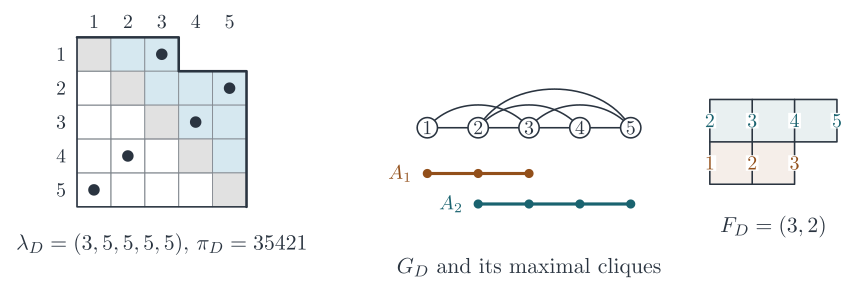
Let \(D\) be a Dyck path of semilength \(n,\) with steps \(U\) and \(D.\) Its area sequence \(a=(a_1,\dotsc,a_n)\) records the height of the path just before its \(j\)th up-step, so \(a_1=0\) and \(a_{j+1}\leq a_j+1.\)
The unit interval graph \(G_D\) on \([n]\) joins each \(j\) to its \(a_j\) immediate predecessors \(j-a_j,\dotsc,j-1.\)
The Ferrers board \(\lambda_D\) has \(\lambda_i\) boxes in row \(i,\) where \(\lambda_i\) is the largest \(j\geq i\) that is \(i\) or a neighbor of \(i\) in \(G_D.\) The rows grow weakly from top to bottom, \(\lambda_i\geq i\) and \(\lambda_n=n.\) The boxes \((i,c)\) with \(i\lt{}c\) are the edges of \(G_D,\) and reading the upper right boundary of the board from the top left, with east steps as \(U\) and south steps as \(D,\) gives the path \(D\) back.
The permutation \(\pi_D\) places a rook in each row of \(\lambda_D,\) from the top, as far to the right as possible without attacking the rooks above. It avoids the pattern \(312,\) every \(312\)-avoiding permutation arises once, and the permutations \(\sigma\) with \(\sigma_i\leq\lambda_i\) for all \(i,\) that is, the complete rook placements on \(\lambda_D,\) form the lower Bruhat interval \([\mathrm{id},\pi_D]\) [AJQ25, Prop. 3].
The peak intervals are the intervals \([i,\lambda_i]\) for the rows \(i\) with \(\lambda_i\gt{}\lambda_{i-1},\) where \(\lambda_0=0.\) They correspond to the peaks of \(D,\) and they are the maximal cliques of \(G_D\): if \(i\lt{}j\) then \(i\) and \(j\) are adjacent exactly when \(j\leq\lambda_i,\) so a clique with smallest element \(i\) lies in \([i,\lambda_i].\)
Number the peak intervals \([\ell_1,u_1],\dotsc,[\ell_r,u_r]\) from left to right. The lattice path matroid \(M_D\) on \([n]\) has as bases the sets \(\{b_1\lt{}\dotsb\lt{}b_r\}\) with \(\ell_k\leq b_k\leq u_k.\) It is the lattice path matroid of the skew shape \(F_D\) with \(r\) rows, whose \(k\)th row from the bottom occupies the columns \(\ell_k-k+1,\dotsc,u_k-k.\) The entries of a peak interval are the possible positions of the north step of that row in a lattice path through \(F_D.\) A peak interval with a single element gives an empty row, and a coloop of \(M_D.\)
Conversely, let \(\lambda/\mu\) be a skew shape with \(r\) rows, empty rows allowed, with \(\lambda_1=c,\) \(\mu_r=0\) and \(\mu_j\leq\lambda_{j+1}\) for all \(j\); these are the shapes whose lattice path matroid has no loops. Each such shape arises from exactly one Dyck path of semilength \(r+c.\) Straight shapes correspond to \(\ell_k=k\) for all \(k.\)
Example
Let \(a=(0,1,2,2,3),\) so \(D=UUUDUUDDDD.\) The board is \(\lambda_D=(3,5,5,5,5)\) and \(\pi_D=35421.\) The graph \(G_D\) has the eight edges \(12,\) \(13,\) \(23,\) \(24,\) \(25,\) \(34,\) \(35\) and \(45,\) and its maximal cliques are the peak intervals \(A_1=[1,3]\) and \(A_2=[2,5].\) The skew shape is \(F_D=(3,2)\): its bottom row admits the north-step positions \(1,2,3\) and its top row the positions \(2,3,4,5.\) The matroid \(M_D\) has rank two, and its bases are all pairs from \([5]\) except \(\{4,5\}.\)
#Statistics on the Bruhat interval
The complete rook placements on \(\lambda_D,\) equivalently the permutations in \([\mathrm{id},\pi_D],\) carry three natural statistics. Write \([k]_q=1+q+\dotsb+q^{k-1}.\)
The number of inversions is the length in the Bruhat order, and \[X_D(q)\coloneqq\sum_{\sigma\leq\pi_D}q^{\operatorname{inv}(\sigma)} =\prod_{j=1}^{n}[a_j+1]_q.\] This is the rook model for the weight \(X_D(q)\) on the page on Touchard–Riordan polynomials. The same product counts the acyclic orientations of \(G_D\) by ascents [AP18, Sec. 9]: inserting vertex \(j\) into an acyclic orientation of the earlier vertices, its \(a_j\) earlier neighbors form a clique that is already ordered, and the \(a_j+1\) slots for \(j\) give \(0,\dotsc,a_j\) new ascents. It also counts the perfect matchings of \([2n]\) whose openers are at the up-steps of \(D,\) by crossings, so summing over all Dyck paths gives the Touchard–Riordan polynomial \(T_n(q).\)
The rook-Eulerian polynomial counts the same permutations by ascents, \[Q_D(t)\coloneqq\sum_{\sigma\leq\pi_D}t^{\operatorname{asc}(\sigma)}.\] For the full board \(\lambda_D=(n,\dotsc,n)\) this is the Eulerian polynomial.
Theorem (Alexandersson–Jal–Quemener, [AJQ25, Thms. 12–13]).
For every Dyck path \(D,\) the polynomial \(Q_D(t)\) is real-rooted. More generally this holds for row-complete rook placements on any Ferrers board with \(\lambda_i\geq i,\) and the multivariate ascent-set enumerator is same-phase stable.
The peak polynomial counts them by interior peaks, positions \(1\lt{}i\lt{}n\) with \(\sigma_{i-1}\lt{}\sigma_i\gt{}\sigma_{i+1},\) \[P_D(t)\coloneqq\sum_{\sigma\leq\pi_D}t^{\operatorname{pk}(\sigma)}.\]
Theorem (Alexandersson–Jal–Quemener, [AJQ25]).
For every Ferrers board with weakly increasing rows and \(\lambda_i\geq i,\) the peak polynomial of its row-complete rook placements is real-rooted. In particular \(P_D(t)\) is real-rooted.
Signing the entries connects peaks and descents. Give each entry of \(\sigma\) a sign, and count ordinary descents of the signed word in the usual order of the integers. Each comparison of adjacent entries is decided by the sign of the entry with larger absolute value. An interior peak owns two comparisons and gives exactly one descent for either sign, an entry owning one comparison gives \(1+x\) over its two signs, and the remaining \(p+1\) entries own none. Hence a word with \(p\) peaks gives \(\sum_{\epsilon}x^{\operatorname{des}(\epsilon\sigma)} =2^{2p+1}x^p(1+x)^{n-2p-1},\) and \[\sum_{\sigma\leq\pi_D}\ \sum_{\epsilon\in\{\pm1\}^n} x^{\operatorname{des}(\epsilon\sigma)} =2(1+x)^{n-1}\,P_D\Bigl(\frac{4x}{(1+x)^2}\Bigr).\] The same argument is used for the signed-descent formula for \(Z\)-polynomials of Schubert matroids.
Keeping the whole descent set instead of the number of descents gives the quasisymmetric function \(\sum_{\sigma\leq\pi_D}\gessel_{n,\DES(\sigma)}.\) It is not symmetric unless \(a=(0,\dotsc,0)\) or \(a=(0,1,\dotsc,n-1),\) but it appears to be positive in the quasisymmetric power-sum basis; see the conjecture on lower Bruhat intervals.
#Chromatic quasisymmetric functions
The graph \(G_D\) is the natural unit interval graph \(H_h\) with Hessenberg function \(h=\lambda_D,\) so the Dyck path also indexes its chromatic quasisymmetric function \[\chrom_{G_D}(\xvec;q)=\sum_{\lambda}c_\lambda(q)\,\elementaryE_\lambda(\xvec)\] of J. Shareshian and M. L. Wachs [SW16]. It is symmetric and Schur-positive, it is elementary-positive at \(q=1\) by T. Hikita’s proof of the Stanley–Stembridge conjecture [Hik26], and it is related to the cohomology of regular semisimple Hessenberg varieties. Several of the polynomials on this page are specializations of it.
A sink of an orientation is a vertex with no outgoing edge. Let \[S_D(t;q)\coloneqq\sum_{O}q^{\operatorname{asc}(O)}t^{\operatorname{sink}(O)}, \qquad S_D(t)\coloneqq S_D(t;1),\] summed over the acyclic orientations \(O\) of \(G_D.\) By the Shareshian–Wachs sink identity, \(S_D(t;q)=\sum_\lambda c_\lambda(q)t^{\ell(\lambda)}\) [SW16, Thm. 5.3], and setting \(t=1\) gives \(X_D(q).\) This sink specialization is real-rooted in \(t\) for every \(q\geq0\) [AL26, Thm. 5.2].
A half-sink is a vertex with no outgoing edge to a larger label. Inserting the vertices in decreasing order gives the product \[\sum_{O}q^{\operatorname{asc}(O)}t^{\operatorname{hsink}(O)} =\prod_{i=1}^{n}\bigl(t+q+q^2+\dotsb+q^{\lambda_i-i}\bigr),\] over acyclic orientations, read off from the rows of the board [AL26, Prop. 40].
The fundamental-length specialization gives F. Brenti’s \(w\)-polynomial \[w_D(t)=(1-t)^{n+1}\sum_{m\geq0}\chi_{G_D}(m)\,t^m,\qquad \chi_{G_D}(m)=\prod_{j=1}^{n}(m-a_j),\] where the chromatic polynomial factors since the earlier neighbors of each vertex form a clique. It is real-rooted since \(G_D\) is chordal [Bre92, Thms. 4.11 and 4.15].
Example
For \(a=(0,1,2,2,3),\) every acyclic orientation has a sink, and the only sets of two sinks are \(\{1,4\}\) and \(\{1,5\}.\) Each leaves a triangle with six acyclic orientations, so \(S_D(t)=60t+12t^2,\) with \(X_D(1)=72\) orientations in total. The half-sink polynomial at \(q=1\) is \(t(t+1)(t+2)^2(t+3),\) and \(w_D(t)=48t^4+72t^5.\)
#Natural descents and non-nesting rooks
Two polynomials are attached to the skew shape \(F_D.\) For a standard Young tableau \(T\) of shape \(F_D,\) a natural descent is an entry \(j\) such that \(j+1\) lies in a strictly higher row. Let \[N_D(t)\coloneqq\sum_{T}t^{\operatorname{ndes}(T)},\qquad R_D(t)\coloneqq\sum_{k}r_k\,t^k,\] where \(r_k\) is the number of non-nesting rook placements on \(F_D\) with \(k\) rooks.
Both polynomials are \(P\)-Eulerian polynomials. Reading the cells row by row labels the cell poset of \(F_D\) naturally, and \(N_D\) is its \(P\)-Eulerian polynomial. The non-nesting rook polynomial is the \(P\)-Eulerian polynomial of the width-two poset of the boundary steps, \(R_D=W_P\) [AJ24]. The order ideals of the cell poset are the lattice paths through \(F_D,\) that is, the bases of \(M_D,\) and the maximal cells of an order ideal form a non-nesting rook placement. Hence \(R_D(1)\) is the number of bases of \(M_D.\)
Proposition
If \(F_D\) has \(m\) cells, then \[[t]N_D(t)=R_D(1)-m-1.\]
Proof
By the theory of \(P\)-partitions, \(N_D(t)/(1-t)^{m+1}=\sum_{k\geq0}c_kt^k,\) where \(c_k\) counts the order-preserving maps from the cell poset to \(\{0,\dotsc,k\}.\) Such maps with \(k=1\) are the order ideals, so \(c_1=R_D(1),\) and comparing the coefficients of \(t\) gives \([t]N_D=c_1-(m+1).\)
For two-row shapes there is an identity of whole polynomials after changing the board. If the top row has \(s\) cells, the bottom row has \(b\) cells, and the top row starts \(d\geq0\) columns to the right of the bottom row, then the natural-descent polynomial equals the non-nesting rook polynomial of the Ferrers board with rows \(\theta_j=\min(s,s+d-j),\) for \(1\leq j\leq b.\) A bijection records a tableau by its word in the letters \(A\) (top row) and \(B\) (bottom row). At each occurrence of \(BA,\) let \(x\) and \(y\) count the letters \(A\) and \(B\) up to and including that \(B,\) and place a rook in row \(y\) and column \(s-x\); between two such occurrences, the word is a run of \(A\) followed by a run of \(B.\) For example, the shape \((3,2)\) gives the board \((2,1),\) and both polynomials are \(1+3t+t^2.\)
Real-rootedness of natural-descent polynomials of straight shapes is conjectured. The non-nesting rook numbers are ultra-log-concave, but \(R_D(t)\) need not be real-rooted [AJ24].
#Tableaux as particle hops
The skew shape \(F_D\) can be found inside the board. The cells \((i,c)\) of \(\lambda_D\) with \(i\lt{}c\) are the edges of \(G_D.\) Keep only the rows \(\ell_1,\dotsc,\ell_r\) where a peak interval starts; row \(\ell_k\) contains the edges \(\{\ell_k,p\}\) with \(\ell_k\lt{}p\leq u_k.\) Shifting the \(k\)th kept row \(k\) steps to the left, and stacking the rows from the bottom, gives \(F_D.\)
This leads to a particle model. Place \(r\) particles on the sites \(\ell_1\lt{}\dotsb\lt{}\ell_r\) of \([n].\) In each step one particle moves one site to the right, onto an empty site, and particle \(k\) stops at \(u_k,\) so it never leaves the clique \(A_k.\) The positions at any moment form a basis of \(M_D,\) and a complete run is a maximal chain of bases in Gale order. A standard Young tableau \(T\) of shape \(F_D\) gives a run: if \(t\) lies in the \(k\)th row from the bottom, the \(t\)th step moves particle \(k,\) and the \(c\)th cell of that row is the hop of particle \(k\) onto site \(\ell_k+c,\) that is, the edge \(\{\ell_k,\ell_k+c\}.\) The columns of \(T\) increase precisely when no two particles meet, and every run arises once. A natural descent \(j\) of \(T\) is a time where the particle moved at step \(j+1\) lies to the right of the particle moved at step \(j.\) Hence \(N_D(t)\) counts the runs by the ascents of the word recording which particle moves, and \(R_D(1)\) counts the configurations.
Example
For \(a=(0,1,2,2,3),\) particle \(1\) moves from site \(1\) to site \(3\) and particle \(2\) from site \(2\) to site \(5.\) The tableau with rows \(124\) and \(35\) moves particle \(2,\) particle \(2,\) particle \(1,\) particle \(2\) and particle \(1.\) Its only natural descent is \(3,\) where the next moving particle lies to the right.
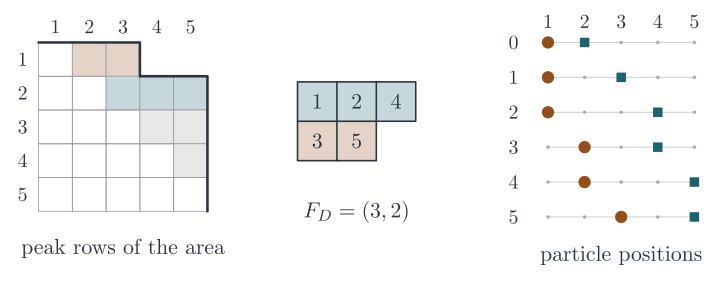
For a straight shape \(\lambda,\) the particles start at \(1,\dotsc,r,\) and a run is a ballot sequence recording the row of each entry. The natural descents are then the descents of the ballot sequence, with rows numbered from the top. For the two-row shape \((m,m)\) these are the valleys of a Dyck path of semilength \(m,\) which have the Narayana distribution.
#Matroid Z-polynomials
Let \(Z_D(t)\) be the \(Z\)-polynomial of the lattice path matroid \(M_D.\) For connected \(F_D\) it is given by the Motzkin path and rook formula on the \(2\times2\) squares of \(F_D.\) In general \(Z_D\) is the product over the connected components of \(F_D,\) with a factor \(1+t\) for each coloop, and for straight shapes it is the \(Z\)-polynomial of a Schubert matroid.
Dyck paths enter a second time, through the word formula. The words \(a_1\dotsm a_n\) there are exactly the area sequences \((0,a_1,\dotsc,a_n)\) of the Dyck paths \(E\) of semilength \(n+1.\) Since \([k]_q\) vanishes at \(q=-1\) precisely when \(k\) is even, the number of odd letters is the order of vanishing of \(X_E\) at \(q=-1.\) For a Schubert matroid of rank \(n\) with board of squares \(B,\) \[Z(t)=\sum_{E}t^{\operatorname{ord}_{q=-1}X_E(q)}\, W_B\bigl(\{j\in[n-1]: a_{j+1}(E)\geq2\}\bigr),\] summed over Dyck paths \(E\) of semilength \(n+1,\) where \(a_{j+1}(E)\) is the height of \(E\) before its \((j+2)\)nd up-step. When the board of squares is empty, for instance for the uniform matroid \(U_{n,n+1},\) every \(W_B\) equals one, and \[N_{n+1}(t)=\sum_{E}t^{\operatorname{ord}_{q=-1}X_E(q)}\] is the Narayana polynomial. For \(n=2,\) the five area sequences \(000,\) \(001,\) \(010,\) \(011\) and \(012\) give \(1+3t+t^2.\)
#The fourteen Dyck paths of semilength four

The first table lists the objects attached to each Dyck path: the board \(\lambda_D,\) the permutation \(\pi_D,\) the peak intervals and the skew shape \(F_D,\) written as \(\lambda/\mu\) with rows from top to bottom.
$a$ $\lambda_D$ $\pi_D$ $A_1,\dotsc,A_r$ $F_D$ $0000$ $1234$ $1234$ $[1],[2],[3],[4]$ $(0,0,0,0)$ $0001$ $1244$ $1243$ $[1],[2],[3,4]$ $(1,0,0)$ $0010$ $1334$ $1324$ $[1],[2,3],[4]$ $(1,1,0)/(1,0,0)$ $0011$ $1344$ $1342$ $[1],[2,3],[3,4]$ $(1,1,0)$ $0012$ $1444$ $1432$ $[1],[2,4]$ $(2,0)$ $0100$ $2234$ $2134$ $[1,2],[3],[4]$ $(1,1,1)/(1,1,0)$ $0101$ $2244$ $2143$ $[1,2],[3,4]$ $(2,1)/(1,0)$ $0110$ $2334$ $2314$ $[1,2],[2,3],[4]$ $(1,1,1)/(1,0,0)$ $0111$ $2344$ $2341$ $[1,2],[2,3],[3,4]$ $(1,1,1)$ $0112$ $2444$ $2431$ $[1,2],[2,4]$ $(2,1)$ $0120$ $3334$ $3214$ $[1,3],[4]$ $(2,2)/(2,0)$ $0121$ $3344$ $3241$ $[1,3],[3,4]$ $(2,2)/(1,0)$ $0122$ $3444$ $3421$ $[1,3],[2,4]$ $(2,2)$ $0123$ $4444$ $4321$ $[1,4]$ $(3)$The second table lists the polynomials. The product \(X_D(q)\) can be read off from \(a\) directly.
$a$ $Q_D$ $P_D$ $S_D$ $N_D$ $R_D$ $Z_D$ $0000$ $t^3$ $1$ $t^4$ $1$ $1$ $1+4t+6t^2+4t^3+t^4$ $0001$ $t^2+t^3$ $1+t$ $2t^3$ $1$ $1+t$ $1+3t+3t^2+t^3$ $0010$ $t^2+t^3$ $1+t$ $2t^3$ $1$ $1+t$ $1+3t+3t^2+t^3$ $0011$ $3t^2+t^3$ $1+3t$ $3t^2+t^3$ $1$ $1+2t$ $1+4t+4t^2+t^3$ $0012$ $t+4t^2+t^3$ $1+5t$ $6t^2$ $1$ $1+2t$ $1+2t+t^2$ $0100$ $t^2+t^3$ $2$ $2t^3$ $1$ $1+t$ $1+3t+3t^2+t^3$ $0101$ $t+2t^2+t^3$ $2+2t$ $4t^2$ $1+t$ $1+2t+t^2$ $1+2t+t^2$ $0110$ $3t^2+t^3$ $2+2t$ $3t^2+t^3$ $1$ $1+2t$ $1+4t+4t^2+t^3$ $0111$ $t+6t^2+t^3$ $2+6t$ $4t+4t^2$ $1$ $1+3t$ $1+6t+6t^2+t^3$ $0112$ $3t+8t^2+t^3$ $2+10t$ $8t+4t^2$ $1+t$ $1+3t+t^2$ $1+3t+t^2$ $0120$ $t+4t^2+t^3$ $4+2t$ $6t^2$ $1$ $1+2t$ $1+2t+t^2$ $0121$ $4t+7t^2+t^3$ $4+8t$ $8t+4t^2$ $1+t$ $1+3t+t^2$ $1+3t+t^2$ $0122$ $7t+10t^2+t^3$ $4+14t$ $16t+2t^2$ $1+t$ $1+4t+t^2$ $1+4t+t^2$ $0123$ $1+11t+11t^2+t^3$ $8+16t$ $24t$ $1$ $1+3t$ $1+t$Some polynomials coincide. Reversing the Dyck path, as for \(0001\) and \(0100,\) gives isomorphic graphs, rotated skew shapes and isomorphic matroids, so \(S_D,\) \(N_D,\) \(R_D\) and \(Z_D\) are unchanged. The Bruhat interval does not have this symmetry: \(Q_D\) often agrees but \(P_D\) usually differs, as for \(0001\) and \(0100.\) The rows \(0101,\) \(0112,\) \(0121\) and \(0122,\) whose shapes have two nonempty rows, have \(R_D=Z_D,\) while the row \(0111\) shows that the two differ in general.
Bibliography
- [AJ24]Per Alexandersson and Aryaman Jal. Rook matroids and log-concavity of ${P}$-Eulerian polynomials. arXiv:2410.00127, 2024.
.bib
@article{AlexanderssonJal2024x, Author = {Per Alexandersson and Aryaman Jal}, Title = {Rook matroids and log-concavity of ${P}$-{E}ulerian polynomials}, Year = {2024}, Eprint = {2410.00127}, url = {https://arxiv.org/abs/2410.00127}, journal = {arXiv e-prints} } - [AJQ25]Per Alexandersson, Aryaman Jal and Maena Quemener. Rook-Eulerian polynomials and permutation ideals. arXiv:2502.05939v1, 2025.
.bib
@article{AlexanderssonJalQuemener2025x, author = {Per Alexandersson and Aryaman Jal and Maena Quemener}, title = {Rook-{E}ulerian polynomials and permutation ideals}, year = {2025}, eprint = {2502.05939v1}, url = {https://arxiv.org/abs/2502.05939v1}, journal = {arXiv e-prints} } - [AL26]Per Alexandersson and Leonardo Saud Maia Leite. Sink polynomials of line graphs and weighted matching polynomials. arXiv:2610.41502v1, 2026.
.bib
@article{AlexanderssonLeite2026x, author = {Per Alexandersson and Leonardo Saud Maia Leite}, title = {Sink polynomials of line graphs and weighted matching polynomials}, year = {2026}, eprint = {2610.41502v1}, url = {https://arxiv.org/abs/2610.41502v1}, journal = {arXiv e-prints} } - [AP18]Per Alexandersson and Greta Panova. LLT polynomials, chromatic quasisymmetric functions and graphs with cycles. Discrete Mathematics, 341(12):3453–3482, December 2018.
.bib
@article{AlexanderssonPanova2018, doi = {10.1016/j.disc.2018.09.001}, url2 = {https://doi.org/10.1016/j.disc.2018.09.001}, year = {2018}, month = dec, publisher = {Elsevier {BV}}, volume = {341}, number = {12}, pages = {3453--3482}, author = {Per Alexandersson and Greta Panova}, title = {{LLT} polynomials, chromatic quasisymmetric functions and graphs with cycles}, journal = {Discrete Mathematics} } - [Bre92]Francesco Brenti. Expansions of chromatic polynomials and log-concavity. Transactions of the American Mathematical Society, 332(2):729–756, 1992.
.bib
@article{Brenti1992, author = {Brenti, Francesco}, title = {Expansions of chromatic polynomials and log-concavity}, year = {1992}, journal = {Transactions of the American Mathematical Society}, volume = {332}, number = {2}, pages = {729--756}, publisher = {American Mathematical Society (AMS)}, doi = {10.1090/s0002-9947-1992-1069745-7}, url = {http://dx.doi.org/10.1090/S0002-9947-1992-1069745-7}, issn = {0002-9947} } - [Hik26]Tatsuyuki Hikita. A proof of the Stanley–Stembridge conjecture. Journal of the American Mathematical Society, 2026.
.bib
@article{Hikita2024x,
  author = {Tatsuyuki Hikita},
  title = {A proof of the {S}tanley--{S}tembridge conjecture},
  year = {2026},
  eprint = {2410.12758},
  url = {https://arxiv.org/abs/2410.12758},
  journal = {Journal of the American Mathematical Society},
  doi = {10.1090/jams/1090}
}