#Permutation patterns
A permutation \(\pi \in \symS_n\) is said to contain the pattern \(\sigma \in \symS_k,\) if there is a subsequence of \(\pi\) which is order-isomorphic to \(\sigma.\) For example, \(\pi = [1, 8, 5, 3, 7, 4, 6, 2]\) contains the pattern \([2,3,1]\) because the subsequence \(3,6,2\) has the same relative order as \(2,3,1.\)
Example (A permutation in \(\symS_8\) and the pattern 231).
The permutation matrices associated with \(\pi = [1, 8, 5, 3, 7, 4, 6, 2]\) and \(\sigma = [2,3,1].\) Here we see that \(\pi\) contains the pattern \(\sigma\) (there are other instances of this pattern in \(\pi\)).
Example (Structure of 132-avoiding permutations).
The number of permutations in \(\symS_n\) avoiding \(132\) is given by the Catalan number \(\frac{1}{n+1}\binom{2n}{n}.\) The structure of a permutation matrix avoiding the pattern \(132\) can be seen in the figure below. The larger regions on the left and right are also \(132\)-avoiding.
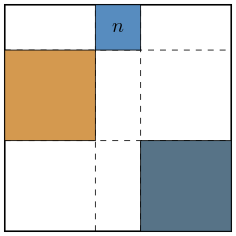
This structure explains why 132-avoiding permutations satisfy the recursion for Catalan numbers.
In [Vat19], the author studies possible growth rates for pattern-avoiding permutations. For a recent survey of some open problems regarding permutation patterns, see [Vat26]. R. Domagalski, S. Elizalde, J. Liang, Q. Minnich, B. E. Sagan, J. Schmidt, and A. Sietsema introduce cyclic pattern containment and avoidance [DELM+22]. The cyclic setting treats permutations up to rotation and leads to cyclic analogues of classical avoidance questions.
#Arrow patterns and shallow permutations
Arrow patterns are variants of permutation patterns designed to remember some information from cycle notation while still being checked through one-line notation. An arrow pattern consists of an ordinary pattern together with arrows between labels, and an occurrence must realize both the usual order-isomorphism and the corresponding arrows under the permutation map.
Y. Berman and B. E. Tenner introduced arrow patterns in their study of pattern-functions and shallow permutations [BT22]. Let \(I(\pi)\) be the inversion number, let \(T(\pi)\) be the reflection length, and let \(D(\pi)=\sum_i |\pi_i-i|\) be the total displacement. The Diaconis–Graham inequalities say \[I(\pi)+T(\pi) \leq D(\pi) \leq 2I(\pi).\] A permutation is shallow if equality holds in the lower bound. These permutations can be characterized by pattern avoidance conditions in cycle form. Shallow permutations avoiding a classical pattern of length three were enumerated by K. Archer, A. Geary, and R. P. Laudone [AGL26].
K. Archer and R. P. Laudone initiated a systematic study of arrow-pattern avoidance, including arrow-Wilf equivalence and enumeration of several avoidance classes [AL26]. S. Fu and Z. Yang then studied simultaneous avoidance of a classical pattern of length \(3\) and an arrow pattern of length \(3,\) resolving three conjectures of Archer–Laudone [FY26].
#Direct sums and skew sums of permutations
Given \(\pi \in \symS_m\) and \(\sigma \in \symS_n,\) we define the direct sum and the skew sum of \(\pi\) and \(\sigma\) as \[\begin{aligned} \pi \oplus \sigma \coloneqq {}& [\pi_1,\dotsc,\pi_m,\sigma_1+m,\dotsc,\sigma_n+m] \in \symS_{m+n}, \\ \pi \ominus \sigma \coloneqq {}& [\pi_1+n,\dotsc,\pi_m+n,\sigma_1,\dotsc,\sigma_n] \in \symS_{m+n}. \end{aligned}\] Note that these operations are not commutative, but they are associative.
#Pattern-avoidance classes
Many important families of permutations are defined by pattern avoidance. Here are some of the most common ones:
Dominant (132-avoiding), counted by Catalan numbers A000108.
Grassmannian (at most one descent), see A000325.
Separable (avoids \(2413\) and \(3142\)), see A006318.
Baxter (avoids \(2\text{-}41\text{-}3\) and \(3\text{-}14\text{-}2\)), see A001181.
Fully commutative (321-avoiding), counted by Catalan numbers A000108.
For a comprehensive list including non-pattern-based families, see the named families of permutations page.
Bibliography
- [AGL26]Kassie Archer, Aaron Geary and Robert P. Laudone. Pattern-avoiding shallow permutations. The Electronic Journal of Combinatorics, 33(1):P1.49, 2026.
.bib
@article{ArcherGearyLaudone2026, author = {Kassie Archer and Aaron Geary and Robert P. Laudone}, title = {Pattern-avoiding shallow permutations}, year = {2026}, journal = {The Electronic Journal of Combinatorics}, volume = {33}, number = {1}, pages = {P1.49}, doi = {10.37236/13826} } - [AL26]Kassie Archer and Robert P. Laudone. Arrow pattern avoidance in permutations: Structure and enumeration. arXiv:2603.04218, 2026.
.bib
@article{ArcherLaudone2026x, author = {Kassie Archer and Robert P. Laudone}, title = {Arrow pattern avoidance in permutations: structure and enumeration}, year = {2026}, eprint = {2603.04218}, url = {https://arxiv.org/abs/2603.04218}, journal = {arXiv e-prints} } - [BT22]Yosef Berman and Bridget Eileen Tenner. Pattern-functions, statistics, and shallow permutations. The Electronic Journal of Combinatorics, 29(4):P4.43, 2022.
.bib
@article{BermanTenner2022, author = {Yosef Berman and Bridget Eileen Tenner}, title = {Pattern-functions, statistics, and shallow permutations}, year = {2022}, journal = {The Electronic Journal of Combinatorics}, volume = {29}, number = {4}, pages = {P4.43}, doi = {10.37236/10858} } - [DELM+22]Rachel Domagalski, Sergi Elizalde, Jinting Liang, Quinn Minnich, Bruce E. Sagan, Jamie Schmidt and Alexander Sietsema. Cyclic pattern containment and avoidance. Advances in Applied Mathematics, 135:102320, 2022.
.bib
@article{DomagalskiElizaldeLiangMinnichSaganSchmidtSietsema2022, author = {Rachel Domagalski and Sergi Elizalde and Jinting Liang and Quinn Minnich and Bruce E. Sagan and Jamie Schmidt and Alexander Sietsema}, title = {Cyclic pattern containment and avoidance}, year = {2022}, journal = {Advances in Applied Mathematics}, volume = {135}, pages = {102320}, doi = {10.1016/j.aam.2022.102320}, url = {https://doi.org/10.1016/j.aam.2022.102320}, eprint = {2106.02534} } - [FY26]Shishuo Fu and Zhenghe Yang. When arrow patterns meet classical patterns. arXiv:2607.04094, 2026.
.bib
@article{FuYang2026x, author = {Shishuo Fu and Zhenghe Yang}, title = {When arrow patterns meet classical patterns}, year = {2026}, eprint = {2607.04094}, url = {https://arxiv.org/abs/2607.04094}, journal = {arXiv e-prints} } - [Vat19]Vincent Vatter. Growth rates of permutation classes: From countable to uncountable. Proceedings of the London Mathematical Society, 119(4):960–997, May 2019.
.bib
@article{Vatter2019, doi = {10.1112/plms.12250}, url2 = {https://doi.org/10.1112/plms.12250}, year = {2019}, month = may, publisher = {Wiley}, volume = {119}, number = {4}, pages = {960--997}, author = {Vincent Vatter}, title = {Growth rates of permutation classes: from countable to uncountable}, journal = {Proceedings of the London Mathematical Society} } - [Vat26]Vincent Vatter. An assortment of problems in permutation patterns: Unimodality, equivalence, derangements, and sorting. arXiv:2602.16355, 2026.
.bib
@article{Vatter2026x,
Author = {Vincent Vatter},
Title = {An assortment of problems in permutation patterns: unimodality, equivalence, derangements, and sorting},
Year = {2026},
Eprint = {2602.16355},
  url = {https://arxiv.org/abs/2602.16355},
journal = {arXiv e-prints}
}