#Kostka coefficients
The Kostka coefficients appear in the monomial expansion of Schur functions, and the Schur expansion of the complete homogeneous symmetric functions: \[\schurS_\lambda = \sum_\mu K_{\lambda\mu} \monomial_\mu, \qquad \completeH_\mu = \sum_\lambda K_{\lambda\mu} \schurS_\lambda.\] Hence, \(K_{\lambda\mu}\) is equal to the number of semistandard Young tableaux of shape \(\lambda\) and content \(\mu.\)
It follows immediately that \(K_{\lambda\lambda}=1,\) \(K_{\lambda,1^n} = f^{\lambda},\) and that \(K_{\lambda\mu}=0\) unless \(\lambda \trianglerighteq \mu\) in dominance order.
S. Gao, J. Kiers, G. Orelowitz, and A. Yong study the semigroup of pairs \((\lambda,\mu)\) with positive Kostka coefficient [GKOY24]. They prove that Hilbert-basis membership is NP-complete, give a Gale–Ryser style criterion using KGR graphs, and classify the extremal rays of the associated cone. A. Krishnan and S. Neville relate Kostka numbers to permutations with prescribed longest increasing subsequence behavior [KN19]. Their results generalize the classical Catalan case where permutations with longest increasing subsequence of length at most two are counted by a Kostka number.
Example (Kostka matrices).
Below is the matrix \((K_{\lambda\mu})\) and its inverse, with rows and columns indexed by the partitions 5, 41, 32, 311, 221, 2111, 11111. \[(K_{\lambda\mu})= \begin{pmatrix} 1 & 1 & 1 & 1 & 1 & 1 & 1 \\ 0 & 1 & 1 & 2 & 2 & 3 & 4 \\ 0 & 0 & 1 & 1 & 2 & 3 & 5 \\ 0 & 0 & 0 & 1 & 1 & 3 & 6 \\ 0 & 0 & 0 & 0 & 1 & 2 & 5 \\ 0 & 0 & 0 & 0 & 0 & 1 & 4 \\ 0 & 0 & 0 & 0 & 0 & 0 & 1 \\ \end{pmatrix} , \quad (K_{\lambda\mu})^{-1}= \begin{pmatrix} 1 & -1 & 0 & 1 & 0 & -1 & 1 \\ 0 & 1 & -1 & -1 & 1 & 1 & -2 \\ 0 & 0 & 1 & -1 & -1 & 2 & -2 \\ 0 & 0 & 0 & 1 & -1 & -1 & 3 \\ 0 & 0 & 0 & 0 & 1 & -2 & 3 \\ 0 & 0 & 0 & 0 & 0 & 1 & -4 \\ 0 & 0 & 0 & 0 & 0 & 0 & 1 \\ \end{pmatrix}\]
See the overview of transition matrices for a combinatorial interpretation of the entries in the inverse matrix.
#Kostka coefficients from Littlewood–Richardson
Proposition
For skew Kostka coefficients, we have the equality
\[K_{\lambda/\mu,\nu} = \langle \schurS_{\mu} \cdot \completeH_{\nu} , \schurS_\lambda \rangle =
\langle \schurS_{\mu} \cdot \schurS_{(\nu_1)} \dotsm \cdot \schurS_{(\nu_\ell)} , \schurS_\lambda \rangle\]
and the latter is a Littlewood–Richardson coefficient \(c^{\tau}_{\sigma\lambda}\)
where \(\tau/\sigma\) is the skew shape obtained by concatenating
\(\ell\) horizontal strips of sizes given by \(\nu,\) and the shape \(\mu.\)
See [p. 338, Sta01] for a proof.
#Recursions for Kostka coefficients
From the definition of Kostka coefficients, there is a straightforward recursion. This recursion is equivalent to the Pieri rule. Let \(\mu = (\mu_1,\dotsc,\mu_\ell)\) be a partition with \(\ell \geq 2\) parts, and let \(\mu^{(\ell)}\) denote the partition \((\mu_1,\dotsc,\mu_{\ell-1})\) (this is \(\mu\) with the last part removed). Then \[K_{\lambda \mu} = \sum_{\nu} K_{\nu,\mu^{(\ell)}}\] where the sum is taken over all partitions \(\nu\) of size \(|\lambda|-\mu_\ell,\) such that \(\lambda/\nu\) is a horizontal strip.
See also the recursion for Kostka–Foulkes polynomials.
In [p. 327, Mac95], the following recursion is described. It generalizes to Jack polynomials.
Theorem
First, let \(d(\lambda)\coloneqq \partitionN(\lambda')-\partitionN(\lambda).\) Let \(\mu\) be a partition of length \(\ell.\) Then we have the recursion \[K_{\lambda, \mu} = \frac{1}{ d(\lambda) - d(\mu)} \sum_{1 \leq i \lt j \leq \ell} \sum_{1 \leq r \leq \mu_j} (\mu_i - \mu_j) K_{\lambda, (\mu+r \evec_i - r \evec_j)^*}\] where \((\mu+r \evec_i - r \evec_j)^*\) denotes the partition obtained from \(\mu\) by decreasing entry \(i\) by \(r,\) and increasing entry \(j\) by \(r,\) and rearrange in decreasing fashion. The initial conditions are given by \(K_{\mu, \mu}=1,\) and \(K_{\lambda, \mu}=0\) unless \(\lambda \geq \mu\) in dominance order.
#Recursions for inverse Kostka coefficients
A convenient recursive formula for the entries in \((K_{\lambda\mu})^{-1}\) is given in [ER90]. The formula is based on the combinatorial model using special rim hook tabloids.
Theorem (Eğecioğlu–Remmel, 1990).
Let \(\lambda = (r_1^{j_1}, r_2^{j_2},\dotsc,r_k^{j_k})\) where \(r_1 \lt r_2 \lt \dotsb.\) Let \(\mu = (\mu_1,\dotsc,\mu_\ell)\) in increasing order. Then \[K^{-1}_{\lambda\mu} = \sum_{\substack{1 \leq j \leq d \\ r_j = \mu_i+j-1}} (-1)^{i-1} K^{-1}_{\lambda[j], (\mu_1-1,\mu_2-1,\dotsc,\mu_{i-1}-1,\mu_{i+1},\dotsc,\mu_{\ell})}\] where \(\lambda[j]\) denotes the partition obtained from \(\lambda\) with one part equal to \(j\) removed.
Computationally, the recursion is useful because each term removes one part from \(\lambda.\)
In [Car98], a \(t\)-version of the Eğecioğlu–Remmel result is proved, where \((K_{\lambda\mu}(t))^{-1}\) is given a combinatorial interpretation. E. E. Allen, K. Celano, and S. K. Mason give a new proof of the Eğecioğlu–Remmel inverse Kostka formula [ACM25]. Their proof uses a Garsia–Milne sign-reversing involution and relates the calculation to dual bases in \(\spaceSym\) and noncommutative symmetric functions.
A similar-looking but different recursion is given in [Thm. 3, Dua03].
Theorem (H. Duan, 2003).
Let \(\lambda = (r_1^{j_1}, r_2^{j_2},\dotsc,r_k^{j_k})\) where \(r_1 \lt r_2 \lt \dotsb.\) Let \(\mu = (\mu_1,\dotsc,\mu_\ell)\) in increasing order. Then \[K^{-1}_{\lambda\mu} = \sum_{r_j \geq \mu_\ell} (-1)^{r_j-\mu_\ell} \sum_{\nu} K^{-1}_{\lambda[j], \nu}\] where \(\lambda[j]\) denotes the partition obtained from \(\lambda\) with one part equal to \(j\) removed, and the inner sum is taken over all \(\nu\) such that \(\mu/\nu\) is a vertical strip of size \(r_j-\mu_\ell.\)
See also [WZ18], where the coefficients appearing in \[\schurS_\mu \hallLittlewoodP_\nu(t) = \sum_\lambda \bar{K}^\lambda_{\mu\nu}(t) \schurS_{\nu}\] are studied.
Z. Z. Petrovi{\'c} and M. Radovanovi{\'c} use a Gröbner basis for the small quantum cohomology ring of the Grassmannian to derive recurrence relations for Kostka numbers and inverse Kostka numbers [PR16]. This is related to the quantum Kostka coefficients discussed below.
#The Kostant partition function
See P. Harris, E. Insko and M. Omar [HIO18] for a short introduction.
Let \(\evec_{ij}\) denote the vector with \(1\) at index \(i\) and \(-1\) at index \(j\) and remaining entries equal to \(0.\) We refer to this collection of vectors as positive roots or just roots for short. Given an integer vector \(w\) of length \(n,\) let Kostant’s partition function \(\kostantP(w)\) be the number of solutions to \[w = \sum_{(i,j) \in \binom{[n]}{2}} a_{ij} \evec_{ij}\] with \(a_{ij}\geq 0.\) This is the definition in root system type \(A_{n-1}\); there are analogues of the partition function in other types. Clearly, \(\kostantP(w)=0\) unless \(w_1+w_2+\dotsb+w_n=0.\)
There is a \(q\)-analogue of \(\kostantP(w),\) denoted \(\kostantP_q(w)\) introduced by G. Lusztig [Lus83]. It is defined as \[\kostantP_q(w) \coloneqq \sum_{ (a_1,\dotsc,a_\ell) } q^{a_1+\dotsb + a_\ell}\] where we sum over all nonnegative solutions \((a_1,\dotsc,a_\ell)\) that express \(w\) as a nonnegative linear combination of roots.
It follows from the definition above that \[\prod_{1 \leq i \lt j \leq n} \left( 1 - q\frac{x_i}{x_j} \right)^{-1} = \sum_{ w \in \setZ^n } \kostantP_q(w) \xvec^w.\]
This has a close relationship with the Jacobi–Trudi identity; see the excellent introduction in [DLT94].
Example
Let \(w=(5,2,-7),\) and our roots are \(\evec_{12},\) \(\evec_{13}\) and \(\evec_{23}.\) We have \(\kostantP(w) = 6,\) since there are \(6\) solutions with nonnegative coefficients: \[052, 143, 234, 325, 416, 507\] For example, \((5,2,-7) = 3\evec_{12} + 2\evec_{13} + 5\evec_{23}.\) Furthermore, \[\kostantP_q(w) = q^{12}+q^{11}+q^{10}+q^9+q^8+q^7.\]
KostantPartitionFunction[w_List] /; Tr[w] != 0 = {};
KostantPartitionFunction[w_List] := Module[
   {a, n = Length[w], roots, idx, vars, sol},
   idx = Subsets[Range[n], {2}];
   roots = Table[SparseArray[ss->{1,-1},{n}], {ss,idx}];
   vars = a /@ idx;
   sol = Solve[
     And @@ Join[Thread[vars >= 0],
       Thread[w == vars.roots]]
     , vars, Integers];
   If[Length[sol] == 0, {}, vars /. sol]
];
KostantPartitionFunction[{5,2,-7}]
Kostant’s partition function is related to juggling sequences; see [BHHM+20].
The number of summands used in expressing \(w\) converges to a Gaussian distribution; see [HRS19]. Similar properties hold for other root systems.
#Kostant partition function in general types
In more generality, let \(\Phi^+ \subset \Phi\) be a set of positive roots in a root system. The Kostant partition function for \(\Phi^+\) is defined via the relation \[\prod_{\alpha \in \Phi^+} \frac{1}{1-e^\alpha} = \sum_{w} \kostantP(w) e^w.\] Note that \(e\) is just a formal variable in this context, but with this convention, \(e^{\alpha} e^{\beta} = e^{\alpha + \beta}.\) The \(q\)-analogue is then defined via \[\prod_{\alpha \in \Phi^+} \frac{1}{1-q e^\alpha} = \sum_{w} \kostantP_q(w) e^w.\] Thus, the coefficient \([q^j]\kostantP_q(w)\) counts the number of ways to express \(w\) as a sum of exactly \(j\) positive roots.
In [Ras04], a different \(q\)-analogue, defined via \[\prod_{\alpha \in \Phi^+} \frac{1+(q-1)e^\alpha}{1- e^\alpha} = \sum_{w} \kostantP^*(w;q) e^w,\] is considered. Then \([q^j]\kostantP^*(w;q)\) is the number of ways to express \(w\) as a sum of positive roots, where exactly \(j\) roots appear with a positive multiplicity.
K. Chang, P. Harris, and E. Insko study the nonzero terms in Kostant’s weight multiplicity formula when the highest weight is the sum of all simple roots [CHI20]. For the zero weight, the number of contributing terms is a Fibonacci number in types \(A\) and \(B,\) and a multiple of a Lucas number in types \(C\) and \(D.\)
#Kostka coefficients from Kostant’s partition function
Let \(\lambda\) and \(\mu\) be integer partitions of \(n.\) Then the Kostant’s multiplicity formula (see [(1.1.5), Kos59]) states that \[K_{\lambda,\mu} = \sum_{\sigma \in \symS_n} (-1)^{\length(\sigma)} \kostantP\left( \sigma(\lambda + \rho) - (\mu+\rho) \right)\] where \(\rho = (n-1,n-2,\dotsc,2,1,0).\) This formula is used to prove polynomiality of stretched Kostka coefficients; see [BGR04]. Note that the above formula is really not an efficient way to compute Kostka coefficients.
The Kostka–Foulkes polynomials \(K_{\lambda,\mu}(q)\) can be computed via the \(q\)-analogue: \[K_{\lambda,\mu}(q) = \sum_{\sigma \in \symS_n} (-1)^{\length(\sigma)} \kostantP_q\left( \sigma(\lambda + \rho) - (\mu+\rho) \right).\]
A. Jiang, N. Jing, and N. Liu study \(Q\)-Kostka polynomials and spin Green polynomials using vertex-operator realizations of \(Q\)-Hall–Littlewood functions [JJL23]. They prove stability properties and give iterative formulas for the spin Green polynomials. N. Jing and N. Liu also derive an iterative formula for spin Kostka–Foulkes polynomials using vertex operators [JL23].
Theorem (See [DLT94]).
We have \[\completeH_\mu(\xvec) = \sum_{\alpha \in \setZ^n} \kostantP(\alpha)\schurS_{\mu + \alpha}(\xvec).\]
#Kostka coefficients from contingency tables
Let \(\lambda\) and \(\mu\) be partitions of lengths at most \(n\) and let \(\rho = (n-1,n-2,\dotsc,2,1).\) Moreover, let \(M_\alpha[\beta]\) be the number of nonnegative integer matrices with row sums given by \((\alpha_1,\dotsc,\alpha_n)\) and column sums given by \((\beta_1,\dotsc,\beta_n).\) Thus, \(M_\alpha[\beta]\) count certain contingency tables.
Using the Jacobi–Trudi identity, we obtain the following identity for skew Kostka coefficients: \[K_{\lambda/\mu,\nu} = [\monomial_\nu] \schurS_{\lambda/\mu} = \sum_{\sigma \in \symS_n} (-1)^\sigma M_\nu[\sigma(\lambda+\rho) - (\mu+\rho)].\]
Proof
We do the proof in the non-skew case. The skew case is similar. Recall that for \(\lambda = (\lambda_1,\dotsc,\lambda_\ell),\) the Jacobi–Trudi identity states that \[\schurS_\lambda(\xvec) = \left| \completeH_{\lambda_i - i + j}(\xvec) \right|_{1 \leq i,j \leq \ell} .\] Setting \(\rho \coloneqq (n-1,n-2,\dotsc,2,1,0),\) we can write this as \[\schurS_\lambda(\xvec) = \left| \completeH_{\lambda_i + \rho_i - \rho_j}(\xvec) \right|_{1 \leq i,j \leq \ell}\] Expanding the determinant, we recognize this as \[\schurS_\lambda(\xvec) = \sum_{\sigma \in \symS_n} (-1)^\sigma \prod_{j=1}^{\ell} \completeH_{\sigma(\lambda+\rho)_j - \rho_j}(\xvec) = \sum_{\sigma \in \symS_n} (-1)^\sigma \completeH_{\sigma(\lambda+\rho) - \rho}(\xvec).\] Recall now that \[\completeH_\alpha(\xvec) = \sum_{\beta} M_\alpha[\beta] m_\beta(\xvec),\] where \(M_\alpha[\beta]\) counts the number of nonnegative integer matrices with row sums given by \(\alpha\) and column sums given by \(\beta.\) This observation completes the proof.
#Littlewood–Richardson coefficients from the partition function
Let \(\lambda,\) \(\mu\) and \(\nu\) be partitions of length at most \(k,\) and such that \(|\lambda|+|\mu| = |\nu|.\) Set \[\delta \coloneqq \frac{1}{2}(k-1,k-3,\dotsc,3-k,1-k).\]
Theorem (Steinberg’s formula [Ste61, Ras04]).
The Littlewood–Richardson coefficient \(c^{\nu}_{\lambda \mu}\) is given by \[c^{\nu}_{\lambda \mu} = \sum_{\sigma, \tau \in \symS_k} (-1)^{\inv(\sigma \tau)} \cdot \kostantP\left( \sigma(\lambda+\delta) + \tau(\mu+\delta) - (\nu+2\delta) \right).\]
LittlewoodRichardson[lam_List, mu_List, nu_List] :=
  Module[{perms, nlam, nmu, nnu, k, delta},
   k = Max[Length /@ {lam, mu, nu}];
   perms = Permutations@Range[k];
   {nlam, nmu, nnu} = PadRight[#, k] & /@ {lam, mu, nu};
   delta = 1/2 Table[j, {j, k - 1, -(k - 1), -2}];
   Sum[
    With[{
      vec = (nlam + delta)[[sigma]]
        +
        (nmu + delta)[[tau]]
        -
        (nnu + 2 delta)},
     (-1)^Inversions[sigma[[tau]]]
      Length[KostantPartitionFunction[vec]]
     ]
    , {sigma, perms}, {tau, perms}]
   ];

(* This should return 1 *)
LittlewoodRichardson[{2, 2}, {3}, {4, 2, 1}]
(* This should return 2 *)
LittlewoodRichardson[{2, 1, 1}, {3, 1}, {4, 2, 1, 1}]
A similar expression for the Schur P structure coefficients can be found in [Thm. 6.2.5, Ras04]. This can be viewed as a type \(B\) analogue of Steinberg’s formula.
In [BZ88] the authors attribute the following formula to B. Kostant:
Theorem (Kostant).
Let \(\lambda,\mu,\nu\) be partitions of length at most \(\ell,\) such that \(|\nu|=|\lambda|+|\mu|.\) Then \[c^{\nu}_{\lambda \mu} = \sum_{\sigma \in \symS_\ell} \varepsilon(\sigma) K_{\mu, \sigma(\nu+\rho)-(\lambda+\rho)},\] where \(\rho = \tfrac12 (\ell-1,\ell-3,\dotsc,1-\ell).\)
S. Shrivastava [Shr22] provides a modern proof of this formula.
A generalization of this formula exists for Gromov–Witten invariants, which appear in the study of toric Schur functions.
#Stretched Kostka coefficients
See also stretched Littlewood–Richardson coefficients.
Using the Gelfand–Tsetlin polytope model for semistandard Young tableaux, we can obtain the Kostka coefficients \(K_{\lambda,\mu}\) as the number of lattice points in certain non-integral (some vertices might not have integer coordinates) polytopes. This implies that the map \(k \mapsto K_{k\lambda,k\mu}\) is a quasi-polynomial in \(k.\) However, we have the stronger statement, due to H. Derksen and J. Weyman [DW02]:
Theorem
The map \(k \mapsto K_{k\lambda,k\mu}\) is a polynomial in \(k.\)
This follows from the analogous statement for Littlewood–Richardson coefficients.
The proof idea (both for Kostka and Littlewood–Richardson coefficients) is to express \(K_{k\lambda,k\mu}\) using Kostant’s partition function. It then remains to prove that for fixed vectors \(\alpha \in \setN^n\) and \(\beta \in \setZ^n,\) the map \(k \mapsto \kostantP\left( k \alpha + \beta \right)\) is a polynomial for all sufficiently large \(k.\) This follows from [Thm. 1, Stu95] together with the fact that the vector partition function \(\phi_A\) in type \(A\) (another name for \(\kostantP\)) arises from a unimodular matrix (all minors have determinant in \(\{-1,0,1\}\)). Unimodularity for the matrix corresponding to Kostant’s partition function follows easily from [Appendix, HT57].
Flagged skew Kostka coefficients can be expressed using contingency tables. A. Nakayashiki and Y. Yamada relate Kostka polynomials to energy functions in solvable lattice models [NY95]. From this expression, polynomiality also follows; see [AO23].
S. Gao and Y. Gao give a type-uniform formula for the degree of the stretched Kostka quasi-polynomial in all classical types [GG24]. Their proof uses the Berenstein–Zelevinsky model for weight multiplicities.
#Kostka–Foulkes polynomials from charge
For an excellent background on charge, see [Ch. 2.4, But94]. A. Kirillov provides an extensive survey on Kostka–Foulkes polynomials in [Kir01].
Here is a longer explanation of how to compute the Kostka–Foulkes polynomials \(K_{\lambda,\mu}(q)\) using charge. These coefficients appear in the expansion of Schur polynomials into Hall–Littlewood polynomials. The combinatorial model using charge was first described by A. Lascoux and M. P. Schützenberger in [LS78].
First introduce the charge of a permutation. For \(\sigma \in \symS_k,\) we let \[\charge(\sigma) \coloneqq \maj(\rev(\sigma^{-1})) = \sum_{i \notin \DES(\sigma^{-1})} (k-i).\] For example, \[\charge(198423765) = \maj(\rev(156498732) ) = \maj(237894651) = 20.\]
The cocharge of a permutation, \(\cocharge(\pi)\) is defined as \(\binom{n}{2}-\charge(\pi).\)
Example (Computing cocharge).
Computing \(\cocharge(198423765)\) can be done as follows. Write the permutation and write a 0 as a subscript for \(1.\) \[1_0\; 9\; 8\; 4\; 2\; 3\; 7\; 6\; 5\] We then move to the next larger element in the permutation with no subscript. If moving to the left, the subscript is increased by one, otherwise it stays the same. The first two steps here is to the right, so the subscripts are set to \(0.\) \[1_0\; 9\; 8\; 4\; 2_0\; 3_0\; 7\; 6\; 5\] We then move to the left, \[1_0\; 9\; 8\; 4_1\; 2_0\; 3_0\; 7\; 6\; 5,\] and then to the right: \[1_0\; 9\; 8\; 4_1\; 2_0\; 3_0\; 7\; 6\; 5_1.\] Proceeding in this fashion, we arrive at \[1_0\; 9_5\; 8_4\; 4_1\; 2_0\; 3_0\; 7_3\; 6_2\; 5_1.\] The cocharge is now the sum of the subscripts, \(0+5+4+1+0+0+3+2+1 = 16.\) This agrees with the fact that \(16+20 = 36 = \binom{9}{2}.\)
#Standard subwords
Given a word \(w\) with content \(\mu \vdash n,\) partition its entries into standard subwords as follows. Start from the right of \(w\) and mark the first occurrence of \(1.\) Proceed to the left and mark the first occurrence of \(2,\) then \(3\) and so on, wrapping around the end if necessary, until \(\mu'_1\) entries have been marked. This subword is the first standard subword of \(w.\) Remove this subword, and repeat the process to find the second standard subword, of length \(\mu'_2.\)
For example, the first standard subword in \(w = 2 1 1 2 3 5 4 3 4 1 1 2 2 3\) has been underlined. \[2, 1, 1, \underline{2}, 3, \underline{5}, 4, 3, \underline{4}, 1, \underline{1}, 2, 2, \underline{3}.\] In total, we have four standard subwords in \(w,\) with corresponding charge values \[\charge(25413) = 3,\quad \charge(2431)=2 \quad \charge(132)=2 \quad \charge(12) = 1,\] and we define \(\charge(w)\) as the sum of the charge values of the standard subwords. Hence \(\charge(w) = 8\) for our particular word.
#Charge of SSYT
For a semistandard Young tableau \(T \in \SSYT(\lambda,\mu),\) the reading word of \(T,\) \(\rw(T)\) is given by concatenating the rows of \(T,\) starting with the bottom-most row. We then define \(\charge(T) = \charge(\rw(T)),\) and the Kostka–Foulkes polynomial \(K_{\lambda,\mu}(q)\) may be computed as \[K_{\lambda,\mu}(q) = \sum_{T \in \SSYT(\lambda,\mu)} q^{\charge(T)}.\]
Similarly, the modified Kostka–Foulkes polynomials are defined as \[\tilde{K}_{\lambda,\mu}(q) = \sum_{T \in \SSYT(\lambda,\mu)} q^{\cocharge(T)}.\] We have the relation \[\tilde{K}_{\lambda,\mu}(q) = q^{\partitionN(\mu)} K_{\lambda,\mu}(q^{-1}).\]
Example (Computing a Kostka–Foulkes polynomial).
We now compute \(K_{421,3211}(q).\) There are four tableaux in \(\SSYT(421,3211):\)
The corresponding standard subwords and charge values are given by \[\underset{1+0+0}{ 3214,\; 21,\; 1 } \qquad % \underset{2+0+0}{4213,\; 21,\; 1 } \qquad % \underset{1+1+0}{ 3241,\; 12,\; 1} \qquad % \underset{2+1+0}{4231,\; 12,\; 1}\] Hence, \(K_{\lambda\mu}(q) = q+2q^2+q^3.\)
Example (Table of \(K_{\lambda,\mu}(q),\) for size \(4\)).
Here are all \(K_{\lambda,\mu}(q)\) for partitions of size \(4.\) The rows are indexed by \(\lambda.\)
\( \; \) \( \textbf{4} \) \( \textbf{31} \) \( \textbf{22} \) \( \textbf{211} \) \( \textbf{1111} \) \( \textbf{4} \) \( 1 \) \( 0 \) \( 0 \) \( 0 \) \( 0 \) \( \textbf{31} \) \( q \) \( 1 \) \( 0 \) \( 0 \) \( 0 \) \( \textbf{22} \) \( q^2 \) \( q \) \( 1 \) \( 0 \) \( 0 \) \( \textbf{211} \) \( q^3 \) \( q^2+q \) \( q \) \( 1 \) \( 0 \) \( \textbf{1111} \) \( q^6 \) \( q^5+q^4+q^3 \) \( q^4+q^2 \) \( q^3+q^2+q \) \( 1 \)#Properties of charge
The elementary Knuth transforms are transformations on three adjacent letters on words. We allow the transformations \(yzx \leftrightarrows yxz\) whenever \(x \lt y\leq z\) and \(xzy \leftrightarrows zxy\) whenever \(x \leq y \lt z.\) Two words are Knuth-equivalent, denoted \(\equiv,\) if one can obtain one from the other via a sequence of elementary Knuth transforms. See also the close relationship with the Robinson–Schensted–Knuth correspondence.
For words of partition weight, we have some extra nice properties: Each equivalence class contains a unique word which is the reading word of a semistandard Young tableau. Furthermore, if \(w \equiv w',\) then \(\charge(w)=\charge(w')\); see [Cor. 2.4.38, But94].
Theorem (Proved in [LS78]).
Charge on words is the unique statistic with the following properties:
\(\charge(\emptyset) = 0,\)
\(\charge(w) = \charge(\sigma\cdot w),\) where \(\sigma\) acts via Lascoux–Schützenberger involutions,
if \(x \neq 1\) and \(wx\) has partition-content, then \(\charge(wx) = \charge(xw)+1,\)
if \(w1^m\) has partition-content and \(w\) contains no ones, then \(\charge(w1^m) = \charge(w),\)
if \(w\) and \(w'\) are Knuth-equivalent, then \(\charge(w) = \charge(w').\)
This is stated as above in [p. 54, Nel05].
Charge can also be obtained via crystal operators [Pat25].
#Skew Kostka–Foulkes polynomials
The skew Kostka–Foulkes polynomials \(K_{\lambda/\mu,\nu}(q)\) are defined as the coefficients in the expansion \[\schurS_{\lambda/\mu}(\xvec) = \sum_{\nu}K_{\lambda/\mu,\nu}(q) \hallLittlewoodP_{\nu}(\xvec;q).\]
The above formula generalizes; see [Cor. 2.5.8, But94]. \[K_{\lambda/\mu,\nu}(q) = \sum_{T \in \SSYT(\lambda/\mu,\nu)} q^{\charge(T)}.\]
Rigged configurations can also be used to compute Kostka–Foulkes polynomials in an efficient manner.
#Cyclage
J. Blasiak relates cyclage and catabolism to cellular subquotients of the extended affine Hecke algebra and to \(q\)-analogues of Garsia–Procesi modules [Bla11]. In related work, he gives an insertion algorithm that computes catabolizability of the insertion tableau of a standard word and characterizes catabolizability using Knuth transformations, rotations, and catabolism transformations [Bla12].
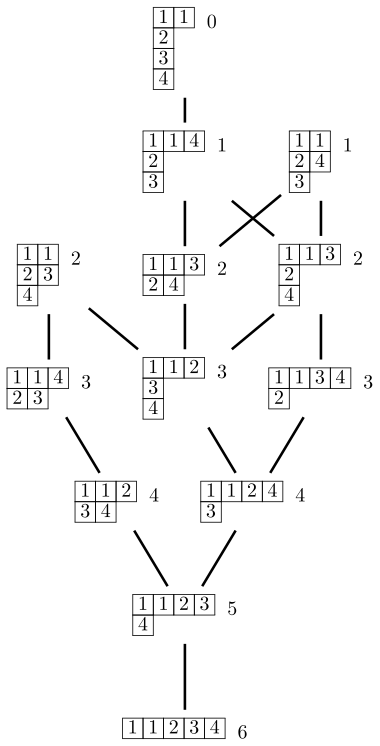
In [LS81], A. Lascoux and M.P. Schützenberger introduce the notion of cyclage. Let \(\mu\) be a partition, and consider the set \(\SSYT(\cdot,\mu) \coloneqq \bigcup_\lambda \SSYT(\lambda,\mu).\) That is, the set of all semistandard Young tableaux with content \(\mu.\) They define a poset structure on \(\SSYT(\cdot,\mu)\) via the covering relations \[T \prec T' \text{ if there is $i\geq 2$ such that } \rw(T)\cdot i \equiv i\cdot \rw(T'),\] where \(\equiv\) denotes Knuth equivalence. This is a graded poset, whose grading is given by cocharge. See [Sec. 5.6, Lot02] for more properties of cyclage.
Example (Figure of a cyclage poset).
The charge is displayed on the right-hand side of each tableau.
#Catabolism
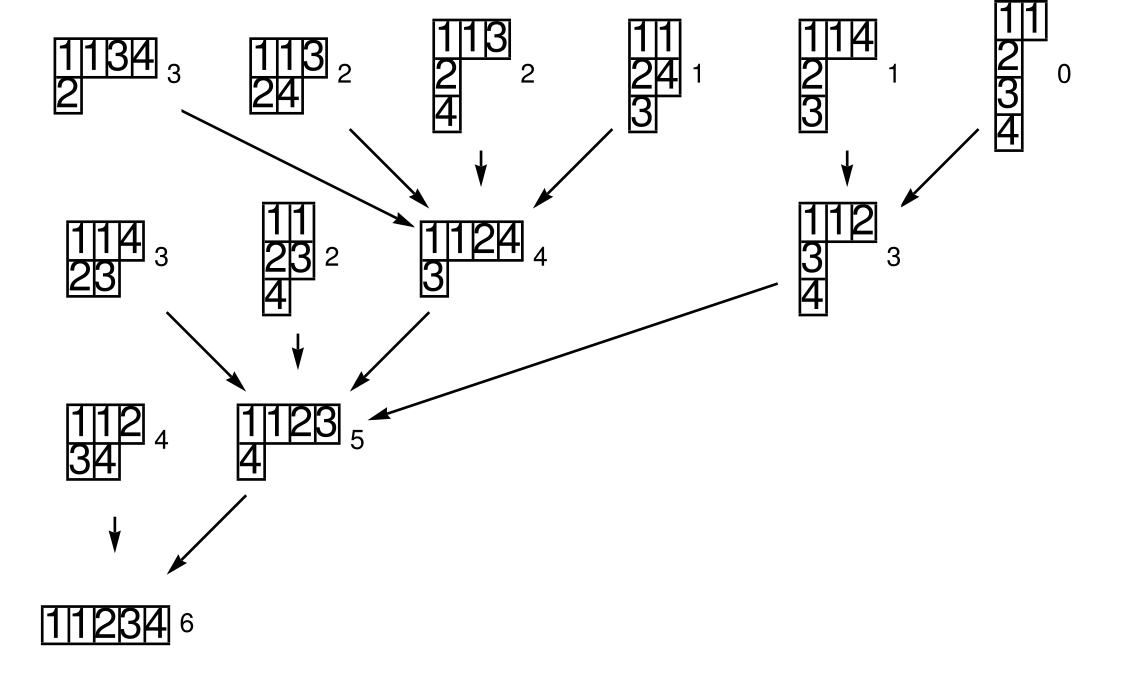
Catabolism is defined in [Exercise 5.6.1, Lot02] as follows. Given a tableau \(T\) of shape \(\lambda,\) let \(F\) be the first row of length \(\lambda_1\) and \(R\) be the tableau consisting of the remaining rows. Perform row insertion on \(F \cdot \rw(R).\) This gives a new tableau with the same weight as \(T,\) and charge has increased by \(|\lambda|-\lambda_1.\) Tableaux with only one row are the only fixed points under catabolism.
Example (Catabolism of a tableau).
In this example, we start with
The top row is moved to the bottom, to create a skew shape.
We then perform jeu-de-taquin to get a straight shape.
The final tableau is the result of catabolism. This procedure is equivalent to the one described above.
Example (Catabolism poset).
The charge is displayed on the right-hand side of each tableau.
For a broader account of why the charge and cocharge machinery is central, see M. Haiman’s survey [Hai03]. The survey reviews the Lascoux–Schützenberger charge formula for Kostka–Foulkes positivity and explains its role in the development of the Macdonald positivity problem and the Hilbert-scheme proof.
#Identities
Using the Robinson–Schensted–Knuth correspondence, we have \[\sum_{\lambda \vdash n} K_{\lambda \mu} K_{\lambda \nu} = N_{\mu\nu},\] where \(N_{\mu\nu}\) is the number of \(n \times n\)-matrices with entries in \(\setN,\) row sums are determined by \(\mu\) and column-sums are determined by \(\nu.\)
There is a \(q\)-analogue of this in the case \(\nu=1^n\); see [Corollary 1.3, Kir00]. \[\sum_{\lambda \vdash n} K_{\lambda \mu} K_{\lambda, 1^n}(q) = q^{n(\mu')} \qbinom{n}{\mu_1,\dotsc,\mu_\ell}_q.\]
Theorem (See [BJ16]).
For a partition \(\lambda\) let \[\lambda^{(i)} \coloneqq (\lambda_1+1,\lambda_2+1,\dotsc,\lambda_{i-1}+1,\lambda_{i+1},\dotsc,\lambda_{\ell}).\] Furthermore, \(\lambda^{[i]}\coloneqq (\lambda_{i+1},\dotsc,\lambda_\ell).\) With these definitions, we have the following recursion for Kostka–Foulkes polynomials: \[K_{\lambda\mu}(q) = \sum_{i=1}^{\mu_1} (-1)^{i-1} q^{\lambda_1-\mu_1-i+1} \sum_{\tau^i} K_{\tau^i,\mu^{[1]}}(q)\] where the sum runs over all partitions \(\tau^i\) such that \(\tau^i/\lambda^{(i)}\) are horizontal \((\lambda_1-\mu_1-i+1)\)-strips.
#Parabolic Kostka polynomials
The parabolic Kostka polynomials \(K_{\lambda,R}(q)\) (or generalized Kostka polynomials) generalize the Kostka–Foulkes polynomials. The following definition appears in [SW00].
Let \(R = (R^1,\dotsc,R^k)\) be a sequence of partitions, and let \(\lambda\) be a partition such that \(|\lambda| = \sum_j |R^j|.\) Furthermore, let \(\eta_j \coloneqq \length(R^j)\) and \(N \coloneqq \sum_j \eta_j.\) Let \(\gamma\) be the length-\(N\) sequence obtained by concatenating the parts of the \(R^j.\) Let \(M\) be the \(N\times N\) matrix with diagonal blocks of size \(\eta_j,\) and let \(R^+_\eta \subset [N]^2\) be the subset of entries in \(M\) strictly above the blocks.
Example (Generalized Kostka setup).
This example is from Shimozono’s AIM note on generalized Kostka polynomials [Shi05].
Let \(R=((4,4),(3),(1,1,1)).\) Then \(\eta = (2,1,3),\) \(N=6\) and \(\gamma = 443111.\) The matrix \(M\) is as follows where \(R^+_\eta\) consists of the lightgreen boxes.
Hence, \[R^+_\eta = \{13,14,15,16, \; 23,24,25,26, \; 34, 35, 36 \}.\]
We introduce \(\kostantP^\eta_q(w),\) which is a generalization of the \(q\)-analogue of the Kostant partition function, via the relation \[\sum_{w \in \setZ^N} \kostantP^\eta_q(w)\xvec^w = \prod_{(i,j) \in R^+_\eta} \frac{1}{1-q\frac{x_i}{x_j}}.\] Finally, the parabolic Kostka polynomial \(K_{\lambda,R}(q)\) is defined as \[K_{\lambda,R}(q) = \sum_{\sigma \in \symS_N} (-1)^{\length(\sigma)} \kostantP^\eta_q\left( \sigma(\lambda + \rho) - (\gamma+\rho) \right),\] where \(\rho = (N-1,\dotsc,2,1,0).\) The definition shows that if each partition \(R^i = (\mu_i)\) has a single part, then \(K_{\lambda,R}(q) = K_{\lambda,\mu}(q),\) the standard Kostka–Foulkes polynomial.
By [Prop. 8, SW00], \[K_{\lambda,R}(1) = \langle \schurS_\lambda, \schurS_{R^1} \schurS_{R^2} \dotsm \schurS_{R^k} \rangle,\] which is a type of generalized Littlewood–Richardson coefficient.
#Symplectic Kostka–Foulkes polynomials
Maciej Dołęga, T. Gerber, and J. Torres give a positive combinatorial formula for symplectic Kostka–Foulkes polynomials in the row case [DGT20]. This is a type \(C\) analogue of the charge formula for ordinary Kostka–Foulkes polynomials.
#Rectangular special case
When all \(R^j\) are rectangles, the \(K_{\lambda,R}(q)\) are Poincaré polynomials.
Several conjectures regarding this special case appear in [Shi05]. In particular, there is a connection with LLT polynomials.
When the part sizes in the rectangles \(R^j\) are weakly decreasing, we have a dominant sequence of rectangles. In this case, it is known that \(K_{\lambda,R}(q) \in \setN[q],\) via a rigged configuration proof. A charge formula is conjectured in [Conj. 27, SW00], and later proved by M. Shimozono [Thm. 11, Shi01]. There, \[K_{\lambda,R}(q) = \sum_{T \in LRT(\lambda,R)} q^{\charge_R(T)}\] where \(\charge_R\) is a generalization of charge, and \(LRT(\lambda,R)\) is the set of certain Littlewood–Richardson tableaux. See [KS02, KSS01, SW99] for more background.
For a representation-theoretic realization of \(q\)-Kostka polynomials, A. M. Garsia and C. Procesi construct graded \(\symS_n\)-modules whose graded multiplicities are governed by these polynomials [GP92]. This connects the Kostka–Foulkes theory with Springer fibers and Tanisaki-type quotient rings.
P. Petrullo and D. Senato introduce a monoid of admissible Kostka–Foulkes polynomials [PS20]. These polynomials are stable under uniform translation of partitions, and every Kostka–Foulkes polynomial can be written as a signed linear combination of admissible ones.
A convenient dynamic program for ordinary Kostka coefficients is obtained from the Pieri recursion. Let \(\mu=(\mu_1,\dotsc,\mu_\ell).\) We count chains \[\emptyset=\lambda^{(0)}\subseteq \lambda^{(1)}\subseteq \dotsb \subseteq \lambda^{(\ell)}=\lambda\] such that each difference \(\lambda^{(j)}/\lambda^{(j-1)}\) is a horizontal strip of size \(\mu_j.\) Equivalently, layer \(j\) consists of partitions of size \(\mu_1+\dotsb+\mu_j,\) and the edge relation is adding a horizontal strip of the prescribed size. Counting directed paths from \(\emptyset\) to \(\lambda\) in this layered graph gives \(K_{\lambda,\mu}.\)
#Atomic decomposition
Lascoux’s atomic decomposition asks for a positive expansion of Kostka–Foulkes polynomials into atomic polynomials. C. Lecouvey and C. Lenart formulate this idea uniformly for characters and crystals, prove it in type \(A,\) and establish stable-range results and conjectures in the other classical types [LL21].
#Quantum Kostka coefficients
The quantum Kostka coefficients arise in the study of the quantum cohomology of the Grassmannian [PR16]. A combinatorial formula for these coefficients first appeared in [BCF99].
Let \(\lambda \subseteq n \times k\) and suppose \(\nu\) satisfies \(|\nu| = |\lambda| + m(n+k).\) Then the quantum Kostka coefficient \(K_{\lambda \nu}^{k,n}\) is given by \[K_{\lambda \nu}^{k,n} = \sum_{\rho} \sign(\rho/\lambda) K_{\rho \nu}\] where \(K_{\rho \nu}\) is a regular Kostka coefficient and the sum ranges over all partitions \(\rho\) occupying at most \(n\) columns, obtained by adding \(m\) ribbons (each containing \((n+k)\) boxes). The sign \(\sign(\rho/\lambda)\) is given by multiplying \((-1)^{n-width(r_j)}\) for all ribbons \(r_j\) where the width is the number of columns the ribbon occupies.
#Generalizations
A. N. Kirillov gives new combinatorial formulas for modified Hall–Littlewood polynomials, for transition coefficients between elementary and Hall–Littlewood bases, and for point counts on unipotent partial flag varieties [Kir00]. The same paper reviews \(q\)-analogues of Littlewood–Richardson coefficients and formulates conjectures for one-dimensional sums and generalized Kostka–Foulkes polynomials.
C. Lenart studies how charge may be extended beyond type \(A\) by using the Ram–Yip formula for Macdonald polynomials and the quantum Bruhat order [Len11]. In type \(A\) this recovers the usual charge, while in type \(C\) it gives a new charge-like statistic.
For a compact catalogue of related \(q\)-identities, see [DLT94]. Their survey places Kostka–Foulkes polynomials alongside Hall–Littlewood functions, Kostant’s partition function, plethysm, and the representation theory of finite linear groups and symmetric groups. For the roots-of-unity direction, F. Descouens gives a combinatorial proof that rectangular Hall–Littlewood functions specialized at primitive roots of unity can be expressed as plethysms, using Schilling’s bijection between ribbon tableaux and ribbon rigged configurations [Des08]. See also the overview of evaluations at roots of unity.
Bibliography
- [AO23]Per Alexandersson and Ezgi Kantarci Oğuz. Cylindric Schur functions. arXiv:2311.07382, 2023.
.bib
@article{AlexanderssonOguz2023x, Author = {Per Alexandersson and Ezgi Kantarci Oğuz}, Title = {Cylindric {S}chur functions}, Year = {2023}, Eprint = {2311.07382}, url = {https://arxiv.org/abs/2311.07382}, journal = {arXiv e-prints} } - [ACM25]Edward E. Allen, Kyle Celano and Sarah K. Mason. A new proof of an Eğecioğlu–Remmel inverse Kostka matrix problem via a Garsia–Milne involution involving Sym and NSym. arXiv:2511.18156, 2025.
.bib
@article{AllenCelanoMason2025x, author = {Edward E. Allen and Kyle Celano and Sarah K. Mason}, title = {A new proof of an {E}{\u{g}}ecio{\u{g}}lu--{R}emmel inverse {K}ostka matrix problem via a {G}arsia--{M}ilne involution involving {S}ym and {{N}{S}}ym}, year = {2025}, eprint = {2511.18156}, url = {https://arxiv.org/abs/2511.18156}, journal = {arXiv e-prints} } - [BHHM+20]Carolina Benedetti, Christopher R. H. Hanusa, Pamela E. Harris, Alejandro H. Morales and Anthony Simpson. Kostant’s partition function and magic multiplex juggling sequences. Springer Science; Business Media LLC, 2020.
.bib
@article{BenedettiHanusaHarrisMoralesSimpson2020, doi = {10.1007/s00026-020-00498-0}, url2 = {https://doi.org/10.1007/s00026-020-00498-0}, year = {2020}, month = jun, publisher = {Springer Science and Business Media {LLC}}, volume = {24}, number = {3}, pages = {439--473}, author = {Carolina Benedetti and Christopher R. H. Hanusa and Pamela E. Harris and Alejandro H. Morales and Anthony Simpson}, title = {Kostant's Partition Function and Magic Multiplex Juggling Sequences} } - [BZ88]A. D. Berenstein and A. V. Zelevinsky. Tensor product multiplicities and convex polytopes in partition space. Journal of Geometry and Physics, 5(3):453–472, 1988.
.bib
@article{BerensteinZelevinsky1988, title = {Tensor product multiplicities and convex polytopes in partition space}, journal = {Journal of Geometry and Physics}, volume = {5}, number = {3}, pages = {453--472}, year = {1988}, issn = {0393-0440}, doi = {10.1016/0393-0440(88)90033-2}, url2 = {http://www.sciencedirect.com/science/article/pii/0393044088900332}, author = {A. D. Berenstein and A. V. Zelevinsky} } - [BCF99]Aaron Bertram, Ionuţ Ciocan-Fontanine and William Fulton. Quantum multiplication of Schur polynomials. Journal of Algebra, 219(2):728–746, September 1999.
.bib
@article{BertramCiocanFontanineFulton1999, doi = {10.1006/jabr.1999.7960}, url2 = {https://doi.org/10.1006/jabr.1999.7960}, year = {1999}, month = sep, publisher = {Elsevier {BV}}, volume = {219}, number = {2}, pages = {728--746}, author = {Aaron Bertram and Ionu{\c{t}} Ciocan-Fontanine and William Fulton}, title = {Quantum Multiplication of {S}chur Polynomials}, journal = {Journal of Algebra} } - [BGR04]Sara Billey, Victor Guillemin and Etienne Rassart. A vector partition function for the multiplicities of $\mathfrak{sl}_k(\mathbb{C})$. Journal of Algebra, 278(1):251–293, August 2004.
.bib
@article{BilleyGuilleminRassart2004, doi = {10.1016/j.jalgebra.2003.12.005}, url2 = {https://doi.org/10.1016/j.jalgebra.2003.12.005}, year = {2004}, month = aug, publisher = {Elsevier {BV}}, volume = {278}, number = {1}, pages = {251--293}, author = {Sara Billey and Victor Guillemin and Etienne Rassart}, title = {A vector partition function for the multiplicities of $\mathfrak{sl}_k(\mathbb{C})$}, journal = {Journal of Algebra} } - [Bla11]Jonah Blasiak. Cyclage, catabolism, and the affine Hecke algebra. Advances in Mathematics, 228(4):2292–2351, 2011.
.bib
@article{Blasiak2011Cyclage, author = {Jonah Blasiak}, title = {Cyclage, catabolism, and the affine {H}ecke algebra}, year = {2011}, journal = {Advances in Mathematics}, volume = {228}, number = {4}, pages = {2292--2351}, doi = {10.1016/j.aim.2011.07.006}, url = {https://doi.org/10.1016/j.aim.2011.07.006}, eprint = {1001.1569} } - [Bla12]Jonah Blasiak. An insertion algorithm for catabolizability. European Journal of Combinatorics, 33(2):267–276, 2012.
.bib
@article{Blasiak2012Catabolizability, author = {Jonah Blasiak}, title = {An insertion algorithm for catabolizability}, year = {2012}, journal = {European Journal of Combinatorics}, volume = {33}, number = {2}, pages = {267--276}, doi = {10.1016/j.ejc.2011.09.042}, url = {https://doi.org/10.1016/j.ejc.2011.09.042}, eprint = {0908.1967} } - [BJ16]Timothee W. Bryan and Naihuan Jing. An algebraic formula for the Kostka–Foulkes polynomials. arXiv:1608.01775, 2016.
.bib
@article{BryanJing2016, Author = {Timothee W. Bryan and Naihuan Jing}, Title = {An algebraic formula for the {K}ostka--{F}oulkes polynomials}, Year = {2016}, Eprint = {1608.01775}, url = {https://arxiv.org/abs/1608.01775}, journal = {arXiv e-prints} } - [But94]Lynne M. Butler. Subgroup lattices and symmetric functions. American Mathematical Society, 1994.
.bib
@book{Butler1994, Author = {Lynne M. Butler}, Title = {Subgroup Lattices and Symmetric Functions}, Publisher = {American Mathematical Society}, url = {https://bookstore.ams.org/memo-112-539}, Year = {1994}, ISBN = {082182600X} } - [Car98]Joaquin O. Carbonara. A combinatorial interpretation of the inverse t-Kostka matrix. Discrete Mathematics, 193(1-3):117–145, November 1998.
.bib
@article{Carbonara1998, doi = {10.1016/s0012-365x(98)00138-1}, url2 = {https://doi.org/10.1016/s0012-365x(98)00138-1}, year = {1998}, month = nov, publisher = {Elsevier {BV}}, volume = {193}, number = {1-3}, pages = {117--145}, author = {Joaquin O. Carbonara}, title = {A combinatorial interpretation of the inverse t-{K}ostka matrix}, journal = {Discrete Mathematics} } - [CHI20]Kevin Chang, Pamela E. Harris and Erik Insko. Kostant’s weight multiplicity formula and the Fibonacci and Lucas numbers. Journal of Combinatorics, 11(1):141–167, 2020.
.bib
@article{ChangHarrisInsko2020, author = {Kevin Chang and Pamela E. Harris and Erik Insko}, title = {Kostant's weight multiplicity formula and the {F}ibonacci and {L}ucas numbers}, year = {2020}, journal = {Journal of Combinatorics}, volume = {11}, number = {1}, pages = {141--167}, doi = {10.4310/JOC.2020.v11.n1.a7}, url = {https://doi.org/10.4310/JOC.2020.v11.n1.a7}, eprint = {1111.6648} } - [DW02]Harm Derksen and Jerzy Weyman. On the Littlewood–Richardson polynomials. Journal of Algebra, 255(2):247–257, 2002.
.bib
@article{DerksenWeyman2002, title = {On the {L}ittlewood--{R}ichardson polynomials}, journal = {Journal of Algebra }, volume = {255}, number = {2}, pages = {247--257}, year = {2002}, issn = {0021-8693}, doi = {10.1016/S0021-8693(02)00125-4}, url2 = {http://www.sciencedirect.com/science/article/pii/S0021869302001254}, author = {Harm Derksen and Jerzy Weyman} } - [DLT94]Jacques Désarménien, Bernard Leclerc and Jean-Yves Thibon. Hall-Littlewood functions and Kostka–Foulkes polynomials in representation theory. Séminaire Lotharingien de Combinatoire [electronic only], 32:38, 1994.
.bib
@article{DesarmenienLeclercThibon1994, author = {Jacques D{\'{e}}sarm{\'{e}}nien and Bernard Leclerc and Jean-Yves Thibon}, journal = {S{\'{e}}minaire Lotharingien de Combinatoire [electronic only]}, language = {eng}, pages = {38}, publisher = {Universit{\"{a}}t Wien, Fakult{\"{a}}t f{\"{u}}r Mathematik}, title = {Hall-{L}ittlewood functions and {K}ostka--{F}oulkes polynomials in representation theory}, url = {http://eudml.org/doc/119019}, volume = {32}, year = {1994}, } - [Des08]Francois Descouens. Ribbon tableaux, ribbon rigged configurations and Hall–Littlewood functions at roots of unity. Journal of Combinatorial Theory, Series A, 115(3):361–375, April 2008.
.bib
@article{Descouens2008, doi = {10.1016/j.jcta.2007.06.005}, url2 = {https://doi.org/10.1016/j.jcta.2007.06.005}, year = {2008}, month = apr, publisher = {Elsevier {BV}}, volume = {115}, number = {3}, pages = {361--375}, author = {Francois Descouens}, title = {Ribbon tableaux, ribbon rigged configurations and {H}all--{L}ittlewood functions at roots of unity}, journal = {Journal of Combinatorial Theory, Series A} } - [DGT20]Maciej Dołęga, Thomas Gerber and Jacinta Torres. A positive combinatorial formula for symplectic Kostka–Foulkes polynomials I: Rows. Journal of Algebra, 560:1253–1296, 2020.
.bib
@article{DolegaGerberTorres2020, author = {Dołęga, Maciej and Gerber, Thomas and Torres, Jacinta}, title = {A positive combinatorial formula for symplectic {K}ostka--{F}oulkes polynomials {I}: {R}ows}, year = {2020}, journal = {Journal of Algebra}, volume = {560}, pages = {1253--1296}, publisher = {Elsevier BV}, doi = {10.1016/j.jalgebra.2020.05.030}, url = {https://doi.org/10.1016/j.jalgebra.2020.05.030}, eprint = {1911.06732} } - [Dua03]Haibao Duan. On the inverse Kostka matrix. Journal of Combinatorial Theory, Series A, 103(2):363–376, August 2003.
.bib
@article{Duan2003, doi = {10.1016/s0097-3165(03)00106-7}, url2 = {https://doi.org/10.1016/s0097-3165(03)00106-7}, year = {2003}, month = aug, publisher = {Elsevier {BV}}, volume = {103}, number = {2}, pages = {363--376}, author = {Haibao Duan}, title = {On the inverse {K}ostka matrix}, journal = {Journal of Combinatorial Theory, Series A} } - [ER90]Eğecioğlu and Jeffrey B. Remmel. A combinatorial interpretation of the inverse Kostka matrix. Linear and Multilinear Algebra, 26(1-2):59–84, January 1990.
.bib
@article{EgeciogluRemmel1990, doi = {10.1080/03081089008817966}, url2 = {https://doi.org/10.1080/03081089008817966}, year = {1990}, month = jan, publisher = {Informa {UK} Limited}, volume = {26}, number = {1-2}, pages = {59--84}, author = {{\"{O}}mer E{\u{g}}ecio{\u{g}}lu and Jeffrey B. Remmel}, title = {A combinatorial interpretation of the inverse {K}ostka matrix}, journal = {Linear and Multilinear Algebra} } - [GG24]Shiliang Gao and Yibo Gao. Degrees of the stretched Kostka quasi-polynomials. Bulletin of the London Mathematical Society, 56(5):1748–1761, 2024.
.bib
@article{GaoGao2024, author = {Shiliang Gao and Yibo Gao}, title = {Degrees of the stretched {K}ostka quasi-polynomials}, year = {2024}, journal = {Bulletin of the London Mathematical Society}, volume = {56}, number = {5}, pages = {1748--1761}, doi = {10.1112/blms.13024}, url = {https://doi.org/10.1112/blms.13024}, eprint = {2210.10158} } - [GKOY24]Shiliang Gao, Joshua Kiers, Gidon Orelowitz and Alexander Yong. The Kostka semigroup and its Hilbert basis. Enumerative Combinatorics and Applications, 4(2):S2R9, 2024.
.bib
@article{GaoKiersOrelowitzYong2024, author = {Shiliang Gao and Joshua Kiers and Gidon Orelowitz and Alexander Yong}, title = {The {K}ostka semigroup and its {H}ilbert basis}, year = {2024}, journal = {Enumerative Combinatorics and Applications}, volume = {4}, number = {2}, pages = {S2R9}, doi = {10.54550/ECA2024V4S2R9}, url = {https://doi.org/10.54550/ECA2024V4S2R9}, eprint = {2102.00935} } - [GP92]Adriano M. Garsia and Claudio Procesi. On certain graded $S_n$-modules and the $q$-Kostka polynomials. Advances in Mathematics, 94(1):82–138, 1992.
.bib
@article{GarsiaProcesi1992, doi = {10.1016/0001-8708(92)90034-I}, url2 = {https://doi.org/10.1016/0001-8708(92)90034-I}, year = {1992}, publisher = {Elsevier BV}, volume = {94}, number = {1}, pages = {82--138}, author = {Adriano M. Garsia and Claudio Procesi}, title = {On certain graded {$S_n$}-modules and the {$q$}-{K}ostka polynomials}, journal = {Advances in Mathematics} } - [Hai03]Mark Haiman. Combinatorics, symmetric functions, and Hilbert schemes. Current developments in mathematics, 2002:39–111, 2003.
.bib
@incollection{Haiman2002CDM, author = {Mark Haiman}, title = {Combinatorics, symmetric functions, and {H}ilbert schemes}, booktitle = {Current Developments in Mathematics, 2002}, pages = {39--111}, publisher = {International Press}, address = {Somerville, MA}, year = {2003}, doi = {10.4310/CDM.2002.v2002.n1.a2}, url = {https://doi.org/10.4310/CDM.2002.v2002.n1.a2} } - [HIO18]Pamela E. Harris, Erik Insko and Mohamed Omar. The $q$-analog of Kostant’s partition function and the highest root of the simple Lie algebras. Australasian J. Combinatorics, 71:68–91, 2018.
.bib
@article{HarrisInskoOmar2018, author = {Pamela E. Harris and Erik Insko and Mohamed Omar}, title = {The $q$-analog of {K}ostant's partition function and the highest root of the simple {L}ie algebras}, journal = {Australasian J. Combinatorics}, volume = {71}, pages = {68--91}, year = {2018}, url = {https://ajc.maths.uq.edu.au/pdf/71/ajc_v71_p068.pdf} } - [HRS19]Pamela E. Harris, Margaret Rahmoeller and Lisa Schneider. On the asymptotic behavior of the $q$-analog of Kostant’s partition function. arXiv:1912.02266, 2019.
.bib
@article{HarrisRahmoellerSchneider2019x, Author = {Pamela E. Harris and Margaret Rahmoeller and Lisa Schneider}, Title = {On the asymptotic behavior of the $q$-analog of {K}ostant's partition function}, Year = {2019}, Eprint = {1912.02266}, url = {https://arxiv.org/abs/1912.02266}, journal = {arXiv e-prints} } - [HT57]I. Heller and C. B. Tompkins. An extension of a theorem of Dantzig’s. Linear inequalities and related systems. (AM-38):247–254, December 1957.
.bib
@incollection{HellerTompkins1957, doi = {10.1515/9781400881987-015}, url2 = {https://doi.org/10.1515/9781400881987-015}, year = {1957}, month = dec, publisher = {Princeton University Press}, pages = {247--254}, author = {I. Heller and C. B. Tompkins}, title = {An Extension of a Theorem of {D}antzig's}, booktitle = {Linear Inequalities and Related Systems. ({AM}-38)} } - [JJL23]Anguo Jiang, Naihuan Jing and Ning Liu. Q-Kostka polynomials and spin Green polynomials. Monatshefte für Mathematik, 201(1):109–125, 2023.
.bib
@article{JiangJingLiu2023, author = {Anguo Jiang and Naihuan Jing and Ning Liu}, title = {Q-{K}ostka polynomials and spin {G}reen polynomials}, year = {2023}, journal = {Monatshefte für Mathematik}, volume = {201}, number = {1}, pages = {109--125}, doi = {10.1007/s00605-023-01843-0}, url = {https://doi.org/10.1007/s00605-023-01843-0}, eprint = {2304.07439} } - [JL23]Naihuan Jing and Ning Liu. Spin Kostka polynomials and vertex operators. Pacific Journal of Mathematics, 325(1):127–146, 2023.
.bib
@article{JingLiu2023, author = {Naihuan Jing and Ning Liu}, title = {Spin {K}ostka polynomials and vertex operators}, year = {2023}, journal = {Pacific Journal of Mathematics}, volume = {325}, number = {1}, pages = {127--146}, doi = {10.2140/pjm.2023.325.127}, url = {https://doi.org/10.2140/pjm.2023.325.127}, eprint = {2303.10664} } - [Kir00]Anatol N. Kirillov. New combinatorial formula for modified Hall–Littlewood polynomials. $q$-series from a contemporary perspective:283–333, 2000.
.bib
@incollection{Kirillov2000, author = {Anatol N. Kirillov}, title = {New combinatorial formula for modified {H}all--{L}ittlewood polynomials}, pages = {283--333}, doi = {10.1090/conm/254}, year = {2000}, publisher = {American Mathematical Society}, booktitle = {$q$-Series from a Contemporary Perspective} } - [Kir01]Anatol N. Kirillov. Ubiquity of Kostka polynomials. Physics and combinatorics:85–200, April 2001.
.bib
@inproceedings{Kirillov2001, title = {Ubiquity of {K}ostka Polynomials}, url = {http://dx.doi.org/10.1142/9789812810199_0006}, DOI = {10.1142/9789812810199_0006}, booktitle = {Physics and Combinatorics}, publisher = {World Scientific}, author = {Anatol N. Kirillov}, year = {2001}, month = apr, pages = {85--200} } - [KSS01]Anatol N. Kirillov, Anne Schilling and Mark Shimozono. Various representations of the generalized Kostka polynomials. The andrews festschrift:209–226, 2001.
.bib
@incollection{KirillovSchillingShimozono2001, doi = {10.1007/978-3-642-56513-7_10}, url2 = {https://doi.org/10.1007/978-3-642-56513-7_10}, year = {2001}, publisher = {Springer Berlin Heidelberg}, pages = {209--226}, author = {Anatol N. Kirillov and Anne Schilling and Mark Shimozono}, title = {Various Representations of the Generalized {K}ostka Polynomials}, booktitle = {The Andrews Festschrift} } - [KS02]Anatol N. Kirillov and Mark Shimozono. A generalization of the Kostka–Foulkes polynomials. Journal of Algebraic Combinatorics, 15(1):27–69, 2002.
.bib
@article{KirillovShimozono2002, doi = {10.1023/a:1013269131974}, url2 = {https://doi.org/10.1023/a:1013269131974}, year = {2002}, publisher = {Springer Nature}, volume = {15}, number = {1}, pages = {27--69}, title = {A Generalization of the {K}ostka--{F}oulkes Polynomials}, author = {Anatol N. Kirillov and Mark Shimozono}, journal = {Journal of Algebraic Combinatorics} } - [Kos59]Bertram Kostant. A formula for the multiplicity of a weight. Transactions of the American Mathematical Society, 93(1):53–73, 1959.
.bib
@article{Kostant1959, doi = {10.1090/s0002-9947-1959-0109192-6}, url = {https://doi.org/10.1090/s0002-9947-1959-0109192-6}, year = {1959}, publisher = {American Mathematical Society ({AMS})}, volume = {93}, number = {1}, pages = {53--73}, author = {Bertram Kostant}, title = {A formula for the multiplicity of a weight}, journal = {Transactions of the American Mathematical Society} } - [KN19]Arjun Krishnan and Scott Neville. Kostka Numbers and Longest Increasing Subsequences. arXiv:1907.03881, 2019.
.bib
@article{KrishnanNeville2019x, author = {Arjun Krishnan and Scott Neville}, title = {Kostka {N}umbers and {L}ongest {I}ncreasing {S}ubsequences}, year = {2019}, eprint = {1907.03881}, url = {https://arxiv.org/abs/1907.03881}, journal = {arXiv e-prints} } - [LS81]Alain Lascoux and Marcel-Paul Schützenberger. Le monoïde plaxique (proc. Colloqu. Naples 1978). Quad. Ricerca Sci., 109, 1981.
.bib
@article{LascouxSchutzenberger1981, year = {1981}, volume = {109}, author = {Alain Lascoux and Marcel-Paul Sch{\"{u}}tzenberger}, title = {Le mono{\"{i}}de plaxique (Proc. Colloqu. Naples 1978)}, journal = {Quad. Ricerca Sci.} } - [LS78]Alain Lascoux and Marcel-Paul Schützenberger. Sur une conjecture de H. O. Foulkes. C. R. Acad. Sci. Paris Sér. A-B, 286(7):A323–A324, 1978.
.bib
@article{LascouxSchutzenberger78, AUTHOR = {Lascoux, Alain and Sch{\"{u}}tzenberger, Marcel-Paul}, TITLE = {Sur une conjecture de {H}. {O}. {F}oulkes}, JOURNAL = {C. R. Acad. Sci. Paris S{\'{e}}r. A-B}, VOLUME = {286}, YEAR = {1978}, NUMBER = {7}, PAGES = {A323--A324} } - [LL21]Cédric Lecouvey and Cristian Lenart. Atomic decomposition of characters and crystals. Advances in Mathematics, 376:107453, 2021.
.bib
@article{LecouveyLenart2021, author = {C{\'e}dric Lecouvey and Cristian Lenart}, title = {Atomic decomposition of characters and crystals}, year = {2021}, journal = {Advances in Mathematics}, volume = {376}, pages = {107453}, doi = {10.1016/j.aim.2020.107453}, eprint = {1809.01262} } - [Len11]Cristian Lenart. From Macdonald polynomials to a charge statistic beyond type A. arXiv:1106.3296, 2011.
.bib
@article{Lenart2011x, author = {Cristian Lenart}, title = {From {M}acdonald polynomials to a charge statistic beyond type {A}}, year = {2011}, eprint = {1106.3296}, url = {https://arxiv.org/abs/1106.3296}, journal = {arXiv e-prints} } - [Lot02]M. Lothaire. Algebraic combinatorics on words. Cambridge University Press, 2002.
.bib
@book{Lothaire2002, doi = {10.1017/cbo9781107326019}, year = {2002}, publisher = {Cambridge University Press}, author = {M. Lothaire}, title = {Algebraic Combinatorics on Words} } - [Lus83]George Lusztig. Singularities, character formulas, and a $q$-analog of weight multiplicities. Analyse et topologie sur les espaces singuliers (II-III) - 6 - 10 juillet 1981:208–229, 1983.
.bib
@incollection{Lusztig1983, author = {Lusztig, George}, title = {Singularities, character formulas, and a $q$-analog of weight multiplicities}, booktitle = {Analyse et topologie sur les espaces singuliers (II-III) - 6 - 10 juillet 1981}, series = {Ast{\'{e}}risque}, publisher = {Soci{\'{e}}t{\'{e}} math{\'{e}}matique de France}, number = {101-102}, year = {1983}, pages = {208-229}, mrnumber = {737932}, zbl = {0561.22013}, language = {en}, url = {http://www.numdam.org/item/AST_1983__101-102__208_0} } - [Mac95]Ian G. Macdonald. Symmetric functions and Hall polynomials. Oxford mathematical monographs. The Clarendon Press, Oxford University Press, 1995. With contributions by A. Zelevinsky, Oxford Science Publications
.bib
@book{Macdonald1995, address = {New York}, author = {Ian G. Macdonald}, edition = {Second}, isbn = {0-19-853489-2}, mrclass = {05E05 (05-02 20C30 20C33 20K01 33C80 33D80)}, note = {With contributions by A. Zelevinsky, Oxford Science Publications}, pages = {x+475}, publisher = {The Clarendon Press, Oxford University Press}, series = {Oxford Mathematical Monographs}, title = {Symmetric functions and {H}all polynomials}, year = {1995} } - [NY95]Atsushi Nakayashiki and Yasuhiko Yamada. Kostka polynomials and energy functions in solvable lattice models. arXiv:q-alg/9512027, 1995.
.bib
@article{NakayashikiYamada1995x, author = {Atsushi Nakayashiki and Yasuhiko Yamada}, title = {Kostka polynomials and energy functions in solvable lattice models}, year = {1995}, eprint = {q-alg/9512027}, archivePrefix = {arXiv} } - [Nel05]Kendra Nelsen. A New Interpretation of the Cocharge Statistic. University of Pennsylvania, 2005.
.bib
@mastersthesis{Nelsen2005, author = {Kendra Nelsen}, title = {A {N}ew {I}nterpretation of the {C}ocharge {S}tatistic}, type = {M.S Thesis}, school = {University of Pennsylvania}, url = {https://www.math.upenn.edu/~jhaglund/thesis/kendra.pdf}, year = {2005} } - [Pat25]Leonardo Patimo. Charges via the affine Grassmannian. Transformation Groups, 2025.
.bib
@article{Patimo2021x, author = {Leonardo Patimo}, title = {Charges via the affine {G}rassmannian}, year = {2025}, journal = {Transformation Groups}, doi = {10.1007/s00031-025-09940-0}, url = {https://doi.org/10.1007/s00031-025-09940-0}, eprint = {2106.02564} } - [PR16]Zoran Z. Petrović and Marko Radovanović. Recurrence formulas for Kostka and inverse Kostka numbers via quantum cohomology of Grassmannians. Algebras and Representation Theory, 20(2):257–273, August 2016.
.bib
@article{PetrovicRadovanovic2016, doi = {10.1007/s10468-016-9640-5}, url2 = {https://doi.org/10.1007/s10468-016-9640-5}, year = {2016}, month = aug, publisher = {Springer Science and Business Media {LLC}}, volume = {20}, number = {2}, pages = {257--273}, author = {Zoran Z. Petrovi{\'{c}} and Marko Radovanovi{\'{c}}}, title = {Recurrence Formulas for {K}ostka and Inverse {K}ostka Numbers via Quantum Cohomology of {G}rassmannians}, journal = {Algebras and Representation Theory} } - [PS20]Pasquale Petrullo and Domenico Senato. A monoid of Kostka–Foulkes polynomials. Journal of Algebraic Combinatorics, 51:353–368, 2020.
.bib
@article{PetrulloSenato2020, doi = {10.1007/s10801-019-00878-7}, url2 = {https://doi.org/10.1007/s10801-019-00878-7}, year = {2020}, publisher = {Springer Science and Business Media LLC}, volume = {51}, pages = {353--368}, author = {Pasquale Petrullo and Domenico Senato}, title = {A monoid of {K}ostka--{F}oulkes polynomials}, journal = {Journal of Algebraic Combinatorics} } - [Ras04]Etienne Rassart. Geometric approaches to computing Kostka numbers and Littlewood-Richardson coefficients. Massachusetts Institute of Technology, 2004.
.bib
@PHDTHESIS{RassartThesis, author = {Etienne Rassart}, title = {Geometric approaches to computing {K}ostka numbers and {L}ittlewood-{R}ichardson coefficients}, school = {Massachusetts Institute of Technology}, year = {2004} } - [SW99]Anne Schilling and S. Ole Warnaar. Inhomogeneous lattice paths, generalized Kostka polynomials and ${A}_{n-1}$ supernomials. Communications in Mathematical Physics, 202(2):359–401, April 1999.
.bib
@article{SchillingWarnaar1999, doi = {10.1007/s002200050586}, url2 = {https://doi.org/10.1007/s002200050586}, year = {1999}, month = apr, publisher = {Springer Science and Business Media {LLC}}, volume = {202}, number = {2}, pages = {359--401}, author = {Anne Schilling and S. Ole Warnaar}, title = {Inhomogeneous Lattice Paths, Generalized {K}ostka Polynomials and ${A}_{n-1}$ Supernomials}, journal = {Communications in Mathematical Physics} } - [Shi01]Mark Shimozono. A cyclage poset structure for Littlewood–Richardson tableaux. European Journal of Combinatorics, 22(3):365–393, March 2001.
.bib
@article{Shimozono2001, doi = {10.1006/eujc.2000.0464}, url2 = {https://doi.org/10.1006/eujc.2000.0464}, year = {2001}, month = mar, publisher = {Elsevier {BV}}, volume = {22}, number = {3}, pages = {365--393}, author = {Mark Shimozono}, title = {A Cyclage Poset Structure for {L}ittlewood--{R}ichardson Tableaux}, journal = {European Journal of Combinatorics} } - [Shi05]Mark Shimozono. Generalized Kostka polynomials as parabolic Lusztig $q$-analogues. AIM workshop note, 2005.
.bib
@misc{Shimozono2005GeneralizedKostka, author = {Mark Shimozono}, title = {Generalized {Kostka} polynomials as parabolic {Lusztig} {$q$}-analogues}, howpublished = {AIM workshop note}, year = {2005}, url = {https://www.aimath.org/WWN/kostka/gksw.pdf} } - [SW00]Mark Shimozono and Jerzy Weyman. Graded characters of modules supported in the closure of a nilpotent conjugacy class. European Journal of Combinatorics, 21(2):257–288, February 2000.
.bib
@article{ShimozonoWeyman2000, doi = {10.1006/eujc.1999.0344}, url2 = {https://doi.org/10.1006/eujc.1999.0344}, year = {2000}, month = feb, publisher = {Elsevier {BV}}, volume = {21}, number = {2}, pages = {257--288}, author = {Mark Shimozono and Jerzy Weyman}, title = {Graded Characters of Modules Supported in the Closure of a Nilpotent Conjugacy Class}, journal = {European Journal of Combinatorics} } - [Shr22]Sagar Shrivastava. Littlewood–Richardson coefficients as a signed sum of Kostka numbers. arXiv:2211.10669, 2022.
.bib
@article{Shrivastava2022x, Author = {Sagar Shrivastava}, Title = {Littlewood--{R}ichardson coefficients as a signed sum of {K}ostka numbers}, Year = {2022}, journal = {arXiv e-prints}, Eprint = {2211.10669} } - [Sta01]Richard P. Stanley. Enumerative Combinatorics: Volume 2. Cambridge University Press, First, 2001.
.bib
@book{StanleyEC2, author = {Richard P. Stanley}, title = {Enumerative {C}ombinatorics: {V}olume 2}, publisher = {Cambridge University Press}, year = {2001}, edition = {First}, isbn = {0521789877}, doi = {10.1017/CBO9780511609589} } - [Ste61]Robert Steinberg. A general Clebsch–Gordan theorem. Bull. Amer. Math. Soc., 67(4):406–407, July 1961.
.bib
@article{Steinberg1961, author = {Robert Steinberg}, fjournal = {Bulletin of the American Mathematical Society}, journal = {Bull. Amer. Math. Soc.}, month = jul, number = {4}, pages = {406--407}, publisher = {American Mathematical Society}, title = {A general {C}lebsch--{G}ordan theorem}, url = {https://projecteuclid.org:443/euclid.bams/1183524263}, volume = {67}, year = {1961} } - [Stu95]Bernd Sturmfels. On vector partition functions. Journal of Combinatorial Theory, Series A, 72(2):302–309, November 1995.
.bib
@article{Sturmfels1995, doi = {10.1016/0097-3165(95)90067-5}, url2 = {https://doi.org/10.1016/0097-3165(95)90067-5}, year = {1995}, month = nov, publisher = {Elsevier {BV}}, volume = {72}, number = {2}, pages = {302--309}, author = {Bernd Sturmfels}, title = {On vector partition functions}, journal = {Journal of Combinatorial Theory, Series A} } - [WZ18]M. Wheeler and P. Zinn-Justin. Hall polynomials, inverse Kostka polynomials and puzzles. Journal of Combinatorial Theory, Series A, 159:107–163, October 2018.
.bib
@article{WheelerZinnJustin2018,
  doi = {10.1016/j.jcta.2018.05.005},
  url2 = {https://doi.org/10.1016/j.jcta.2018.05.005},
  year = {2018},
  month = oct,
  publisher = {Elsevier {BV}},
  volume = {159},
  pages = {107--163},
  author = {M. Wheeler and P. Zinn-Justin},
  title = {{H}all polynomials,  inverse {K}ostka polynomials and puzzles},
  journal = {Journal of Combinatorial Theory,  Series A}
}