For an online introduction, see [Mat].
#Crystals on words and semi-standard tableaux
The notion of crystals (in type \(A\)) refers to a set of raising and lowering operators that give rise to a certain graph structure on weighted combinatorial objects, such as words and tableaux. If the operators satisfy certain axioms, the generating function of each connected component in the graph is a single Schur function.
The operators also provide an explicit \(\symS_n\)-action on the set of objects, thus also providing a representation-theoretic proof of Schur positivity.
A nice introduction to crystals in type \(A\) is given in [Shi05]. See also [BS17] for a thorough introduction to crystals.
J. Blasiak gives a video overview of crystals in type \(A\) in [Bla20], starting around 25:00.
#Operators on words
We define two operators \[\cryse_i, \crysf_i : \setN^k \to \setN^k \cup \{ \emptyset \}\] as follows. Given a word \(w,\) consider the subword \(w_i\) consisting only of the letters \(i\) and \(i+1.\) Replace each instance of \(i\) with a right bracket and each \(i+1\) with a left bracket. Remove all pairs of matching brackets and consider the remaining unmatched brackets, which now consist of \(a\) right brackets and \(b\) left brackets. These brackets correspond to a subword \(w'\) of the form \(i^a (i+1)^b\) in \(w.\)
The operator \(\cryse_i\) acting on \(w\) turns the leftmost \(i+1\) of \(w'\) into \(i,\) if such an entry exists, otherwise, \(\cryse_i(w)=\emptyset.\) Similarly, \(\crysf_i\) acting on \(w\) turns the rightmost \(i\) in \(w'\) into \(i+1,\) if such an entry exists, otherwise, \(\crysf_i(w)=\emptyset.\) The operator \(\cryse_i\) is a crystal raising operator, while \(\crysf_i\) is a crystal lowering operator.
We also define crystal reflections \(\cryss_i(w)\) by replacing the subword \(i^a (i+1)^b\) above with \(i^b (i+1)^a.\) Such a reflection can be realized by applying a number of \(\cryse_i\) or \(\crysf_i\) to the word. The crystal reflection operators \(\cryss_1,\dotsc,\cryss_{n-1}\) generate an \(\symS_n\)-action on words. These crystal reflection operators are also called Lascoux–Schützenberger involutions.
Example
Let us compute \(\crysf_2\) and \(\cryse_2\) of the word \(213313212131.\) First find the subword consisting of the letters \(2\) and \(3,\) replace with brackets and remove paired brackets. \[\begin{matrix} 2&1&3&3&1&3&2&1&2&1&3&1 \\ 2& &3&3& &3&2& &2& &3& \\ ]& &[&[& &[&]& &]& &[& \\ ]& &[& & & & & & & &[& \end{matrix}\] We can now see that \[\crysf_2(213313212131) = \underline{3}13313212131, \qquad \cryse_2(213313212131) = 31\underline{2}313212131.\]
#Strings and graphs
Given a word \(w,\) consider the sequence \[\dotsc, \cryse^2_i(w), \cryse_i(w), w, \crysf_i(w), \crysf^2_i(w),\dotsc .\] This is referred to as an \(i\)-string. For example, \[\emptyset \overset{1}{\rightarrow} 12112111 \overset{1}{\rightarrow} 12112112 \overset{1}{\rightarrow} 12112122 \overset{1}{\rightarrow} 12122122 \overset{1}{\rightarrow} 22122122 \overset{1}{\rightarrow} \emptyset\] is a \(1\)-string.
Consider the connected graph consisting of words connected with edges given by \(\cryse_i\) and \(\crysf_i,\) for all \(i.\) This is referred to as a crystal. Each such crystal contains a unique word \(w\) of the form \(n^{\lambda_n} \dotsm 2^{\lambda_2} 1^{\lambda_1},\) where \(\lambda_1 \geq \lambda_2 \geq \dotsb \geq \lambda_n\) is a partition. Note that, for this particular word, \(\cryse_i(w)=\emptyset\) for all \(i.\) This word is called the highest weight in the crystal, and \(\lambda\) is the highest weight vector of the crystal.
#Crystals on semi-standard tableaux
One can show that all words in a crystal with highest weight vector \(\lambda\) are in bijection with semistandard Young tableaux of shape \(\lambda.\) In fact, the set of reading words of tableaux of shape \(\lambda\) is closed under \(\cryse_i\) and \(\crysf_i.\) This can be proved by realizing that an \(i+1\) on top of an \(i\) in the tableau will always become paired brackets.
In conclusion, if a set of combinatorial objects is closed under the crystal operators, the sum over the weights of these objects is Schur-positive. One way to do this is to exhibit a crystal-preserving bijection with words or SSYTs — a bijection that commutes with the raising and lowering operators.
G. D. Appleby and T. Whitehead introduce perforated tableaux as a combinatorial model for type \(A_{n-1}\) crystal graphs [AW20].
Note that the crystal operators \(\cryse_i,\) \(\crysf_i\) and \(\cryss_i\) are also defined on skew semistandard Young tableaux, by acting on the reading word. The crystal graph on \(\SSYT(\lambda/\mu)\) is no longer connected; the connected components correspond to the right-hand side in the Schur expansion \[\schurS_{\lambda/\mu} = \sum_{\nu} c^{\lambda}_{\mu \nu} \schurS_\nu.\] Here, \(c^{\lambda}_{\mu \nu}\) are the Littlewood–Richardson coefficients, and the crystal graph on \(\SSYT(\lambda/\mu)\) contains \(c^{\lambda}_{\mu \nu}\) connected components isomorphic to the (irreducible) crystal graph on \(\SSYT(\nu).\) In other words, crystals can be used to prove the Littlewood–Richardson rule.
One important property of the crystal operators acting on skew shapes is that they are coplactic, meaning that they commute with jeu-de-taquin slides.
Set-valued tableaux carry related \(K\)-theoretic crystal structures. Recent constructions identify the ordinary type \(A\) crystal on skew set-valued tableaux with local operators on decorated five-vertex states, and transport square-root crystal operators from straight-shape tableaux to cells of Gelfand–Tsetlin polytopes [Shi26, Smi26]. The detailed bijections and their dimension and excess statistics are described on the Grothendieck-polynomial page.
Example (Crystal graphs on words and SSYT).
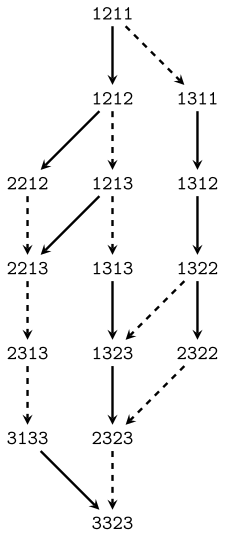
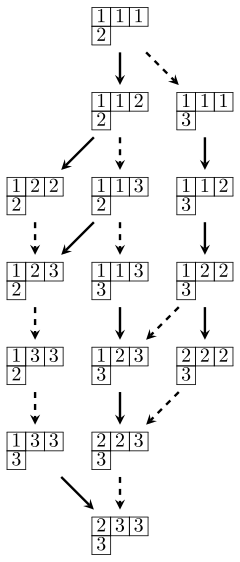
In the following figures, the solid lines are the \(\crysf_1\) edges, and the dashed lines are \(\crysf_2.\) The two graphs are isomorphic, and they must be, since the highest weight is \(\lambda =31\) in both cases.
#Kashiwara crystals
The following definition is taken from [GL19].
A finite \(\GL_n\) Kashiwara crystal is a set \(B\) together with raising and lowering operators \(\cryse_i,\) \(\crysf_i\) on \(B,\) length functions \(\epsilon_i,\) \(\phi_i\) from \(B\) to \(\setZ,\) and a weight function \(w,\) satisfying the following axioms, where \(1 \leq i \leq n-1.\)
The operators \(\cryse_i,\) \(\crysf_i\) are partial inverses, and if \(Y = \cryse_i(X),\) then \[\left(\epsilon_i(Y), \phi_i(Y) \right) = \left( \epsilon_i(X)-1, \phi_i(X)+1 \right) \quad \text{and} \quad w(Y) = w(X)+ \alpha_i,\] where \(\alpha_i = \evec_i - \evec_{i+1},\) the vector with coordinate \(i\) set to \(1,\) and coordinate \(i+1\) set to \(-1.\)
For any \(i \in [n-1]\) and any \(X \in B,\) \(\phi_i(X) = \langle w(X), \alpha_i \rangle + \epsilon_i(X).\)
The inner product used here is from the root system.
Moreover, a Kashiwara crystal is a type \(A\) Stembridge crystal if
If \(|i-j| \gt 1\) and \(\cryse_i(X),\) \(\cryse_j(X)\) are defined, then their compositions are defined and equal, i.e., \(\cryse_i \cryse_j(X) = \cryse_j \cryse_i(X).\) The same statement is true for \(\crysf_i,\) \(\crysf_j.\)
If \(\crysf_{i \pm 1}(Y) = X,\) then \[\left(\epsilon_i(Y) - \epsilon_i(X), \phi_i(Y) - \phi_i(X) \right) \in \{ (0,-1), (1,0) \}.\]
Suppose \(|i-j|=1\) and \(\crysf_i(Z)=X,\) \(\crysf_j(Z)=Y\) are both defined. Set \[\Delta \coloneqq \left(\epsilon_i(Z) - \epsilon_i(X), \epsilon_i(Z) - \epsilon_i(Y) \right).\] (By the previous axioms, \(\Delta \in \{ (1,1), (1,0), (0,1), (0,0) \}.\)) If \(\Delta \neq (0,0),\) then \(\crysf_i \crysf_j(Z) = \crysf_j \crysf_i(Z) \neq \emptyset.\) Otherwise, \(\crysf_i {\crysf}^{\;2}_j \crysf_i(Z) = \crysf_j {\crysf}^{\;2}_i \crysf_j(Z) \neq \emptyset.\)
We have the dual axiom, where the \(\crysf_i\) above are replaced with \(\cryse_i,\) and the \(\epsilon_i\) are replaced with \(\phi_i.\)
These are reworded versions of J. Stembridge’s local axioms given in [Ste03].
S. Nguyen and P. Pylyavskyy introduce Temperley–Lieb crystals, built from shuffle tableaux and Temperley–Lieb immanants evaluated on Jacobi–Trudi matrices [NP24]. They use Stembridge’s axioms to show that the resulting graphs are type \(A\) Kashiwara crystals, giving a generalized Littlewood–Richardson rule and a Schur-positivity result for these immanants.
#Demazure crystals
Demazure crystals (in type \(A\)) are truncated versions of the classical type \(A\) crystals. Connected components are now Demazure polynomials.
Some papers using these crystal structures are [Wan20], [AS18] and [AG20].
N. Jacon and C. Lecouvey extend the key-map viewpoint to Demazure crystals for Kac–Moody algebras [JL20]. In a related direction, J. Gibson shows that truncations of product monomial crystals are Demazure crystals and gives a Demazure-type character formula for these truncations [Gib21].
S. Assaf, A. Dranowski, and N. González [ADG23] study tensor products of Demazure crystals. They give a local criterion for when a tensor product of Demazure crystals decomposes as a direct sum of Demazure crystals, phrased through extremal subsets and broken hinges. In particular, the primary component in the tensor square of any Demazure crystal is again Demazure. This is a crystal-level structural result, and should not be read as a proof that arbitrary products of key polynomials are key-positive. S. Assaf and N. González give a local characterization of subsets of highest-weight crystals that are unions of Demazure crystals [AG25]. Their characterization works for symmetrizable Kac–Moody type, gives disjoint decompositions into Demazure atoms, and yields a new criterion for a subset to be a single Demazure crystal.
S. Kundu constructs a Demazure crystal on flagged set-valued reverse plane partitions of arbitrary skew shape [Kun26, Thm. 4]. Its character gives the key expansion of the flagged hybrid Grothendieck polynomial and specializes to the earlier crystals on flagged set-valued tableaux and reverse plane partitions. See the Grothendieck-polynomial discussion.
#Quasi-crystals
Quasi-crystals are used to find the fundamental quasisymmetric expansion, see [CMRR23, CMRR23].
Florence Maas-Gariepy studies quasicrystals inside tableau crystals through the expansion of Schur functions in fundamental quasisymmetric functions [Maa23]. The connected crystal \(B(\lambda)\) decomposes into induced subgraphs corresponding to the fundamental summands, and replacing each subgraph by its associated standard tableau gives a skeleton of the crystal related to dual equivalence graphs.
A notion similar to crystals is dual equivalence graphs.
#Crystals for type B
In [GHPS20, AO18, AO20], the authors define crystal operators on skew shifted SSYT. This gives a crystal structure where connected components are Schur P functions.
In [GL19], a Stembridge-type set of local axioms is used to define a type \(B\) crystal structure. The raising and lowering operators act on shifted tableaux. These operators commute with jeu-de-taquin slides, as in type \(A,\) making them coplactic. This gives a crystal structure where connected components are Schur Q functions.
In the follow-up paper, M. Gillespie, J. Levinson, and K. Purbhoo [GLP20] further study this crystal structure on skew shifted tableaux, and show how one can act on the reading-word of the tableaux. Furthermore, they identify the highest weight elements in the crystals, which turn out to be shifted Littlewood–Richardson tableaux. With this machinery, they obtain a new proof of the Littlewood–Richardson rule for the Schur Q functions.
I. Rodrigues describes an action of the cactus group on shifted tableau crystals [Rod23].
E. Marberg and K. H. Tong give two related shifted-tableau crystal constructions. First, primed decomposition tableaux give a simpler model for extended queer crystals whose normal connected objects have Schur \(Q\)-characters [MT25]. Second, they construct crystal structures on set-valued decomposition tableaux, giving \(K\)-theoretic shifted crystals and partial progress toward formulas for \(K\)-theoretic Schur \(P\)-functions [MT25].
This builds on their construction of a modified highest-weight crystal category whose normal connected objects have characters equal to Schur \(Q\)-functions [MT23]. The category has an additional crystal operator and a tensor product adapted to Schur \(Q\)-characters.
E. Marberg and T. Scrimshaw give crystal interpretations of shifted \(P\)- and \(Q\)-key polynomials [MS25]. These polynomials occur as characters of connected subcrystals of normal crystals for the queer Lie superalgebra \(\mathfrak{q}_n.\) Their construction also suggests crystal-theoretic lifts of conjectures on decomposing involution Schubert polynomials into shifted key bases.
#See also
More background and examples appear in the Sage manual for crystals [Dev].
There are some results on the interaction with crystals and dual RSK here, [Aze06]. See also [AM07].
Bibliography
- [AW20]Glenn D. Appleby and Tamsen Whitehead. Perforated tableaux: A combinatorial model for crystal graphs in type $A_{n-1}$. arXiv:2007.11721, 2020.
.bib
@article{ApplebyWhitehead2020, author = {Glenn D. Appleby and Tamsen Whitehead}, title = {Perforated tableaux: A combinatorial model for crystal graphs in type {$A_{n-1}$}}, year = {2020}, eprint = {2007.11721}, archivePrefix = {arXiv}, primaryClass = {math.CO}, doi = {10.1007/s10468-022-10135-4} } - [ADG23]Sami Assaf, Anne Dranowski and Nicolle González. Extremal Tensor Products of Demazure Crystals. Algebras and Representation Theory, 27(1):627–638, 2023.
.bib
@article{AssafDranowskiGonzalez2023, author = {Sami Assaf and Anne Dranowski and Nicolle Gonz{\'a}lez}, title = {Extremal {T}ensor {P}roducts of {D}emazure {C}rystals}, year = {2023}, journal = {Algebras and Representation Theory}, volume = {27}, number = {1}, pages = {627--638}, doi = {10.1007/s10468-023-10231-z}, url = {http://dx.doi.org/10.1007/s10468-023-10231-z}, eprint = {2210.10236} } - [AG20]Sami Assaf and Nicolle Gonzalez. Affine Demazure crystals for specialized nonsymmetric Macdonald polynomials. arXiv:2002.04141, 2020.
.bib
@article{AssafGonzalez2020x, Author = {Sami Assaf and Nicolle Gonzalez}, Title = {Affine {D}emazure crystals for specialized nonsymmetric {M}acdonald polynomials}, Year = {2020}, Eprint = {2002.04141}, url = {https://arxiv.org/abs/2002.04141}, journal = {arXiv e-prints} } - [AG25]Sami Assaf and Nicolle González. A Local Characterization of Unions of Demazure Crystals. arXiv:2512.19814, 2025.
.bib
@article{AssafGonzalez2025x, author = {Sami Assaf and Nicolle Gonz{\'a}lez}, title = {A {L}ocal {C}haracterization of {U}nions of {D}emazure {C}rystals}, year = {2025}, eprint = {2512.19814}, url = {https://arxiv.org/abs/2512.19814}, journal = {arXiv e-prints} } - [AO18]Sami Assaf and Ezgi Kantarcı Oğuz. Crystal graphs for shifted tableaux. 30th International conference on formal power series and algebraic combinatorics, 80B, 2018. 12 pages
.bib
@inproceedings{AssafOguz2018, author = {Sami Assaf and Ezgi Kantarcı Oğuz}, title = {Crystal graphs for shifted tableaux}, url = {https://www.mat.univie.ac.at/~slc/wpapers/FPSAC2018/26-Assaf-KantarciOguz.pdf}, year = {2018}, booktitle = {30th {I}nternational Conference on Formal Power Series and Algebraic Combinatorics}, venue = {Hanover}, publisher = {S{\'{e}}minaire Lotharingien de Combinatoire}, volume = {80B}, number = {26}, note = {12 pages} } - [AO20]Sami Assaf and Ezgi Kantarcı Oğuz. Toward a local characterization of crystals for the quantum queer superalgebra. Annals of Combinatorics, 24(1):3–46, January 2020.
.bib
@article{AssafOguz2020, doi = {10.1007/s00026-019-00477-0}, url2 = {https://doi.org/10.1007/s00026-019-00477-0}, year = {2020}, month = jan, publisher = {Springer Science and Business Media {LLC}}, volume = {24}, number = {1}, pages = {3--46}, author = {Sami Assaf and Ezgi Kantarcı Oğuz}, title = {Toward a Local Characterization of Crystals for the Quantum Queer Superalgebra}, journal = {Annals of Combinatorics} } - [AS18]Sami Assaf and Anne Schilling. A Demazure crystal construction for Schubert polynomials. Algebraic Combinatorics, 1(2):225–247, 2018.
.bib
@article{AssafSchilling2018, author = {Assaf, Sami and Schilling, Anne}, title = {A {D}emazure crystal construction for {S}chubert polynomials}, journal = {Algebraic Combinatorics}, publisher = {MathOA foundation}, volume = {1}, number = {2}, year = {2018}, pages = {225-247}, doi = {10.5802/alco.13}, language = {en}, url2 = {http://alco.centre-mersenne.org/item/ALCO_2018__1_2_225_0} } - [Aze06]Olga Azenhas. Schur functions, pairing of parentheses, jeu de taquin and invariant factors. Mathematical papers in honour of Eduardo Marques de sá:7–24, 2006.
.bib
@incollection{Azenhas2006, year={2006}, isbn={972-8564-43-0}, booktitle={Mathematical papers in honour of {E}duardo {M}arques de S{\'{a}}}, editor={Olga Azenhas, Ant{\'{o}}nio Leal Duarte, João Filipe Queir{\'{o}} and Ana Paula Santana }, url = {http://www.mat.uc.pt/~oazenhas/Olga4.pdf}, publisher={Departamento de Matem{\'{a}}tica da Universidade de Coimbra}, title={Schur functions, pairing of parentheses, jeu de taquin and invariant factors}, author={Olga Azenhas}, pages={7--24}, language={English} } - [AM07]Olga Azenhas and Ricardo Mamede. Key polynomials, Smith invariants and an action of the symmetric group on skew-tableaux. 2007. Manuscript
.bib
@misc{AzenhasMamede2007Smith, author = {Olga Azenhas and Ricardo Mamede}, title = {Key polynomials, {Smith} invariants and an action of the symmetric group on skew-tableaux}, year = {2007}, url = {http://www.mat.uc.pt/~oazenhas/azenhasmamede.pdf}, note = {Manuscript} } - [Bla20]Jonah Blasiak. Crystal graphs, katabolism, and Schur positivity. 2020. Video lecture
.bib
@misc{Blasiak2020CrystalGraphsVideo, author = {Jonah Blasiak}, title = {Crystal graphs, katabolism, and {Schur} positivity}, year = {2020}, url = {https://www.youtube.com/watch?v=qr7BcV3swMk}, note = {Video lecture} } - [BS17]Daniel Bump and Anne Schilling. Crystal bases: Representations and combinatorics. World Scientific, 2017.
.bib
@book{BumpSchilling2017, doi = {10.1142/9876}, url2 = {https://doi.org/10.1142/9876}, year = {2017}, isbn = {978-9814733441}, month = oct, publisher = {{W}orld {S}cientific}, author = {Daniel Bump and Anne Schilling}, title = {Crystal Bases: representations and combinatorics} } - [CMRR23]Alan J. Cain, António Malheiro, Fátima Rodrigues and Inês Rodrigues. A local characterization of quasi-crystal graphs. arXiv:2309.14898, 2023.
.bib
@article{CainMalheiroRodriguesRodrigues2023Local, author = {Alan J. Cain and Ant{\'o}nio Malheiro and F{\'a}tima Rodrigues and In{\^e}s Rodrigues}, title = {A local characterization of quasi-crystal graphs}, year = {2023}, eprint = {2309.14898}, url = {https://arxiv.org/abs/2309.14898}, journal = {arXiv e-prints} } - [CMRR23]Alan J. Cain, António Malheiro, Fátima Rodrigues and Inês Rodrigues. Structure of quasi-crystal graphs and applications to the combinatorics of quasi-symmetric functions. arXiv:2309.14887, 2023.
.bib
@article{CainMalheiroRodriguesRodrigues2023Structure, author = {Alan J. Cain and Ant{\'o}nio Malheiro and F{\'a}tima Rodrigues and In{\^e}s Rodrigues}, title = {Structure of quasi-crystal graphs and applications to the combinatorics of quasi-symmetric functions}, year = {2023}, eprint = {2309.14887}, url = {https://arxiv.org/abs/2309.14887}, journal = {arXiv e-prints} } - [Gib21]Joel Gibson. A Demazure Character Formula for the Product Monomial Crystal. Algebraic Combinatorics, 4(2):301–327, 2021.
.bib
@article{Gibson2021, author = {Joel Gibson}, title = {A {D}emazure {C}haracter {F}ormula for the {P}roduct {M}onomial {C}rystal}, year = {2021}, journal = {Algebraic Combinatorics}, volume = {4}, number = {2}, pages = {301--327}, doi = {10.5802/alco.156}, eprint = {1907.09681} } - [GHPS20]Maria Gillespie, Graham Hawkes, Wencin Poh and Anne Schilling. Characterization of queer supercrystals. Journal of Combinatorial Theory, Series A, 173:105235, July 2020.
.bib
@article{GillespieHawkesPohSchilling2020, doi = {10.1016/j.jcta.2020.105235}, url2 = {https://doi.org/10.1016/j.jcta.2020.105235}, year = {2020}, month = jul, publisher = {Elsevier {BV}}, volume = {173}, pages = {105235}, author = {Maria Gillespie and Graham Hawkes and Wencin Poh and Anne Schilling}, title = {Characterization of queer supercrystals}, journal = {Journal of Combinatorial Theory, Series A} } - [GL19]Maria Gillespie and Jake Levinson. Axioms for shifted tableau crystals. The Electronic Journal of Combinatorics, 26(2), April 2019.
.bib
@article{GillespieLevinson2019, doi = {10.37236/8033}, url2 = {https://doi.org/10.37236/8033}, year = {2019}, month = apr, publisher = {The Electronic Journal of Combinatorics}, volume = {26}, number = {2}, author = {Maria Gillespie and Jake Levinson}, title = {Axioms for Shifted Tableau Crystals}, journal = {The Electronic Journal of Combinatorics} } - [GLP20]Maria Gillespie, Jake Levinson and Kevin Purbhoo. A crystal-like structure on shifted tableaux. Algebraic Combinatorics, 3(3):693–725, 2020.
.bib
@article{GillespieLevinsonPurbhoo2020, author = {Gillespie, Maria and Levinson, Jake and Purbhoo, Kevin}, title = {A crystal-like structure on shifted tableaux}, journal = {Algebraic Combinatorics}, publisher = {MathOA foundation}, volume = {3}, number = {3}, year = {2020}, pages = {693-725}, doi = {10.5802/alco.110}, language = {en}, url = {alco.centre-mersenne.org/item/ALCO_2020__3_3_693_0/} } - [JL20]Nicolas Jacon and Cédric Lecouvey. Keys and Demazure crystals for Kac–Moody algebras. Journal of Combinatorial Algebra, 4(4):325–358, 2020.
.bib
@article{JaconLecouvey2020, author = {Nicolas Jacon and C{\'e}dric Lecouvey}, title = {Keys and {D}emazure crystals for {K}ac--{M}oody algebras}, year = {2020}, journal = {Journal of Combinatorial Algebra}, volume = {4}, number = {4}, pages = {325--358}, doi = {10.4171/jca/46}, eprint = {1909.09520} } - [Kun26]Siddheswar Kundu. Demazure crystals for flagged set-valued reverse plane partitions. arXiv:2609.18151v1, 2026.
.bib
@article{Kundu2026x, author = {Siddheswar Kundu}, title = {Demazure crystals for flagged set-valued reverse plane partitions}, year = {2026}, eprint = {2609.18151v1}, url = {https://arxiv.org/abs/2609.18151v1}, journal = {arXiv e-prints} } - [Maa23]Florence Maas-Gariépy. Quasicrystal structure of fundamental quasisymmetric functions, and skeleton of crystals. arXiv:2302.07694, 2023.
.bib
@article{MaasGariepy2023x, Author = {Florence Maas-Gariépy}, Title = {Quasicrystal Structure of Fundamental Quasisymmetric Functions, and Skeleton of Crystals}, Year = {2023}, Eprint = {2302.07694}, url = {https://arxiv.org/abs/2302.07694}, journal = {arXiv e-prints} } - [MS25]Eric Marberg and Travis Scrimshaw. Crystals for shifted key polynomials. Algebras and Representation Theory, 28(4):921–979, 2025.
.bib
@article{MarbergScrimshaw2025, author = {Eric Marberg and Travis Scrimshaw}, title = {Crystals for shifted key polynomials}, year = {2025}, journal = {Algebras and Representation Theory}, volume = {28}, number = {4}, pages = {921--979}, doi = {10.1007/s10468-025-10345-6}, url = {https://doi.org/10.1007/s10468-025-10345-6}, eprint = {2306.00336} } - [MT23]Eric Marberg and Kam Hung Tong. Highest weight crystals for Schur $Q$-functions. Combinatorial Theory, 3(2), 2023.
.bib
@article{MarbergTong2023SchurQ, author = {Eric Marberg and Kam Hung Tong}, title = {Highest weight crystals for {S}chur {$Q$}-functions}, year = {2023}, journal = {Combinatorial Theory}, volume = {3}, number = {2}, doi = {10.5070/c63261984}, url = {https://doi.org/10.5070/c63261984}, eprint = {2112.02848} } - [MT25]Eric Marberg and Kam Hung Tong. Primed Decomposition Tableaux and Extended Queer Crystals. Algebras and Representation Theory, 28(2):445–482, 2025.
.bib
@article{MarbergTong2025Primed, author = {Marberg, Eric and Tong, Kam Hung}, title = {Primed {D}ecomposition {T}ableaux and {E}xtended {Q}ueer {C}rystals}, year = {2025}, journal = {Algebras and Representation Theory}, volume = {28}, number = {2}, pages = {445--482}, publisher = {Springer Science and Business Media LLC}, doi = {10.1007/s10468-025-10323-y}, url = {http://dx.doi.org/10.1007/s10468-025-10323-y}, issn = {1572-9079}, eprint = {2312.15409} } - [MT25]Eric Marberg and Kam Hung Tong. Crystals for set-valued decomposition tableaux. Algebraic Combinatorics, 8(4):857–896, 2025.
.bib
@article{MarbergTong2025SetValued, author = {Marberg, Eric and Tong, Kam Hung}, title = {Crystals for set-valued decomposition tableaux}, year = {2025}, journal = {Algebraic Combinatorics}, volume = {8}, number = {4}, pages = {857--896}, publisher = {MathDoc/Centre Mersenne}, doi = {10.5802/alco.437}, url = {http://dx.doi.org/10.5802/alco.437}, issn = {2589-5486}, eprint = {2312.16776} } - [NP24]Son Nguyen and Pavlo Pylyavskyy. Temperley-Lieb Crystals. arXiv:2402.18716, 2024.
.bib
@article{NguyenPylyavskyy2024x, author = {Son Nguyen and Pavlo Pylyavskyy}, title = {Temperley-{L}ieb {C}rystals}, year = {2024}, eprint = {2402.18716}, url = {https://arxiv.org/abs/2402.18716}, journal = {arXiv e-prints} } - [Rod23]Inês Rodrigues. An action of the cactus group on shifted tableau crystals. The Electronic Journal of Combinatorics, 30(4), 2023.
.bib
@article{Rodrigues2023, author = {In{\^e}s Rodrigues}, title = {An action of the cactus group on shifted tableau crystals}, year = {2023}, journal = {The Electronic Journal of Combinatorics}, volume = {30}, number = {4}, doi = {10.37236/9720}, eprint = {2004.00285} } - [Dev]The Sage Developers. Classical crystals. . SageMath thematic tutorial
.bib
@misc{SageClassicalCrystals, author = {{The Sage Developers}}, title = {Classical Crystals}, url = {https://doc.sagemath.org/html/en/thematic_tutorials/lie/crystals.html}, note = {SageMath thematic tutorial} } - [Shi26]Tatsushi Shimazaki. Crystals and sign-reversing involutions for set-valued skew tableaux and decorated states of the five-vertex model. arXiv:2609.11233v1, 2026.
.bib
@article{Shimazaki2026Crystals, author = {Tatsushi Shimazaki}, title = {Crystals and sign-reversing involutions for set-valued skew tableaux and decorated states of the five-vertex model}, year = {2026}, eprint = {2609.11233v1}, url = {https://arxiv.org/abs/2609.11233v1}, journal = {arXiv e-prints} } - [Shi05]Mark Shimozono. Crystals for dummies. Online, 2005.
.bib
@misc{Shimozono2005, author = {Mark Shimozono}, title = {Crystals for dummies}, howpublished = {Online}, year = {2005}, url = {https://www.aimath.org/WWN/kostka/crysdumb.pdf} } - [Smi26]Evgeny Smirnov. Set-valued tableaux and cells of Gelfand–Zetlin polytopes. arXiv:2609.08760v2, 2026.
.bib
@article{Smirnov2026x, author = {Evgeny Smirnov}, title = {Set-valued tableaux and cells of {G}elfand--{Z}etlin polytopes}, year = {2026}, eprint = {2609.08760v2}, url = {https://arxiv.org/abs/2609.08760v2}, journal = {arXiv e-prints} } - [Mat]Stanford Mathematics. Crystals. . Online introduction
.bib
@misc{StanfordCrystalsIntro, author = {{Stanford Mathematics}}, title = {Crystals}, url = {http://sporadic.stanford.edu/crystals/index.html}, note = {Online introduction} } - [Ste03]John R. Stembridge. A local characterization of simply-laced crystals. Transactions of the American Mathematical Society, 355(12):4807–4823, 2003.
.bib
@article{Stembridge2003, ISSN = {00029947}, URL2 = {http://www.jstor.org/stable/1194769}, doi = {10.1090/S0002-9947-03-03042-3}, author = {John R. Stembridge}, journal = {Transactions of the American Mathematical Society}, number = {12}, pages = {4807--4823}, publisher = {American Mathematical Society}, title = {A Local Characterization of Simply-Laced Crystals}, volume = {355}, year = {2003} } - [Wan20]George Wang. Locks fit into keys: A crystal analysis of lock polynomials. arXiv:2001.07260, 2020.
.bib
@article{Wang2020x,
Author = {George Wang},
Title = {Locks fit into keys: a crystal analysis of lock polynomials},
Year = {2020},
Eprint = {2001.07260},
  url = {https://arxiv.org/abs/2001.07260},
journal = {arXiv e-prints}
}