#Coxeter groups and types
A Coxeter system is a pair \((W,S)\) where \(W\) is generated by a set \(S\) of simple reflections and has a presentation \[W=\langle s\in S : (st)^{m_{st}}=e\rangle,\] with \(m_{ss}=1,\) \(m_{st}=m_{ts}\in\{2,3,\dotsc\}\cup\{\infty\},\) and no relation imposed when \(m_{st}=\infty.\) The basic combinatorics of \(W\) is controlled by reduced words, Bruhat order, weak order, descents, and parabolic subgroups. A standard reference is [Bjo05].
Finite Weyl groups are Coxeter groups coming from root systems. Every Weyl group is a finite Coxeter group, but not every finite Coxeter group is crystallographic.
A root system \(\Phi\) is crystallographic if its Cartan integers
\[\langle\beta,\alpha^\vee\rangle
=
\frac{2(\beta,\alpha)}{(\alpha,\alpha)}\]
are integers for all \(\alpha,\beta\in\Phi.\) Equivalently, the reflections
preserve the lattice spanned over \(\setZ\) by a choice of simple roots, and
every root has integral coordinates in that lattice. A
crystallographic Coxeter group is
one which is realized as the Weyl group of such a crystallographic root
system. Thus arising from a root system
is essentially the right
idea, provided that the root system satisfies this integrality condition.
Finite Coxeter groups of types \(H_3,\) \(H_4,\) and \(I_2(m)\) for
\(m\notin\{3,4,6\}\) are the standard noncrystallographic examples.
Example
The symmetric group \(\symS_n\) is the Coxeter group of type \(A_{n-1}.\) The simple reflections are the adjacent transpositions \[s_i=(i,i+1),\qquad 1\leq i\leq n-1.\] They satisfy \(s_i^2=e,\) the braid relation \[s_is_{i+1}s_i=s_{i+1}s_is_{i+1},\] and the commutation relation \(s_is_j=s_js_i\) whenever \(|i-j|\geq 2.\)
#Translation between classical types
The word "type" is used to keep several parallel objects aligned: root systems, Weyl groups, Lie groups, Hecke algebras, Schubert calculus, and families of combinatorial objects. The following table records the most common translations.
Type Weyl group Combinatorial model Typical pages $A_{n-1}$ $\symS_n$ permutations permutations, Schubert $B_n$ $\symB_n$ signed permutations type B permutations $C_n$ $\symB_n$ signed permutations symplectic Schur $D_n$ $\symD_n$ even signed permutations root systems $\widetilde A_{n-1}$ affine symmetric group affine permutations affine permutationsExample (Coxeter diagrams).
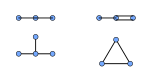
Small Coxeter diagrams for type \(A,\) type \(B/C,\) type \(D,\) and affine type \(A.\) An unlabeled edge denotes braid parameter \(m=3,\) while the doubled edge in type \(B/C\) records \(m=4.\)
Types \(B_n\) and \(C_n\) have different crystallographic root systems but the same Weyl group, the hyperoctahedral group. This is why type \(B\) and type \(C\) combinatorics often share signed-permutation models while differing in root-length conventions, representation theory, or geometry.
The diagram is often the fastest translation layer between a presentation by generators and relations and the corresponding root-system or Weyl-group model.
#Coxeter combinatorics
Several constructions on this site have type \(A\) versions and then analogues in other types:
Bruhat order and weak order organize Schubert calculus and reduced-word combinatorics.
Hecke algebras deform group algebras of Coxeter groups, while 0-Hecke algebras replace the quadratic relation by an idempotent relation.
Kazhdan–Lusztig polynomials are indexed by intervals in Bruhat order.
Coxeter–Catalan objects generalize ordinary Catalan objects from type \(A\) to all finite types.
Root systems provide the geometric language of roots, coroots, chambers, and Weyl groups.
One practical way to read the type dictionary is to ask what replaces an ordinary permutation statistic:
Type Permutation data Typical statistic $A$ ordinary permutations descents, inversions, excedances $B/C$ signed permutations type B descents and sign changes $D$ even signed permutations type D descents $\widetilde A$ affine permutations cyclic descents and windowsThis is often the fastest route from a type \(A\) theorem to a type \(B,\) type \(D,\) or affine question: replace the indexing set, replace the descent notion, and then check which proof ingredients still survive.
#Type \(A\)
Type \(A_{n-1}\) is the symmetric group \(\symS_n.\) It is the ambient type for ordinary Schur functions, Schubert polynomials, RSK, Young tableaux, ordinary parking functions, and most of the basic examples on this site.
In type \(A,\) the root system can be realized as \[\{e_i-e_j : 1\leq i\ne j\leq n\},\] and the simple roots are \(e_i-e_{i+1}.\) The simple reflection \(s_i\) swaps \(i\) and \(i+1.\)
#Types \(B\) and \(C\)
The Weyl group in types \(B_n\) and \(C_n\) is the group of signed permutations. Combinatorially, this means permutations of \[\{\pm 1,\pm 2,\dotsc,\pm n\}\] with \(w(-i)=-w(i).\) It has order \(2^n n!.\) Type \(B\) Eulerian polynomials, type \(B\) noncrossing partitions, and type \(B\) parking-like objects are typical examples of type \(A\) constructions with signed analogues.
#Type \(D\)
Type \(D_n\) is the subgroup of the signed permutation group consisting of signed permutations with an even number of sign changes. It has order \(2^{n-1}n!.\) Type \(D\) often behaves like type \(B\) with an even-sign condition, but this small-looking change can affect descents, Catalan objects, and root-system conventions.
#Affine types
Affine Coxeter groups are infinite Coxeter groups obtained by adding an affine simple reflection. In type \(\widetilde A,\) the resulting group can be modeled by affine permutations. Affine type \(A\) is the natural setting for affine Stanley symmetric functions, \(k\)-Schur functions, affine Grassmannian combinatorics, and related Hecke-algebra constructions.
The affine symmetric group also illustrates why the type translation page is useful. A single affine object can be described as an affine Weyl-group element, a bounded window, an alcove walk, a core partition, or a Schubert class in the affine Grassmannian. These descriptions emphasize different parts of the same combinatorics.
Bibliography
- [Bjo05]Anders Björner. Combinatorics of Coxeter groups. Springer, 2005.
.bib
@Book{Bjorner2005,
 author = {Björner, Anders},
 title = {Combinatorics of {C}oxeter groups},
 publisher = {Springer},
 year = {2005},
 address = {New York, NY},
 isbn = {978-3-540-27596-1}
}