See the cyclic sieving phenomenon page for the definition and related theorems.
The \(q\)-Catalan numbers used here are defined as \[\catalan(n,q) \coloneqq \frac{1}{[n+1]_q}\qbinom{2n}{n}_q.\]
#Catalan objects
There are numerous combinatorial models for the Catalan numbers; see, for example, the extensive survey by R. Stanley [Sta15].
#Triangulations of \((n+2)\)-gons
Let \(\mathrm{TRI}(n)\) be the set of triangulations on an \(n\)-gon. Note that \(|\mathrm{TRI}(n)| = \catalan(n-2).\) We let \(\rot_{n}\) denote rotation by \(2\pi/n.\) Then \[\left( \mathrm{TRI}(n), \langle \rot_{n} \rangle, \catalan(n-2,q) \right)\] exhibits the CSP, see [RSW04].
In [ALPU21, Thm. 8.2], this result is refined. We let \(\mathrm{TRI}_{\mathrm{ear}}(n,k)\) denote the set of triangulations of an \(n\)-gon with \(k\) ears. An ear is a triangle with at most one side in the interior.
Theorem
Let \(2 \leq k \leq \frac{n}{2}\) and let \[\mathrm{Tri}_q(n,k) \coloneqq q^{k(k-2)} \frac{[n]_q}{[k]_q} \qbinom{n-4}{2k-4}\catalan_q(k-2) \left( \sum_{j=0}^{n-2k} q^{j(n-2)}\qbinom{n-2k}{j}\right).\] Then \(\sum_k \mathrm{Tri}_q(n,k) = \catalan_q(n-2),\) and \(\left( \mathrm{TRI}_{\mathrm{ear}}(n,k), \langle \rot_n \rangle, \mathrm{Tri}_q(n,k) \right)\) exhibits the cyclic sieving phenomenon.
#Non-crossing matchings
Let \(X_n\) be the set of non-crossing matchings on \(2n\) vertices. It is well-known that \(|X_n| = \catalan(n).\) We let the generator of \(\grpc_n\) act on \(X_n\) by a \(2\pi/n\) rotation. Then \[\left( X_{n}, \grpc_n, \frac{1}{[n+1]_q}\qbinom{2n}{n}_q \right)\] exhibits the CSP. This is a special case of promotion, \(\partial,\) on rectangular SYT, in the case of tableaux of shape \((n,n).\) In fact, one can refine the above CSP, and let \(\grpc_{2n}\) act on \(X_n\) by a \(\pi/n\) rotation. Then \[\left( X_{n}, \grpc_{2n}, \frac{1}{[n+1]_q}\qbinom{2n}{n}_q \right)\] exhibits the CSP, see [PPR08]. A combinatorial fixed-point count is given by M. Earnest [Ear18].
#Generalized cluster complexes
S.-P. Eu and T.-S. Fu prove cyclic sieving phenomena for faces of generalized cluster complexes [EF08]. They treat faces in types \(A_n,\) \(B_n,\) \(D_n,\) and \(I_2(a),\) and verify the phenomenon for maximal faces in the exceptional types. L. Pouillart refines this setting to parabolic classes of faces [Pou26]. The proof uses a uniform \(q\)-analogue of the face-enumeration formula of T. Douvropoulos and Matthieu Josuat-Verges, followed by a type-by-type verification for finite irreducible Coxeter groups.
Example (Non-crossing matchings).
For \(n=3,\) there are five non-crossing matchings:
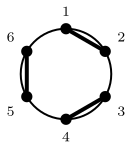
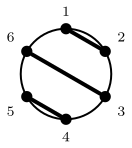
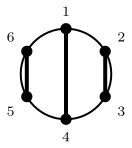
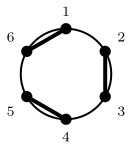
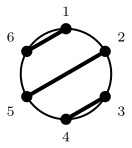
These are in bijection with North-East lattice paths from \((0,0)\) to \((n,n)\) which are never below the main diagonal. The bijection is given by parenthesis matching, where a North-step is a left parenthesis, and an East step is a right parenthesis.
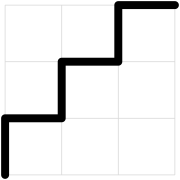
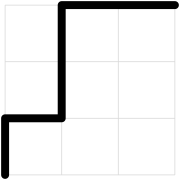
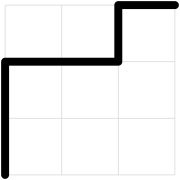
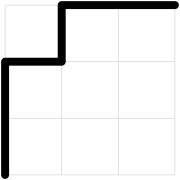

The lattice paths are now in bijection with \(2\times n\) standard Young tableaux. The bijection is given by making the number \(k\) appear in the first row of the SYT if step \(k\) in the path is a North-step.
In [ALPU21, Thm. 4.8], the CSP on non-crossing matchings is refined. Let \(\NCM_{sh}(n, k)\) be the set of non-crossing matchings with exactly \(k\) short edges, and \(\SYT_{cdes}(n^2,k)\) be the set of \(2 \times n\) standard Young tableaux with exactly \(k\) cyclic descents.
Theorem
Let \(k, n \geq 2\) be natural numbers and let \[\SYT_q(n,k) \coloneqq \frac{q^{k(k-2)}(1+q^n)}{[n+1]_q} \qbinom{n+1}{k} \qbinom{n-2}{k-2}.\] Then \[\sum_{k} \SYT_q(n,k) = \catalan_{n}(q),\] and the triples \[(\SYT_{cdes}(n^2,k),\langle \partial_{2n} \rangle,\SYT_q(n,k) )\] and \[(\NCM_{sh}(n, k),\langle \mathrm{rot}_{2n} \rangle, \SYT_q(n,k) )\] exhibit the cyclic sieving phenomenon.
#Non-crossing (1,2)-configurations
Let \(\mathrm{NCC}_n\) be the set of non-crossing \((1,2)\)-configurations of \([n-1].\) That is, elements are partitioned into sets of size \(1\) or \(2\) and sets of size \(2\) are non-crossing. The cardinality is \(|\mathrm{NCC}_n| = \catalan(n),\) [Sta15, Family 60]. The generator of \(\grpc_{n}\) acts on \(\mathrm{NCC}_{n+1}\) by a \(2\pi/n\) rotation. Then \[\left( \mathrm{NCC}_{n+1}, \grpc_{n}, \catalan_{n+1}(q) \right)\] exhibits the CSP, see [Thi17].
A representation-theoretical proof of this cyclic sieving phenomenon can be found in [ZZ24]. The authors also give a dihedral group action with CSP.
#Non-crossing (1,2)-configurations, with twist
There is an alternative group action, combining rotation with a type of twist; see [ALPU21, Thm. 5.4]. With a different \(q\)-analogue of the Catalan numbers, one gets CSP for non-crossing \((1,2)\)-configurations.
Theorem
The triple \[\left( \mathrm{NCC}(n+1), \langle \mathrm{twist}_{2n} \rangle, \qbinom{2n}{n} - q^2 \qbinom{2n}{n-2} \right)\] exhibits the cyclic sieving phenomenon.
There is a type \(B\) version of non-crossing \((1,2)\)-configurations. In [ALPU21, Thm. 6.6], one has \(\left(\mathrm{NCC}^B(n+1), \langle \mathrm{twist}^2_{2n} \rangle, \qbinom{2n}{n}\right)\) is a CSP-triple.
#Non-crossing partitions (Narayana)
A non-crossing partition is a set partition of the vertices in an \(n\)-gon, such that the convex hulls of the parts do not intersect. Let \(X_{n,k}\) be the set of non-crossing partitions with \(k\) blocks, and let \(\grpc_n\) act by rotation of the \(n\)-gon. Then \[\left( X_{n,k}, \grpc_n, q^{k(k+1)} \frac{1}{[n]_q} \qbinom{n}{k}_q \qbinom{n}{k+1}_q \right)\] exhibits the CSP, see [RSW04].
#Non-crossing partitions II
D. Bessis and V. Reiner [BR11] study well-generated complex reflection groups. For such groups \(W,\) one can define a generalization of the \(q\)-Catalan numbers, \(\catalan(W,q),\) as well as the notion of non-crossing partitions. The set of non-crossing partitions \(NC(W)\) is identified with a certain set of reflections in \(W.\) There is then a special element, \(c\in W\) acting on \(NC(W)\) via conjugation.
It is then proved that \[\left( NC(W), \langle c \rangle , \catalan(W,q) \right)\] is a CSP-triple.
The authors provide a connection with Springer’s theory, and end the article with several conjectures. Most of these conjectures are resolved later in [RS18].
#Non-crossing partitions III (Narayana, Kreweras)
In [RS18], the authors find a cyclic sieving phenomenon on non-crossing partitions of \(n\) with exactly \(k\) parts. The number of such non-crossing partitions is given by the Narayana numbers, and we define a \(q\)-analogue of the Narayana numbers as \[N_{n,k}(q) \coloneqq \frac{ q^{k(k-1)} }{ [n]_q } \qbinom{n}{k}_q \qbinom{n}{k-1}_q = \frac{ q^{k(k-1)} }{[k]_q} \qbinom{n-1}{k-1}_q \qbinom{n}{k-1}_q.\] Note that \(\catalan_n(q)=\sum_k N_{n,k}(q).\) The \(\grpc_n\) group action on the non-crossing partitions is given by rotation. For each fixed value of \(n\) and \(k\) with \(1\leq k \leq n,\) we have a cyclic sieving phenomenon.
The authors also prove CSP in the case of \(q\)-Kreweras numbers. Let \(\lambda \vdash n\) and \(\length(\lambda)=k.\) The \(q\)-analog of the Kreweras numbers is defined as \[\mathrm{Krew}(\lambda;q) \coloneqq \frac{q^{k(n-1)-c(\lambda)}}{[n+1]_q} \qbinom{n+1}{m(\lambda),n-k+1}\] where \(c(\lambda) = \sum_{i} \lambda'_i \lambda'_{i+1}\) and \(m(\lambda)\) is the type of \(\lambda.\) Then \(Krew(\lambda;1)\) is the number of non-crossing partitions where the part sizes are given by \(\lambda.\) The cyclic group action still gives a cyclic sieving phenomenon.
The authors generalize this to other classical types of Weyl groups (\(A,\) \(B,\) \(C,\) \(D\)).
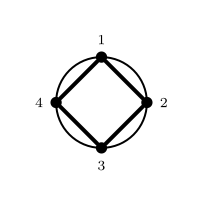
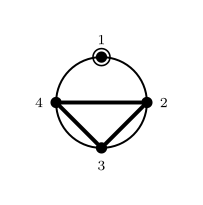
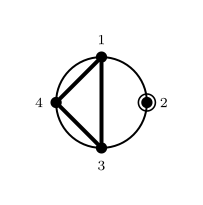
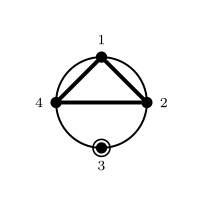
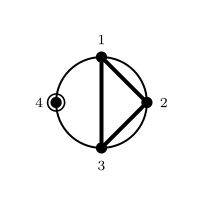
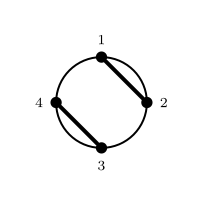
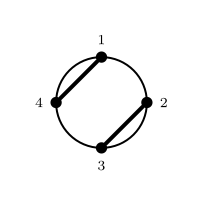
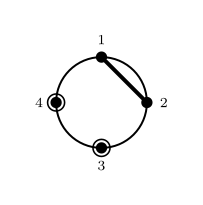
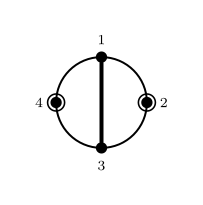
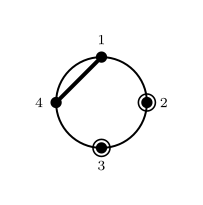
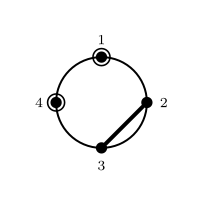
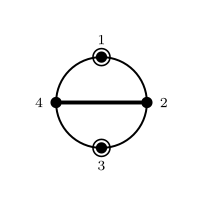
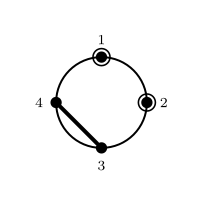
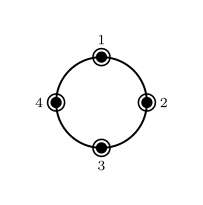
Example (Non-crossing partitions for \(n=4\)).
Here are all the non-crossing partitions for \(n=4.\) There are 14 of them, a Catalan number A000108.
#Non-crossing partitions IV (Fuß–Catalan)
In [KM13], the authors consider \(m\)-divisible non-crossing partitions. Let \(X_{n,m}\) be the number of non-crossing partitions of \([nm]\) where each part has a size which is a multiple of \(m.\) Consider the \(q\)-analogue of the Fuß–Catalan numbers: \[f_{n,m}(q) \coloneqq \frac{1}{[n]_q} \qbinom{(m+1)n}{n-1}_q = \frac{1}{[(m+1)n+1]_q}\qbinom{(m+1)n+1}{n}_q.\] Then \((X_{n,m},\grpc_{mn},f_{n,m}(q))\) is a CSP-triple, where \(\grpc_{mn}\) acts by rotation of \(2\pi/(mn).\)
Similarly, let \(Y_{n,m}\) be the number of non-crossing partitions of \([nm]\) where each part has a size equal to \(m,\) and let \[g_{n,m}(q) \coloneqq \frac{1}{[n]_q} \qbinom{mn}{n-1}_q.\] Then \((Y_{n,m},\grpc_{mn},g_{n,m}(q))\) is a CSP-triple, where \(\grpc_{mn}\) acts by rotation of \(2\pi/(mn).\)
The authors also consider irreducible well-generated complex reflection groups, which reduce to the Fuß–Catalan numbers in type \(A.\) See also [RS18]. C. Krattenthaler and C. Stump study positive \(m\)-divisible non-crossing partitions and positive Kreweras maps [KS25]. They give classical-type models by non-crossing set partitions, a uniform model for general type, and cyclic sieving phenomena for powers of the positive Kreweras maps.
#Rational Catalan and Kreweras
In [BR16], M. Bodnar and B. Rhoades prove that the rational \(q\)-Catalan numbers, \[\catalan_{a/b}(q) = \frac{1}{[a+b]_q} \qbinom{a+b}{a}_q,\] admit a cyclic sieving phenomenon. They require that \(a\lt b\) and \(a,\) \(b\) are coprime. Then \(\grpc_{b-1}\) acts on the set of \((a,b)\)-non-crossing partitions of \([b-1]\) by rotation, and this gives a cyclic sieving phenomenon. This settles a conjecture stated in [Arm12].
They also prove the corresponding refined rational \(q\)-Narayana and \(q\)-Kreweras version of this. The rational \(q\)-Narayana numbers are defined as \[N_{a/b,k}(q) = \frac{1}{[a]_q} \qbinom{a}{k}_q \qbinom{b-1}{k-1}_q,\] where the classical Narayana numbers are recovered when \(a=b=n\) and \(q=1.\)
C. Defant and J. Lin prove a Thomas–Williams conjecture for rowmotion on the rational \((a,b)\)-Tamari lattice when \(b \equiv 1 \pmod a\) [DL24]. In this case rowmotion has order \(a+b-1,\) the full orbit structure can be described, and the action exhibits the cyclic sieving phenomenon. They also prove a rowmotion orbit-structure result for biCambrian lattices in coincidental Coxeter types.
G. Barkley and C. Defant construct cyclic and affine Tamari lattices from the cyclic and affine Dyer lattices [BD25]. These finite lattices have cardinalities given by the type \(B\) and type \(D\) Catalan numbers, respectively, and their rowmotion operators have orbit structures described by cyclic sieving phenomena.
S.-P. Eu, V.-C. Hioe, and Y.-L. Lee study rowmotion on hook and two-row alt \(\nu\)-Tamari lattices [EHL26]. They determine the orbit structures and show that they are independent of the increment vector; in the hook case, rowmotion exhibits the cyclic sieving phenomenon.
B. Adenbaum, E. Barnard, C. Ceballos, C. Chenevière, C. Defant, S. Hopkins, M. Müller, M. Rubey, and J. Striker prove the full increment-vector invariance for every alt \(\nu\)-Tamari lattice [ABCC+26]. For all coprime \(a\lt b,\) rowmotion on every rational \((a,b)\) alt Tamari lattice exhibits cyclic sieving with polynomial \(\catalan_{a/b}(q)\) and has order dividing \(a+b-1.\) See the rowmotion page for the accompanying homomesy theorem and the remaining rational conjecture.
E. Stucky studies the \(q\)-multinomial analogue \[C(\alpha;q) \coloneqq \frac{1}{[n]_q}\qbinom{n}{\alpha}_q, \qquad |\alpha|=n.\] When \(\gcd(\alpha)=1,\) the set of \(\alpha\)-necklaces, together with \(C(\alpha;q)\) and reflection, exhibits Stembridge’s \(q=-1\) phenomenon [Stu19]. The same work proves a more general cyclic sieving statement for suitable double cosets \(C\backslash \symS_n/H.\)
Bibliography
- [ABCC+26]Ben Adenbaum, Emily Barnard, Cesar Ceballos, Clément Chenevière, Colin Defant, Sam Hopkins, Matthias Müller, Martin Rubey and Jessica Striker. Invariance of rowmotion for variants of the Tamari lattice. arXiv:2609.12983v1, 2026.
.bib
@article{AdenbaumBarnardCeballosCheneviereDefantHopkinsMullerRubeyStriker2026x, author = {Ben Adenbaum and Emily Barnard and Cesar Ceballos and Cl{\'e}ment Chenevi{\`e}re and Colin Defant and Sam Hopkins and Matthias M{\"u}ller and Martin Rubey and Jessica Striker}, title = {Invariance of rowmotion for variants of the {T}amari lattice}, year = {2026}, eprint = {2609.12983v1}, url = {https://arxiv.org/abs/2609.12983v1}, journal = {arXiv e-prints} } - [ALPU21]Per Alexandersson, Svante Linusson, Samu Potka and Joakim Uhlin. Refined Catalan and Narayana cyclic sieving. Combinatorial Theory, 1(0), December 2021.
.bib
@article{AlexanderssonLinussonPotkaUhlin2021, doi = {10.5070/c61055513}, url2 = {https://doi.org/10.5070/c61055513}, year = {2021}, month = dec, publisher = {California Digital Library ({CDL})}, volume = {1}, number = {0}, author = {Per Alexandersson and Svante Linusson and Samu Potka and Joakim Uhlin}, title = {Refined {C}atalan and {N}arayana cyclic sieving}, journal = {Combinatorial Theory} } - [Arm12]Drew Armstrong. Rational catalan combinatorics. Online, 2012. Slides from a talk at JMM, Boston
.bib
@misc{Armstrong2012, author = {Drew Armstrong}, title = {Rational Catalan combinatorics}, howpublished = {Online}, year = {2012}, note = {Slides from a talk at JMM, Boston}, url = {https://www.math.miami.edu/~armstrong/RCC_AIM.pdf} } - [BD25]Grant Barkley and Colin Defant. The Affine Tamari Lattice. arXiv:2502.07198, 2025.
.bib
@article{BarkleyDefant2025AffineTamari, author = {Grant Barkley and Colin Defant}, title = {The {A}ffine {T}amari {L}attice}, year = {2025}, eprint = {2502.07198}, url = {https://arxiv.org/abs/2502.07198}, journal = {arXiv e-prints} } - [BR11]David Bessis and Victor Reiner. Cyclic sieving of noncrossing partitions for complex reflection groups. Annals of Combinatorics, 15(2):197–222, May 2011.
.bib
@article{BessisReiner2011, doi = {10.1007/s00026-011-0090-9}, url2 = {https://doi.org/10.1007/s00026-011-0090-9}, year = {2011}, month = may, publisher = {Springer Science and Business Media {LLC}}, volume = {15}, number = {2}, pages = {197--222}, author = {David Bessis and Victor Reiner}, title = {Cyclic Sieving of Noncrossing Partitions for Complex Reflection Groups}, journal = {Annals of Combinatorics} } - [BR16]Michelle Bodnar and Brendon Rhoades. Cyclic sieving and rational Catalan theory. The Electronic Journal of Combinatorics, 23(2), March 2016.
.bib
@article{BodnarRhoades2016, doi = {10.37236/5681}, url2 = {https://doi.org/10.37236/5681}, year = {2016}, month = mar, publisher = {The Electronic Journal of Combinatorics}, volume = {23}, number = {2}, author = {Michelle Bodnar and Brendon Rhoades}, title = {Cyclic Sieving and Rational {C}atalan Theory}, journal = {The Electronic Journal of Combinatorics} } - [DL24]Colin Defant and James Lin. Rowmotion on $m$-tamari and biCambrian lattices. Combinatorial Theory, 4(1), 2024.
.bib
@article{DefantLin2024, author = {Colin Defant and James Lin}, title = {Rowmotion on {$m$}-Tamari and biCambrian lattices}, year = {2024}, journal = {Combinatorial Theory}, volume = {4}, number = {1}, doi = {10.5070/c64163852}, url = {https://doi.org/10.5070/c64163852}, eprint = {2208.10464} } - [Ear18]Mike Earnest. Answer to “computing fixpoints of noncrossing matchings of $2n$ points under rotation”. 2018. Mathematics Stack Exchange answer
.bib
@misc{Earnest2018NoncrossingMatchings, author = {Mike Earnest}, title = {Answer to ``Computing fixpoints of noncrossing matchings of {$2n$} points under rotation''}, year = {2018}, url = {https://math.stackexchange.com/questions/2913242/computing-fixpoints-of-noncrossing-matchings-of-2n-points-under-rotation}, note = {Mathematics Stack Exchange answer} } - [EF08]Sen-Peng Eu and Tung-Shan Fu. The cyclic sieving phenomenon for faces of generalized cluster complexes. Advances in Applied Mathematics, 40(3):350–376, March 2008.
.bib
@article{EuFu2008, doi = {10.1016/j.aam.2007.01.005}, url2 = {https://doi.org/10.1016/j.aam.2007.01.005}, year = {2008}, month = mar, publisher = {Elsevier {BV}}, volume = {40}, number = {3}, pages = {350--376}, author = {Sen-Peng Eu and Tung-Shan Fu}, title = {The cyclic sieving phenomenon for faces of generalized cluster complexes}, journal = {Advances in Applied Mathematics}, eprint = {math/0612679} } - [EHL26]Sen-Peng Eu, Vei-Cheng Hioe and Yi-Lin Lee. Rowmotion on hook and two-row alt $\nu$-Tamari lattices. arXiv:2605.29431, 2026.
.bib
@article{EuHioeLee2026x, author = {Sen-Peng Eu and Vei-Cheng Hioe and Yi-Lin Lee}, title = {Rowmotion on hook and two-row alt {$\nu$}-{T}amari lattices}, year = {2026}, eprint = {2605.29431}, url = {https://arxiv.org/abs/2605.29431}, journal = {arXiv e-prints} } - [KM13]Christian Krattenthaler and Thomas W. Müller. Cyclic sieving for generalised non-crossing partitions associated with complex reflection groups of exceptional type. Advances in combinatorics:209–247, 2013.
.bib
@incollection{KrattenthalerMuller2013, doi = {10.1007/978-3-642-30979-3_12}, url2 = {https://doi.org/10.1007/978-3-642-30979-3_12}, year = {2013}, publisher = {Springer Berlin Heidelberg}, pages = {209--247}, author = {Christian Krattenthaler and Thomas W. M{\"{u}}ller}, title = {Cyclic Sieving for Generalised Non-crossing Partitions Associated with Complex Reflection Groups of Exceptional Type}, booktitle = {Advances in Combinatorics} } - [KS25]Christian Krattenthaler and Christian Stump. Positive $m$-divisible non-crossing partitions and their Kreweras maps. arXiv:2506.14996, 2025.
.bib
@article{KrattenthalerStump2025PositiveDivisible, author = {Christian Krattenthaler and Christian Stump}, title = {Positive $m$-divisible non-crossing partitions and their {K}reweras maps}, year = {2025}, eprint = {2506.14996}, url = {https://arxiv.org/abs/2506.14996}, journal = {arXiv e-prints} } - [PPR08]T. Kyle Petersen, Pavlo Pylyavskyy and Brendon Rhoades. Promotion and cyclic sieving via webs. Journal of Algebraic Combinatorics, 30(1):19–41, September 2008.
.bib
@article{PetersenPylyavskyyRhoades2008, doi = {10.1007/s10801-008-0150-3}, url2 = {https://doi.org/10.1007/s10801-008-0150-3}, year = {2008}, month = sep, publisher = {Springer Nature}, volume = {30}, number = {1}, pages = {19--41}, author = {T. Kyle Petersen and Pavlo Pylyavskyy and Brendon Rhoades}, title = {Promotion and cyclic sieving via webs}, journal = {Journal of Algebraic Combinatorics} } - [Pou26]Lucas Pouillart. Cyclic sieving phenomena on parabolic classes of faces of the cluster complex. arXiv:2603.28242, 2026.
.bib
@article{Pouillart2026x, author = {Lucas Pouillart}, title = {Cyclic sieving phenomena on parabolic classes of faces of the cluster complex}, year = {2026}, eprint = {2603.28242}, url = {https://arxiv.org/abs/2603.28242}, journal = {arXiv e-prints} } - [RS18]Victor Reiner and Eric Sommers. Weyl group $q$-Kreweras numbers and cyclic sieving. Annals of Combinatorics, 22(4):819–874, November 2018.
.bib
@article{ReinerSommers2018, doi = {10.1007/s00026-018-0408-y}, url2 = {https://doi.org/10.1007/s00026-018-0408-y}, year = {2018}, month = nov, publisher = {Springer Nature}, volume = {22}, number = {4}, pages = {819--874}, author = {Victor Reiner and Eric Sommers}, title = {Weyl Group $q$-{K}reweras Numbers and Cyclic Sieving}, journal = {Annals of Combinatorics} } - [RSW04]Victor Reiner, Dennis Stanton and Dennis E. White. The cyclic sieving phenomenon. Journal of Combinatorial Theory, Series A, 108(1):17–50, October 2004.
.bib
@article{ReinerStantonWhite2004, title={The cyclic sieving phenomenon}, volume={108}, url2={http://dx.doi.org/10.1016/j.jcta.2004.04.009}, DOI={10.1016/j.jcta.2004.04.009}, number={1}, journal={Journal of Combinatorial Theory, Series A}, publisher={Elsevier BV}, author={Victor Reiner and Dennis Stanton and Dennis E. White}, year={2004}, month = oct, pages={17--50} } - [Sta15]Richard P. Stanley. Catalan numbers. Cambridge University Press, 2015.
.bib
@book{StanleyCatalan, Author = {Richard P. Stanley}, Title = {Catalan Numbers}, Publisher = {Cambridge University Press}, Year = {2015}, ISBN = {1107427746}, doi = {10.1017/CBO9781139871495} } - [Stu19]Eric Stucky. Cyclic sieving, necklaces, and bracelets. Séminaire Lotharingien de Combinatoire, 82B:Article #96, 12 pp., 2019.
.bib
@article{Stucky2019x, author = {Eric Stucky}, title = {Cyclic sieving, necklaces, and bracelets}, year = {2019}, journal = {S{\'e}minaire Lotharingien de Combinatoire}, volume = {82B}, pages = {Article {\#}96, 12 pp.}, url = {https://www.mat.univie.ac.at/~slc/wpapers/FPSAC2019/96.pdf} } - [Thi17]Marko Thiel. A new cyclic sieving phenomenon for Catalan objects. Discrete Mathematics, 340(3):426–429, March 2017.
.bib
@article{Thiel2017, doi = {10.1016/j.disc.2016.09.006}, url2 = {https://doi.org/10.1016/j.disc.2016.09.006}, year = {2017}, month = mar, publisher = {Elsevier {BV}}, volume = {340}, number = {3}, pages = {426--429}, author = {Marko Thiel}, title = {A new cyclic sieving phenomenon for {C}atalan objects}, journal = {Discrete Mathematics} } - [ZZ24]Chuyi Zeng and Shiwen Zhang. Cyclic sieving on noncrossing (1,2)-configurations. arXiv:2402.05771, 2024.
.bib
@article{ZengZhang2024x,
Author = {Chuyi Zeng and Shiwen Zhang},
Title = {Cyclic sieving on noncrossing (1,2)-configurations},
Year = {2024},
Eprint = {2402.05771},
  url = {https://arxiv.org/abs/2402.05771},
journal = {arXiv e-prints}
}