#Rowmotion and promotion
Rowmotion and promotion are invertible operations on finite combinatorial sets. Promotion acts naturally on linear extensions, while rowmotion acts on order ideals. Both operations can be expressed as products of local involutions. This toggle description explains why their orbits often admit rotation models, cyclic sieving, and homomesy.
Throughout, let \(P\) be a finite poset with \(n\) elements. We write \(\mathcal L(P)\) for its linear extensions and \(J(P)\) for its order ideals.
#Promotion on linear extensions
Let \(w=(p_1,p_2,\dotsc,p_n)\in\mathcal L(P).\) For \(1\leq i\lt{}n,\) define an adjacent involution \(\tau_i\) by interchanging \(p_i\) and \(p_{i+1}\) when these two elements are incomparable, and fixing \(w\) otherwise. The promotion operator is \[\defin{\promotion} \coloneqq \tau_{n-1}\circ\tau_{n-2}\circ\dotsm\circ\tau_1,\] where \(\tau_1\) is applied first. This is Schützenberger promotion on linear extensions [Sch72, Sta09].
Equivalently, label each \(p\in P\) by its position in \(w.\) Remove the label \(1,\) repeatedly slide down the smallest label among the elements covering the empty position, place \(n+1\) at the last position, and subtract \(1\) from every label. The elements visited by the empty position form the promotion chain.
Example (Promotion on a product of chains).
Let \(P=[2]\times[3],\) ordered coordinatewise, and name its elements \[a=(1,1),\quad b=(1,2),\quad c=(1,3),\quad d=(2,1),\quad e=(2,2),\quad f=(2,3).\] Its five linear extensions split into two promotion orbits: \[abcdef\longmapsto abdecf\longmapsto adbcef\longmapsto abcdef, \qquad abdcef\longleftrightarrow adbecf.\] The vertex labels below give the positions of the elements in each word; the three-cycle is in the top row and the two-cycle is in the bottom row.
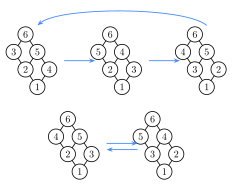
For a Young-diagram poset, linear extensions are standard Young tableaux, and this definition agrees with the tableau promotion operator. The convention for promotion is not uniform in the literature; some authors use its inverse.
#Order-ideal toggles
For \(p\in P,\) the toggle at \(p\) is the involution \(t_p:J(P)\to J(P)\) defined as follows. If \(p\notin I,\) add \(p\) when \(I\cup\{p\}\) is an order ideal. If \(p\in I,\) remove \(p\) when \(I\setminus\{p\}\) is an order ideal. In every other case, leave \(I\) fixed. The subgroup of permutations of \(J(P)\) generated by the \(t_p\) is the toggle group \(T(P)\) [SW12].
Two toggles commute unless their elements are joined by a cover relation. Thus many global actions can be computed in several different orders without changing the result.
#Rowmotion
The rowmotion operator sends an order ideal to the ideal generated by the minimal elements outside it: \[\defin{\operatorname{Row}(I)} \coloneqq \bigl\{y\in P:y\leq_P x \text{ for some }x\in\min(P\setminus I)\bigr\}.\] If \((p_1,p_2,\dotsc,p_n)\) is any linear extension of \(P,\) rowmotion is also obtained by toggling from maximal elements toward minimal elements. More precisely, \[\operatorname{Row} =t_{p_1}\circ t_{p_2}\circ\dotsm\circ t_{p_n},\] so \(t_{p_n}\) is applied first. In particular, rowmotion is a bijection [SW12].
Example (Rowmotion on a product of chains).
Return to \(P=[2]\times[3]\) with the element names used in the promotion example. Its ten order ideals split into two rowmotion orbits of size five: \[\emptyset\longmapsto\{a\}\longmapsto\{a,b,d\} \longmapsto\{a,b,c,d,e\}\longmapsto P\longmapsto\emptyset,\] \[\{a,b\}\longmapsto\{a,b,c,d\}\longmapsto\{a,b,d,e\} \longmapsto\{a,b,c\}\longmapsto\{a,d\}\longmapsto\{a,b\}.\] Blue vertices in the figure belong to the order ideal, while white vertices lie outside it; the element names are written inside the vertices.
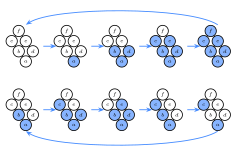
For instance, the minimal elements outside \(\{a\}\) are \(b\) and \(d,\) and the ideal they generate is \(\{a,b,d\}.\)
#Promotion and rowmotion through toggles
There is also a toggle version of promotion on order ideals. Suppose that a poset is drawn with rows and columns so that every cover joins diagonally adjacent positions. Toggling one column at a time defines promotion, while toggling one row at a time defines rowmotion.
Theorem (Striker–Williams, [SW12]).
On every rowed-and-columned poset, toggle promotion and rowmotion are conjugate in the toggle group. Consequently, they have the same orbit structure.
In the Ferrers and root-poset examples, boundary paths convert the column-by-column action into familiar promotion or rotation. This gives, for example, an equivariant bijection between rowmotion on \(J([a]\times[b])\) and rotation of binary words with \(a\) ones and \(b\) zeros. Hence rowmotion has order \(a+b\) on this product of chains, and \[\left(J([a]\times[b]),\langle\operatorname{Row}\rangle, \qbinom{a+b}{a}_q\right)\] exhibits the cyclic sieving phenomenon.
Other rotation models connect rowmotion on positive root posets with Kreweras complementation on noncrossing partitions. See the cyclic-sieving sections on root posets and minuscule posets. Orbit averages of statistics under rowmotion are among the main examples of homomesy.
#Rowmotion on Tamari lattices
The classical definition above treats the distributive lattice \(J(P).\) Rowmotion also extends to semidistributive lattices through their canonical edge labels. Alt \(\nu\)-Tamari lattices form a family of such lattices on \(\nu\)-Dyck paths; for a fixed path \(\nu,\) the family interpolates between a Tamari-type lattice and the distributive nesting lattice.
Theorem (Adenbaum–Barnard–Ceballos–Chenevière–Defant–Hopkins–Müller–Rubey–Striker, [Thm. 1.1, ABCC+26]).
Fix a lattice path \(\nu.\) Any two alt \(\nu\)-Tamari lattices admit a bijection that intertwines rowmotion and preserves the orbit sums of the down-degree statistic.
Thus rowmotion has the same orbit structure throughout the family, even though the underlying lattices need not be isomorphic. The theorem transfers two particularly clean statements from distributive lattices to all rational alt Tamari lattices [Thm. 5.1–5.2, ABCC+26]:
If \(a\lt b\) are coprime, rowmotion on every rational \((a,b)\) alt Tamari lattice has order dividing \(a+b-1,\) and its orbit structure is encoded by the rational \(q\)-Catalan polynomial \[\frac{1}{[a+b]_q}\qbinom{a+b}{a}_q.\]
On every alt \(m\)-Tamari lattice of size parameter \(n,\) the down-degree statistic is homomesic with average \(m(n-1)/(m+1).\)
It remains open whether the down-degree statistic on every rational \((a,b)\) alt Tamari lattice has orbit average \((a-1)(b-1)/(a+b-1).\) The authors also conjecture that rowmotion invariance extends from alt \(\nu\)-Tamari lattices to cross Tamari lattices associated with moon polyominoes.
Bibliography
- [ABCC+26]Ben Adenbaum, Emily Barnard, Cesar Ceballos, Clément Chenevière, Colin Defant, Sam Hopkins, Matthias Müller, Martin Rubey and Jessica Striker. Invariance of rowmotion for variants of the Tamari lattice. arXiv:2609.12983v1, 2026.
.bib
@article{AdenbaumBarnardCeballosCheneviereDefantHopkinsMullerRubeyStriker2026x, author = {Ben Adenbaum and Emily Barnard and Cesar Ceballos and Cl{\'e}ment Chenevi{\`e}re and Colin Defant and Sam Hopkins and Matthias M{\"u}ller and Martin Rubey and Jessica Striker}, title = {Invariance of rowmotion for variants of the {T}amari lattice}, year = {2026}, eprint = {2609.12983v1}, url = {https://arxiv.org/abs/2609.12983v1}, journal = {arXiv e-prints} } - [Sch72]Marcel-Paul Schützenberger. Promotion des morphismes d’ensembles ordonnes. Discrete Mathematics, 2(1):73–94, March 1972.
.bib
@article{Schutzenberger1972, doi = {10.1016/0012-365x(72)90062-3}, url2 = {https://doi.org/10.1016/0012-365x(72)90062-3}, year = {1972}, month = mar, publisher = {Elsevier {BV}}, volume = {2}, number = {1}, pages = {73--94}, author = {Marcel-Paul Sch{\"{u}}tzenberger}, title = {Promotion des morphismes d'ensembles ordonnes}, journal = {Discrete Mathematics} } - [Sta09]Richard P. Stanley. Promotion and evacuation. The Electronic Journal of Combinatorics, 16(2), April 2009.
.bib
@article{Stanley2009, doi = {10.37236/75}, url2 = {https://doi.org/10.37236/75}, year = {2009}, month = apr, publisher = {The Electronic Journal of Combinatorics}, volume = {16}, number = {2}, author = {Richard P. Stanley}, title = {Promotion and Evacuation}, journal = {The Electronic Journal of Combinatorics} } - [SW12]Jessica Striker and Nathan Williams. Promotion and rowmotion. European Journal of Combinatorics, 33(8):1919–1942, November 2012.
.bib
@article{StrikerWilliams2012,
  doi = {10.1016/j.ejc.2012.05.003},
  url2 = {https://doi.org/10.1016/j.ejc.2012.05.003},
  year = {2012},
  month = nov,
  publisher = {Elsevier {BV}},
  volume = {33},
  number = {8},
  pages = {1919--1942},
  author = {Jessica Striker and Nathan Williams},
  title = {Promotion and rowmotion},
  journal = {European Journal of Combinatorics}
}